
God Is Not a Man Sitting on a Cloud
B"H
A Six-Part Foundations of Torah (Yesodei HaTorah) Teaching for Shaarei Tzafon
Part 1 – The First Image We Must Remove
Many people begin religion with an image rather than a teaching.
They picture God as a being above the world—watching, hovering, seated somewhere in the heavens.
Judaism begins by dismantling that image.
The Torah states explicitly:
“You saw no form on the day Hashem spoke to you at Horeb.”
(Devarim / Deuteronomy 4:15)
This verse is foundational.
The Torah emphasizes that revelation occurred without any visual form so that Israel would never confuse God with an image.
The Torah continues:
“Lest you become corrupt and make for yourselves a carved image.”
(Devarim 4:16)
From the very beginning, Judaism ties imagining God physically to the danger of idolatry.
This is why Shaarei Tzafon starts here.
If God is imagined as a form, everything built afterward becomes unstable.

Part 2 – God Has No Body, No Shape, No Location
(Halachic Foundation)
Maimonides codifies this as halacha, not philosophy.
In Mishneh Torah, Hilchot Yesodei HaTorah 1:7–8, he rules:
“God has no body or physical form…
If He had a body, He would be finite and divisible.”
This is not optional belief.
It is part of Yesodei HaTorah — the foundations of Torah itself.
The Rambam further writes (Yesodei HaTorah 1:11):
“All descriptions found in Scripture—standing, sitting, speaking—are metaphorical.”
Halachically speaking:
God does not sit
God does not move
God does not occupy space
God is not located in heaven or earth
The heavens are called “God’s throne” only figuratively, as the prophet states:
“The heavens are My throne and the earth is My footstool.”
(Yeshayahu / Isaiah 66:1)
Chazal explain:
If heaven is a throne and earth a footstool, God cannot literally be seated on either.

Part 3 – Why the Torah Uses Human Language
(Gemara)
The Gemara establishes a key interpretive rule:
“The Torah speaks in the language of human beings.”
(Berakhot 31b; Yevamot 71a)
This means:
Scripture uses familiar human terms
Not to describe God’s essence
But to communicate effects and relationships
The Gemara teaches:
“Wherever you find the greatness of the Holy One, you find His humility.”
(Megillah 31a)
God “lowers” language so humans can understand—but does not lower truth.
Thus:
“Hand of God” = power
“Eyes of God” = awareness
“God descended” = revelation, not movement
The Torah never retracts these metaphors because they teach responsibility, not anatomy.

Part 4 – Clouds, Wings, Thrones
Imagery Used, Not Adopted
Here we must be historically honest.
Clouds, wings, and thrones were already divine symbols in the ancient world—especially in Greek and Near Eastern cultures:
Gods rode clouds
Divine beings had wings
Thrones represented cosmic authority
Jews lived among these cultures.
The Torah did not invent the symbols—it reprogrammed them.
Scripture itself reframes these images:
Clouds
“Hashem said He would dwell in thick cloud.”
(Melakhim I / 1 Kings 8:12)
The Gemara explains this cloud as concealment, not location
(Chagigah 12b).
God is not inside the cloud — the cloud limits human perception.
Wings
“In the shadow of Your wings I take refuge.”
(Tehillim / Psalms 57:2)
Chazal are explicit that this is metaphorical.
God has no wings — the image conveys protection without physicality.
Thrones
“A throne of glory, exalted from the beginning.”
(Yirmiyahu / Jeremiah 17:12)
The Midrash states clearly:
“The throne is not a place — it is authority.”
(Pirkei DeRabbi Eliezer 3)
Judaism keeps the symbol but destroys the idol.
This is Judaism’s radical move:
Keep the language
Reject literalism
Eliminate mythology
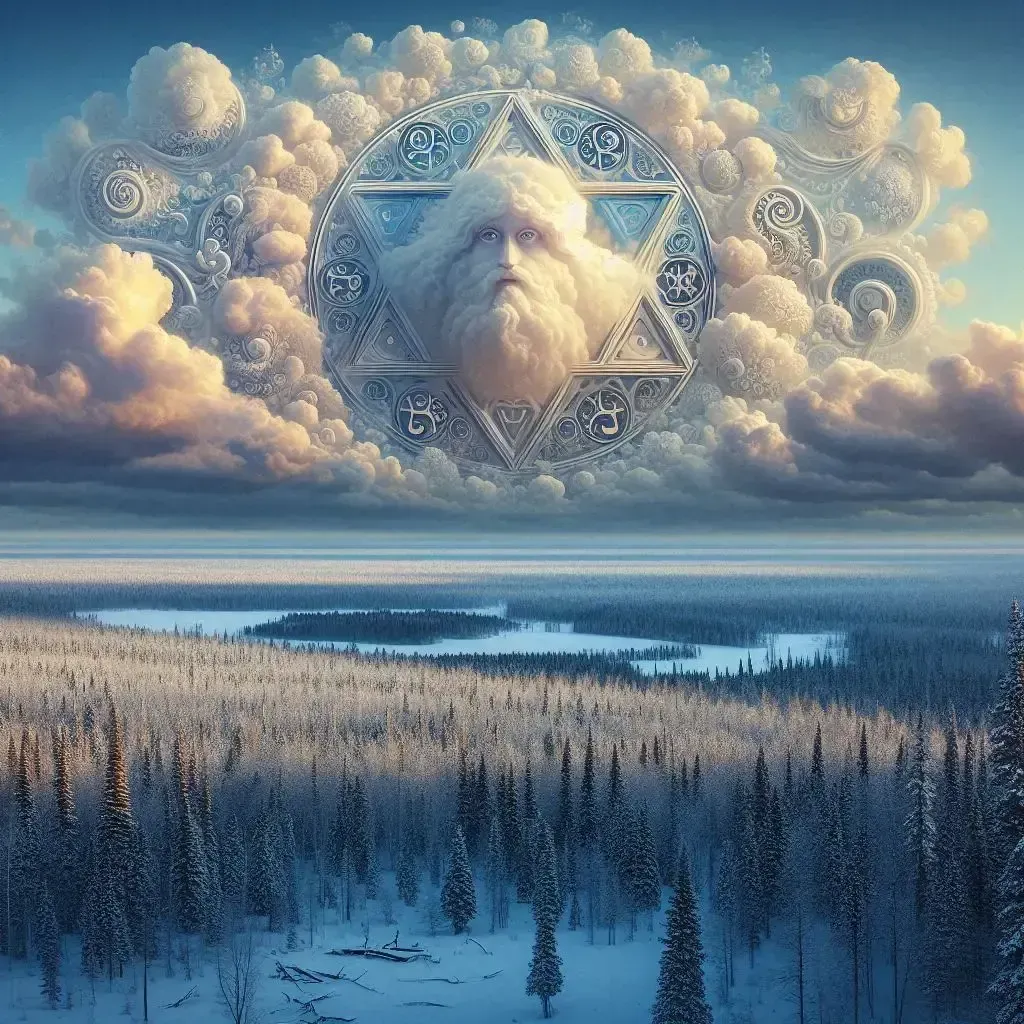
Part 5 – Prayer and Responsibility Without Images
(Halacha in Practice)
If God has no image, how do we pray?
The halacha answers clearly.
The Rambam rules (Hilchot Tefillah 5:4):
“One who prays must direct their heart as though standing before the Divine Presence.”
Not imagining a form.
Not visualizing a being.
But standing in awareness and responsibility.
The Gemara reinforces this:
“Know before Whom you stand.”
(Berakhot 28b)
Not before what you imagine —
but before reality itself.
Judaism removes images of God so that human beings cannot escape accountability.
You cannot manipulate God.
You cannot flatter an image.
You cannot hide behind belief.
You can only:
Act justly
Fear wrongdoing
Repair harm
Live responsibly

Part 6- Final Synthesis: Order, Will, and Human Freedom
Judaism teaches that HaShem—HaKadosh Baruch Hu—both creates the raw material of existence and continuously puts it together. Creation is not only an event that happened once in the past; it is an ongoing act of sustaining and ordering reality. Most of the time, God acts through the stable patterns of nature that He established, and at times He acts beyond them—what we call miracles—not because He must, but because He wills. Miracles are not signs of instability in creation; they are expressions of purpose.
This is hard for many to accept, but the classic dictum applies: Gd’s ways are not our ways. Human understanding is limited, and the Torah itself acknowledges that we can only speak about God using the language we are given—and even that language is flawed. We do not describe God as He is in Himself; we describe how His will is made known to us.
HaShem—HaKadosh Baruch Hu— G-d is within and throughout creation not as a body, force, or component, but as the One who establishes and sustains its existence and order, and He is also entirely above creation, not contained by it.
Like a programmer in relation to code, He is within creation by sustaining it, and beyond it by not being contained by it—
but even this is only a metaphor, not a description of God’s essence.
Hasidic philosophy emphasizes God’s closeness and immanence—אין עוד מלבדו, that nothing exists outside His sustaining presence. Rational philosophy emphasizes God’s transcendence, that He is not a part of the system He creates. These are not competing views. They are two perspectives describing the same reality: God is fully present without being physical, and fully beyond without being distant.
From the human side, predestination and free will stand so close together that they cannot be cleanly separated. God’s knowledge does not compel human choice, and human choice does not escape divine awareness. We live as if our decisions truly matter—because they do—while trusting that nothing falls outside divine order. Judaism does not attempt to flatten this tension into a slogan.
Instead, it teaches us to live responsibly within it.
God governs reality.
Humans are accountable within it.
The closeness of divine will and human freedom is not a contradiction—it is one of the deepest truths Torah asks us to carry.
Conclusion – The Gate of Clarity
Shaarei Tzafon means The Northern Gate — an entrance into serious Judaism.
This teaching is that gate.
Before prayer.
Before mysticism.
Before community.
We begin with Torah truth:
“You saw no form.”
God is not sitting on a cloud.
God is not an image.
God is not a body.
God is the source of existence itself.
And Torah is the discipline that teaches human beings how to live truthfully in that reality.
Understanding HaShem — Torah Education in Northeastern Michigan
The foundations of Jewish belief are not merely subjects for philosophical speculation. They shape how we pray, how we study Torah, how we understand the commandments, and how we teach our children.
At Shaarei Tzafon — The North Gate, we believe that serious Jewish education must begin with a clear understanding of the Torah and the teachings of our sages.
Based in Northeastern Michigan, Shaarei Tzafon is an independent, family-led Orthodox Jewish educational and publishing initiative serving the wider educational needs of those interested in traditional Judaism.
Our work encourages Judaism in Alpena, Orthodox Jewish learning in Hillman, Rogers City, and surrounding communities, and the continued study of Torah and Halakhah throughout Northern Michigan.
Through the writings of Rambam, the Mishnah, Talmud, Geonic literature, and the great inheritance of Sephardi and Ashkenazi scholarship, we seek to make foundational Jewish teachings accessible to families and individual students.
We recognize that traditional Jewish life requires more than the mechanical performance of religious obligations. It also requires understanding the One whom we worship, the meaning of divine commandments, and the responsibility placed upon human beings.
Our vision, however, extends beyond the Alpena region.
The 45th parallel represents the Gate of Shaarei Tzafon, opening northward through Michigan, Canada, and Alaska toward the Arctic.
Across these northern regions, Jewish individuals and families can preserve the same foundations of Torah learning that sustained Jewish life in earlier generations.
We believe that the renewal of small batei midrash, family-centered Jewish education, and independent places of traditional Jewish learning can help carry this inheritance forward.
The study of HaShem's incorporeality is therefore not merely an intellectual exercise. It teaches us to move beyond physical images and approach divine service with knowledge, humility, reverence, and responsibility.
Our work begins locally, but the foundations of Torah belong to the Jewish people wherever they live.
Shaarei Tzafon — The North Gate
Orthodox Jewish Life and Torah Study in Northeastern Michigan
Shaarei Tzafon — The North Gate, led by Rabbi Ariel Manning, is an independent, family-led Orthodox Jewish educational and publishing initiative based in Northeastern Michigan. We support traditional Jewish life, Torah study, Halakhah, and Jewish education throughout Alpena, Hillman, Rogers City, and surrounding communities. Those interested in traditional Judaism are welcome to contact us for educational resources, Torah learning, and opportunities for discussion by prior arrangement.
Rooted locally, our greater mission extends northward from the 45th parallel — The North Gate — through Michigan, Canada, and Alaska toward the Arctic. We seek to encourage independent Jewish communities, family-centered Torah education, and the renewal of small batei midrash and shtieblach, preserving the rich traditions of Orthodox Judaism for future generations.
Our work begins in Northeastern Michigan, but our vision extends from the 45th parallel toward the Arctic.
Guided by Rambam and Mori Qafiḥ, uplifted by Rebbe Nachman, and grounded by Avraham ben HaRambam’s balance of halakha and inward avodah.
The Orchard’s Path
publishes our books and curricula.
Our mission: a bright, authentic Jewish presence in every northern town.
Created with ©systeme.io


