
God Is Not a Man Sitting on a Cloud Part 2
B”H
Worshiping the Infinite, Not the Imagination
A Continuation of the Yesodei HaTorah Teaching for Shaarei Tzafon
Part 1 – The Warning of Rav Yosef Qafih
Rav Yosef Qafih (Kapach), explaining the position of Maimonides, states:
“HaRambam believes that if you do not truly know God, then you are worshiping idols.
That which you imagine God to be — His greatness, His width, His length, His depth, His shape, His Beauty, His Unsightliness — this is just your imagination.
And if you worship God according to your own imagination, then you are worshipping your imagination, not God.”
This is severe.
It is meant to be.
In Part 1, we dismantled the crude image:
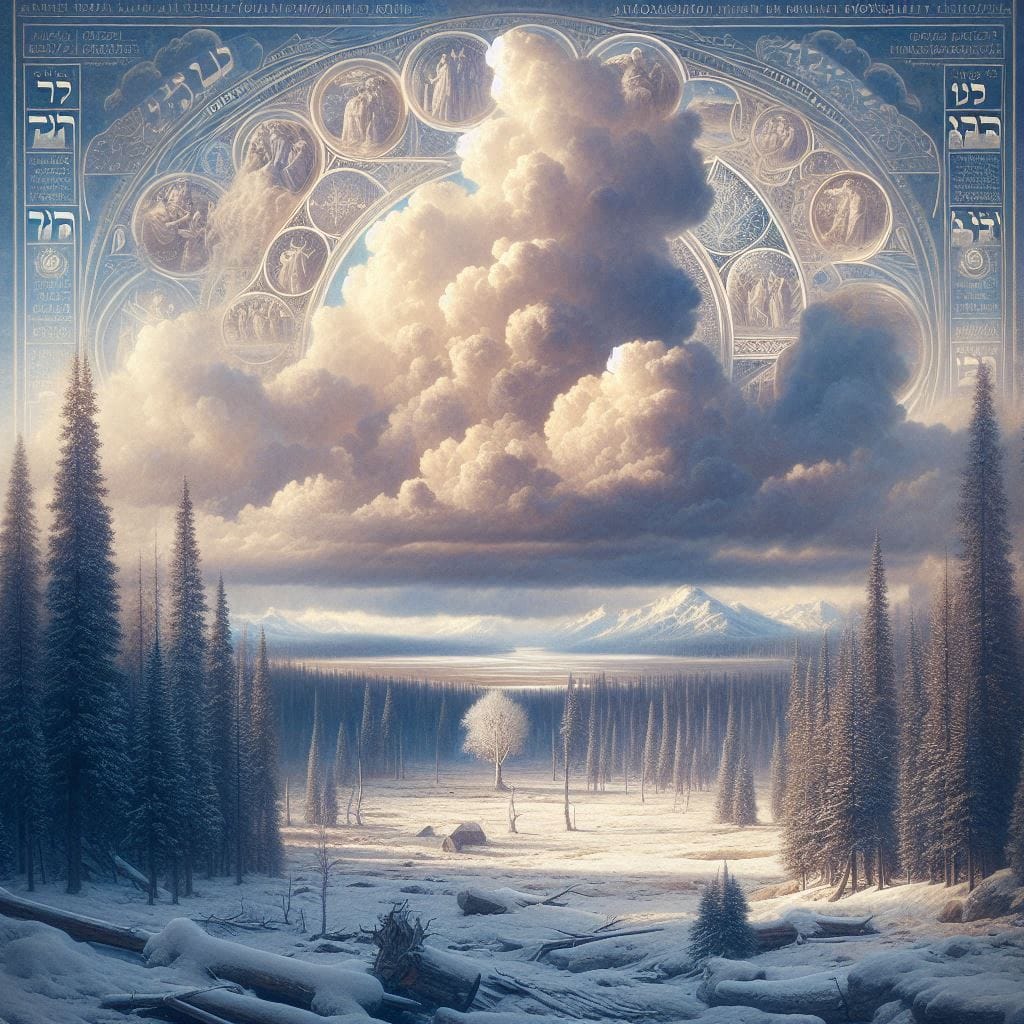
God is not a man seated on a cloud.
But Part 2 must go further.
The greater danger is not the childish image.
The greater danger is the refined one.
Even after removing physical form, the human mind
continues to imagine.
And imagination, when mistaken for knowledge, becomes subtle idolatry.
Part 2 – What Rambam Means by “Knowing God”
Rambam does not define knowing God as emotional warmth or mystical experience.
He defines it as intellectual precision.
In Mishneh Torah, Hilchot Yesodei HaTorah 1:7–8, he rules:
הקב״ה אינו גוף ולא כח בגוף
ואין לו לא ערך ולא דמיון כלל
“The Holy One, blessed be He, is not a body nor a power within a body,
and He has no comparison and no likeness whatsoever.”
He continues:
אילו היה לו גוף היה לו קץ ותכלית
“If He had a body, He would have limit and end.”
This is halacha.
Anything composed of parts depends on those parts.
Anything dependent is not absolute.
Anything not absolute is not God.
Therefore God must be absolutely simple — pashut betachlit hapeshitut.
No internal divisions.
No metaphysical layering.
No spiritual substance.
Divine simplicity is not poetry.
It is ontological necessity.
Part 3 – The Second Form of Idolatry
When physical imagery is removed, abstraction replaces it:
“God is infinite light.”
“God is universal energy.”
“God is cosmic consciousness.”
These appear elevated.
But they still assign created categories.
Light has extension.
Energy has measurable effect.
Consciousness implies process.
All of these belong to creation.
Rambam removes them.
God is not the biggest thing.
Not the highest force.
Not the most luminous presence.
He is not one being among beings.
He is the cause of being itself.
To imagine Him as something — even something infinite — is to reduce Him into category.
And reduction is distortion.
Part 4 – The Discipline of Rambam’s Theology
Rambam teaches that positive attributes mislead.
When we say “God is wise,” we do not mean He possesses wisdom as we do.
Rather, what we call wisdom in creation reflects His perfection.
As Rambam writes:
הוא היודע והוא הידוע והוא הדעה עצמה
“He is the Knower, He is the Known, and He is the Knowledge itself.”
(Yesodei HaTorah 2:10)
This unity defies analogy.
God does not have knowledge.
He is not a being who possesses qualities.
His essence is identical with what we call His attributes.
The human mind cannot positively define Him.
It can only remove falsehood.
Part 5 – Why the Mind Projects
Human cognition depends on form.
We imagine to understand.
When we pray, we instinctively picture:
A throne.
A light.
A presence above.
The Torah prevented this at Sinai.
“You saw no form.”
Revelation was imageless by design.
Had Israel seen a shape, that shape would have become theology.
Imageless revelation forces intellectual discipline.
Part 6 – Transcendence Without Absence
We must now refine a common misunderstanding.
When we say God does not inhabit space, we do not mean He is absent from it.
God is everywhere.
But “everywhere” does not mean spatial occupation the way a body occupies a room.
A body inhabits space because it is limited by space.
It has boundaries.
It displaces other objects.
God does not.
He does not occupy space as an object within it.
He does not move from place to place.
He does not expand or contract.
Rather:
Space itself exists because He sustains it.
He is present everywhere — not as a component inside creation, but as the One giving creation existence.
To say He inhabits space like a being among beings makes Him part of the system.
To say He is absent denies His sustaining presence.
The correct formulation is:
God is fully present everywhere without being spatial.
He sustains space without being contained by it.
“מלוא כל הארץ כבודו” — The whole earth is filled with His glory.
Not filled as matter fills a container.
Filled as effect depends on cause.

Part 7 – Emotional Anthropomorphism
Anthropomorphism is not only physical.
It is emotional.
Scripture speaks of anger, mercy, regret.
Rambam insists that God does not change.
Change implies time.
Time implies sequence.
Sequence implies limitation.
When Scripture says God is angry, it describes justice manifesting in consequence.
When Scripture says God relented, it describes altered human conditions.
God does not fluctuate.
Human experience fluctuates.
Projecting emotional change onto God is another form of idolatry of imagination.

Part 8 – Mysticism Under Guard
This teaching does not eliminate mysticism.
It disciplines it.
Language of divine light, flow, closeness, and immanence can function symbolically.
It may describe:
Human perception of providence.
The soul’s awakening.
The experience of divine nearness.
But it must not imply internal structure within the Divine Essence.
God has no layers.
No emanative components.
No gradations within Himself.
Symbol is permitted.
Division is not.
This preserves monotheism without extinguishing devotion.

Part 9 – Divine Governance and Freedom
God sustains creation constantly.
But sustaining does not mean being a force within matter.
He is not energy animating particles.
He is not part of the equation.
He is the reason the equation exists.
This raises the question of freedom.
In Hilchot Teshuvah 5, Rambam writes:
רשות לכל אדם נתונה
“Permission is granted to every person”
Human choice is real.
God’s knowledge is not observational.
It is identical with His essence.
His knowledge does not compel action.
Human action does not escape His awareness.
This tension is not solved by simplification.
It is carried with humility.
Part 10 – Avoiding Pantheism and Deism
If we say God is identical with the world, we collapse into pantheism.
If we say God is separate and uninvolved, we collapse into deism.
Judaism affirms neither.
God is not the world.
And the world is not independent of God.
Creation is contingent.
God is necessary.
He transcends without distance.
He is immanent without materiality.
This balance preserves both reverence and responsibility.

Part 11 – Prayer Without Visualization
Rambam rules in Hilchot Tefillah 5:4:
One must pray as if standing before the Divine Presence.
He does not instruct visualization.
The Gemara teaches:
“Know before Whom you stand.” (Berakhot 28b)
Prayer is awareness, not imagery.
You are not speaking to a figure.
You are aligning yourself with the Source of existence.
This produces seriousness.
You cannot manipulate an image.
You cannot flatter a projection.
You can only act responsibly before reality.
Part 12 – The Northern Gate
Shaarei Tzafon — The Northern Gate — begins with clarity.
Before mysticism.
Before emotional religion.
Before communal identity.
We establish:
God is not a man sitting on a cloud.
God is not a spiritual body.
God is not universal energy.
God is not cosmic consciousness.
God is the necessary ground of existence itself.
Beyond imagination.
Beyond form.
Beyond projection.
When imagination ends, accountability begins.
When projection dissolves, awe emerges.
This is not cold theology.
It is purified worship.
And that is the entrance to serious Judaism.
That is the Northern Gate.
From Knowing HaShem to Living Torah — Orthodox Jewish Education in Northeastern Michigan
The purpose of understanding HaShem is not merely to establish correct philosophical definitions. Knowledge of HaShem must influence how we pray, study Torah, observe the commandments, and conduct ourselves toward others.
At Shaarei Tzafon — The North Gate, these principles form part of our approach to traditional Orthodox Jewish education.
Based in the Alpena region of Northeastern Michigan, Shaarei Tzafon is an independent, family-led Orthodox Jewish educational and publishing initiative dedicated to Torah study, Halakhah, Jewish philosophy, and the cultivation of traditional Jewish life.
Our teachings seek to make the intellectual inheritance of Rambam, Rabbi Yosef Qafiḥ, the Geonim, and other great Jewish scholars accessible to individuals and families studying Judaism in Alpena, Hillman, Rogers City, and surrounding communities.
We believe that Orthodox Judaism in Northern Michigan must be grounded not only in ritual observance but also in a serious understanding of the foundations of Jewish belief.
This requires education, disciplined reasoning, reverence, and the willingness to distinguish between what the Torah teaches and what the human imagination invents.
Yet our mission extends beyond Northeastern Michigan.
The 45th parallel represents the Gate of Shaarei Tzafon, opening northward through Michigan, Canada, and Alaska toward the Arctic.
Throughout these northern regions, Jewish families can cultivate meaningful Torah learning, preserve the extraordinary intellectual traditions of both Sephardi and Ashkenazi Judaism, and encourage the development of independent batei midrash and small places of Jewish study.
The renewal of traditional Jewish life begins with individuals who understand what they believe and transform that knowledge into action.
Whether in an established Jewish neighborhood or an isolated northern community, the fundamental obligation remains the same: to know HaShem, worship Him without physical images, and live according to His Torah.
Our work begins locally, but the responsibility to preserve authentic Jewish learning belongs to Jews everywhere.
Shaarei Tzafon — The North Gate
Orthodox Jewish Life and Torah Study in Northeastern Michigan
Shaarei Tzafon — The North Gate, led by Rabbi Ariel Manning, is an independent, family-led Orthodox Jewish educational and publishing initiative based in Northeastern Michigan. We support traditional Jewish life, Torah study, Halakhah, and Jewish education throughout Alpena, Hillman, Rogers City, and surrounding communities. Those interested in traditional Judaism are welcome to contact us for educational resources, Torah learning, and opportunities for discussion by prior arrangement.
Rooted locally, our greater mission extends northward from the 45th parallel — The North Gate — through Michigan, Canada, and Alaska toward the Arctic. We seek to encourage independent Jewish communities, family-centered Torah education, and the renewal of small batei midrash and shtieblach, preserving the rich traditions of Orthodox Judaism for future generations.
Our work begins in Northeastern Michigan, but our vision extends from the 45th parallel toward the Arctic.
Guided by Rambam and Mori Qafiḥ, uplifted by Rebbe Nachman, and grounded by Avraham ben HaRambam’s balance of halakha and inward avodah.
The Orchard’s Path
publishes our books and curricula.
Our mission: a bright, authentic Jewish presence in every northern town.
Created with ©systeme.io


