
How Judaism Functions
B"H
Above and Below is an accurate scriptural hierarchy of Judaism put arranged and organized by my Rabbi and friend.
Rabbi Asher Meza
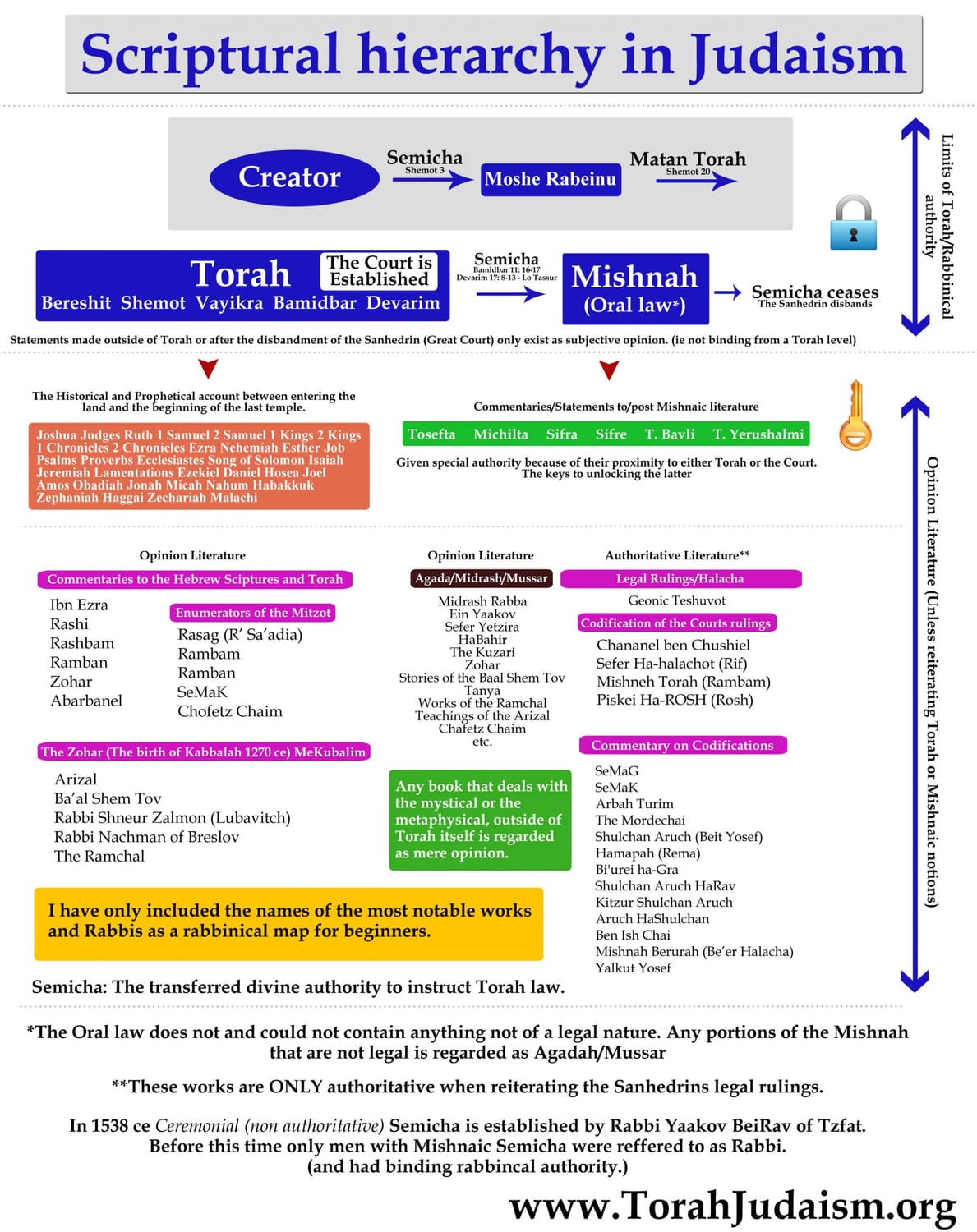
Part 1 – Judaism Is a Legal System With Controlled Authority, Not a Library of Equal Texts
Judaism does not function as a pile of sacred books stacked on top of each other. It functions as a legal system with a controlled flow of authority. Every text, practice, and teaching in Judaism must be evaluated according to where it sits in that flow.
The greatest modern error is assuming that:
Later texts are “more developed”
Popular codes are “more authoritative”
Minhag-based works are “basically Torah”
This error collapses Judaism into confusion and turns custom into false law.
The chart provided does not present Judaism as a hierarchy of holiness. It presents Judaism as a jurisdictional map. Authority enters the system at Sinai, flows through specific institutions, and then stops generating new law. Everything after that point is classificatory, preservational, or communal — not legislative.

Part 2 – Divine Legislation: The Creator and the Torah
At the top of the system stands the Creator alone. Authority in Judaism originates exclusively with God. This authority enters the human world once, through Matan Torah, and is then sealed.
Torah Shebikhtav (Written Torah)
The only divinely legislated law
Supreme
Closed
Immutable
Nothing can:
Override it
Compete with it
Supplement it legislatively
All later authority exists only because the Torah authorizes it, and only within the limits the Torah sets.
This is the first and highest category: Divine legislation.

Part 3 – Authorized Human Authority: Moshe and the Court System
Moshe Rabbeinu is the sole transmitter of divine law. He is not a theologian or mystic; he is the lawgiver. After Moshe, the Torah establishes a court system empowered to interpret and apply the law.
This authority is:
Legal
Institutional
Conditional
Temporary
The Torah explicitly commands obedience to the court only while it exists. This authority is not inheritable by later rabbis or sages by virtue of wisdom or piety.
This creates the second category: Court-backed authority. Which is in Dt.17:8-13

Part 4 – The Mishnah: Binding Law Frozen in Time
The Mishnah occupies a unique and non-repeatable position.
It is:
A record of binding legal rulings
Issued while true semicha existed
Preserved as law, not opinion
The Mishnah does not speculate.
It rules.
Any material within the Mishnah that is not legal is explicitly downgraded to aggadah and carries no binding force.
Once the Mishnah is sealed, no further Mishnah can ever be written. This is the moment where legislative authority stops.
This is the highest level of authoritative human law in Judaism.

Part 5 – The Lock: Semicha Ceases and Authority Downgrades
When the Sanhedrin disbands, true semicha ceases. This is not a minor historical footnote; it is the defining pivot of Jewish legal history.
From this point onward:
No one can issue universally binding halacha
No court can legislate Torah law
No rabbi can recreate Sanhedrin authority
Later attempts to revive semicha are acknowledged as ceremonial, not legislative.
From here forward, Judaism enters a new mode:
Transmission without legislation
This is the lock symbolized on the chart.

Part 6 – Authoritative Explanatory Literature Close to the Court
Immediately after the Mishnah we encounter a special category:
Tosefta
Mechilta, Sifra, Sifre
Talmud Bavli and Yerushalmi
These works are not new law, but they are not mere opinion either.
They are:
Explanations of how binding law was derived
Records of legal reasoning while the court system was still remembered
Keys to understanding Mishnah-era rulings
Their authority is derivative but privileged due to proximity.
They cannot legislate, but they are indispensable for understanding what was legislated.
This is why the chart calls them “the keys to unlocking the latter.”

Part 7 – Three Post-Talmudic Categories: Authoritative, Opinion, and Folklore
After the Talmudic era, Jewish literature splits into three fundamentally different types. Judaism only functions
properly when these are kept distinct.
A. Authoritative Literature (Derivative Authority)
These works are authoritative only when they faithfully transmit earlier binding law.
Examples:
Rif
Rambam (Mishneh Torah)
Rosh
Early codifiers
A ruling in these works is authoritative not because the author wrote it, but because it accurately represents:
Torah → Court → Mishnah-era law
Rambam is the clearest example:
He does not invent law
He codifies what he understands to be binding court-era halacha
Where Rambam is correct, his rulings are authoritative in content, not in rank.
B. Opinion Literature
This includes:
Tosafists
Acharonim
Responsa
Community-oriented rulings
These works:
Resolve disputes where authority no longer exists
Choose between interpretations
Establish standards for specific communities
They are essential, but they are not law in the Torah sense.
They bind only by:
Acceptance
Minhag
Communal structure
C. Folklore, Aggadah, and Legend
This includes:
Aggadic Midrash
Moral tales
Stories of sages
Ethical exhortation
These works:
Inspire
Teach values
Shape culture
They do not obligate or prohibit. Treating them as halacha is a category error.

Part 8 – Codes Revisited: When Codes Are Authoritative and When They Are Not
This is the point at which precision matters, because much of the modern confusion surrounding halacha stems from a failure to distinguish rank, function, and content within post-Talmudic codes.
At a schematic level, the framework is as follows:
Mishneh Torah
– Authoritative where it correctly transmits court-era law.
Tur / Shulchan Aruch
– Mixed works by design:
• Sometimes transmitting binding law
• Sometimes choosing between post-Sanhedrin opinions
• Sometimes codifying minhag
When Maran follows Rambam on a point of law rooted in the court tradition, that ruling is authoritative in content, because the authority traces back to the Sanhedrin. The Shulchan Aruch itself, however, is not a Sanhedrin. It is a filter.
This schematic distinction must be kept in mind before any discussion of codes can proceed responsibly.
Codes, Authority, and the Error of Format
Halachic codes do not derive authority merely from being “codes.” A code is not authoritative by format, popularity, or communal adoption. Rather, a code is authoritative only insofar as it faithfully transmits earlier binding law—that is, Torah law as it was interpreted and fixed during the era of the authorized courts. When a ruling in a code can be traced back through the Mishnah and court-era halacha to the Sanhedrin, that ruling is authoritative in content, even though the code itself is not a source of new authority.
Failing to distinguish between a text that transmits authority and a text that possesses authority is one of the most damaging category errors in contemporary halachic thinking.

The Mishneh Torah the best and most complete code of halacha and Constitutional Codification
Among all post-Talmudic works, Rambam’s Mishneh Torah occupies a unique position. Its strength does not lie in communal consensus, mystical reverence, or later acceptance, but in its methodological discipline.
Rambam did not intend to write a digest of prevailing custom or a catalogue of competing opinions. He explicitly sought to codify only what he understood to be binding halacha rooted in Torah and the court-era legal tradition, deliberately omitting dialectics, unresolved disputes, and local minhagim.
Rambam’s goal was to reconstruct—within the limits of a post-Sanhedrin world—a coherent legal corpus that reflected how halacha functioned when authority still flowed from a central court. For this reason, when Rambam rules on a matter that is demonstrably grounded in Mishnah-era law, his codification carries exceptional weight.
Not because Rambam creates authority, but because he is the most systematic and rigorous transmitter of the earlier authoritative system.
In this sense, the Mishneh Torah is the closest post-Talmudic work to a constitutionally faithful presentation of halacha from the end of the Torah to the end of the Talmud.


The Tur and Shulchan Aruch: Filtering, Not Legislating
The Tur and the Shulchan Aruch operate differently.
They are mixed works by design. At times they faithfully transmit Rambam’s rulings or other court-rooted halacha, and in those instances their rulings are authoritative in content, because the authority ultimately traces back to the Sanhedrin. At other times, they choose between competing post-Talmudic opinions, or codify widely accepted minhagim in order to create communal stability. In those cases, their authority is not constitutional but conventional, binding by acceptance rather than by Torah mandate.
When Maran and HaTur follows Rambam on a point of law rooted in the court tradition, that ruling is authoritative because it channels earlier binding law. When he diverges, he is not overturning Rambam’s authority, but functioning precisely as a filter—selecting a practical standard for communities living in a dispersed, post-legislative halachic reality. The Shulchan Aruch mediates; it does not legislate.
Why Later Codes Do Not Attempt What Rambam Attempted
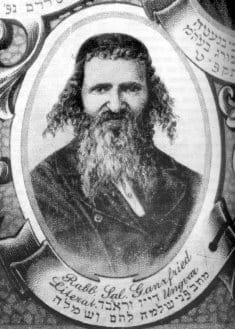
Later halachic works—such as the Kitzur Shulchan Aruch, Ben Ish Chai, Mishnah Berurah, and Yalkut Yosef—were never intended to function as constitutional codifications of binding law in Rambam’s sense. By the time these works were composed, the Sanhedrin had long ceased to exist, true semicha was no longer operative, and halacha had fully entered a post-legislative phase. The central task was no longer to state definitively what the law is, but to guide communities in how to live Torah faithfully amid fragmented authority, geographic dispersion, and competing traditions.
Accordingly, these works consciously incorporate elements Rambam deliberately excluded: unresolved disputes, regional and communal minhagim, kabbalistic preferences, and pastoral or pragmatic considerations.
Their purpose is practical navigation rather than systemic reconstruction. They function as filters and mediators of earlier law, not as constitutional restatements of it.
Crucially, even authors whose works are explicitly minhag-based or kabbalistically informed do not deny Rambam’s primacy as a posek.
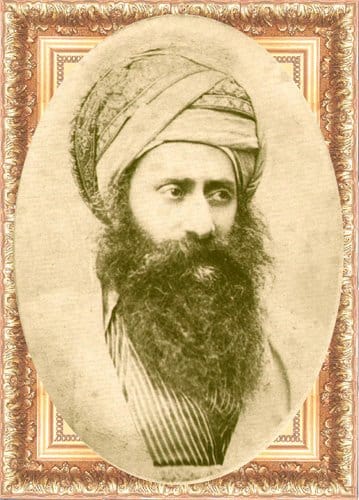
The Ben Ish Chai himself—despite frequently ruling according to mystical considerations and local Babylonian custom—explicitly acknowledges Rambam as the greatest among the poskim and accords his rulings exceptional gravity.
This recognition is not rhetorical. It reflects an underlying consensus that Rambam’s authority derives from the rigor of his method and his commitment to transmitting court-era halacha, rather than shaping practice through custom or metaphysical preference.
The Ben Ish Chai’s willingness to diverge from Rambam in practice is therefore not a rejection of Rambam’s stature, but an admission of the changed halachic landscape. In a post-Sanhedrin world, practice may legitimately follow minhag or kabbalistic tradition, even while recognizing that Rambam remains the clearest legal heir to the original halachic system. This distinction—between acknowledging legal primacy and choosing communal application—precisely captures the difference between authoritative transmission and practical guidance, and explains why Rambam’s code stands apart from all later works.

Part 9 – Modern Codes and Minhag-Based Works
Kitzur Shulchan Aruch
Practical guide
Heavily minhag-driven
Not a constitutional code
Ben Ish Chai
Integrates kabbalistic preference
Often explicitly minhag or mystical
Deeply respected, but not court-derived law
Mishnah Berurah / Yalkut Yosef
Clarify practice
Resolve disputes
Preserve community standards
These works:
May contain authoritative law
Often contain opinion
Frequently preserve minhag
The error is treating the entire book as Torah-level authority instead of classifying each ruling.

Part 10 – The Correct Flow Model of Judaism
Judaism functions when authority flows in this order:
Torah – Divine legislation
Court-era law (Mishnah) – Binding human law
Talmudic and Halachic Drashic explanation – Legal reasoning
Early codification (Rambam, Rif) – Authoritative transmission
(One could stop here legally if desired, on the other side there is jewish history that should be studied via history books and books minhagim)
Later codes – Mixed (law transmission + opinion + minhag)
Community minhag – Binding only as custom
Aggadah / Mysticism – Meaning, not obligation
When these layers are confused, Judaism becomes authoritarian and dishonest.
When they are respected, Judaism remains flexible, faithful, and durable.

Closing
Judaism survives because it knows where authority ends.
Not everything old is Torah.
Not everything printed is law.
Not everything practiced is obligatory.
The chart provided preserves this truth.
The task is to teach it without fear.

Shaarei Tzafon — The North Gate
Orthodox Jewish Life and Torah Study in Northeastern Michigan
Shaarei Tzafon — The North Gate, led by Rabbi Ariel Manning, is an independent, family-led Orthodox Jewish educational and publishing initiative based in Northeastern Michigan. We support traditional Jewish life, Torah study, Halakhah, and Jewish education throughout Alpena, Hillman, Rogers City, and surrounding communities. Those interested in traditional Judaism are welcome to contact us for educational resources, Torah learning, and opportunities for discussion by prior arrangement.
Rooted locally, our greater mission extends northward from the 45th parallel — The North Gate — through Michigan, Canada, and Alaska toward the Arctic. We seek to encourage independent Jewish communities, family-centered Torah education, and the renewal of small batei midrash and shtieblach, preserving the rich traditions of Orthodox Judaism for future generations.
Our work begins in Northeastern Michigan, but our vision extends from the 45th parallel toward the Arctic.
Guided by Rambam and Mori Qafiḥ, uplifted by Rebbe Nachman, and grounded by Avraham ben HaRambam’s balance of halakha and inward avodah.
The Orchard’s Path
publishes our books and curricula.
Our mission: a bright, authentic Jewish presence in every northern town.
Created with ©systeme.io


