
Is It a Benefit to Return to the Three-Year Torah Cycle?
B’H
1. Introduction: The Rhythm of Torah Study
Throughout Jewish history, the rhythm of Torah reading has shaped not only synagogue life but the very way Jews learn, reflect, and live.
The Torah cycle is more than a schedule—it is the heartbeat of Jewish time. Every community that studies Torah follows some pattern of reading, and that rhythm binds Israel together through generations.
Today, most of the Jewish world follows the one-year Torah cycle, completing the Five Books of Moshe annually from Bereshit after Sukkot to V’Zot HaBerachah on Simchat Torah.
Yet this was not always the case. In ancient Eretz Yisrael, Jews followed a three-year cycle, known as the Seder HaYerushalmi—the Jerusalem or triennial system.
At Shaarei Tzafon – The North Gate, we ask a simple but profound question:
Is it a benefit to return to the three-year Torah cycle?
The answer is yes—for both practical and spiritual reasons. It deepens learning, restores an ancient minhag, aligns with halachic precedent, and harmonizes with the pace of real life while preserving sanctity and structure.

2. The Human Condition and the Limits of Time
HaShem declared to Adam:
“בְּזֵעַת אַפֶּיךָ תֹּאכַל לֶחֶם עַד שֻׁבְךָ אֶל הָאֲדָמָה.”
“By the sweat of your face shall you eat bread, until
you return to the ground.” — Bereishit 3:19
This verse captures a truth that echoes across millennia: human life is bound by labor.
To survive, we must work; to work, we sacrifice time. And because of this, most Jews throughout history could not sit in study halls all day.
Even those who yearn to bask in the light of Torah must tend their fields, raise families, and fulfill worldly obligations. The three-year cycle honored that human rhythm. It allowed more time for deeper study and mastery without rushing through each weekly portion.
The one-year system, while powerful, assumes a full-time rhythm of communal reading that may not suit every community—especially those balancing rural, work-heavy lives.
For communities in the northern regions, where days stretch long in summer and shorten sharply in winter, the three-year rhythm restores balance between the natural world and the cycle of Torah.
3. The Halachic Foundation: Talmud and Rambam
The Talmud recognizes both systems explicitly.
In Talmud Bavli, Megillah 29b, we read:
“For the people of the West, i.e., Eretz Yisrael, who complete the cycle of reading the Torah not in one year but in three years.”
This single line preserves the reality that the original Torah-reading custom of the Land of Israel was triennial.
The one-year Babylonian system became dominant only later.
The Rambam (Mishneh Torah, Hilchot Tefillah u’Birkat Kohanim 13:1) writes:
“The common custom throughout all Israel is to complete the reading of the Torah in one year…
There are those who finish the Torah reading in a three-year cycle. However, this is not a widely accepted custom.”
The Rambam does not dismiss the triennial cycle; he simply records that the annual custom had become prevalent in his day.
Its inclusion in Mishneh Torah affirms that the three-year practice is halachically legitimate—merely less common.
Re-adopting it today is therefore not innovation but restoration: a return to an older, authentic minhag with deep halachic roots.
4. Historical Shifts: From Jerusalem to Babylon
Why did the one-year Babylonian system replace the Jerusalem cycle?
After the destruction of the Second Temple, Babylon became the great center of Torah scholarship. The academies of Sura, Pumbedita, and Nehardea shaped much of what we now call the Talmud Bavli, and their customs gradually spread. Their annual cycle likely aligned with their agricultural calendar, culminating each year in the joy of Simchat Torah. Over time, this unity of schedule appealed to the far-flung Jewish diaspora.
Meanwhile, in Eretz Yisrael, where communities were smaller and more localized, the triennial cycle continued for centuries. Archaeological findings—ancient synagogue inscriptions and early Torah-scroll divisions—confirm the existence of the older Seder system.
The Jerusalem Talmud itself often refers to Sedarim (sections) rather than Parashot, reflecting this ancient division. The difference between these two words marks not merely a linguistic nuance but two parallel worlds of Jewish rhythm: Babylonian brevity versus Jerusalem depth.
5. The Meaning of Sidra and Parashah
We go thru the Torah Sidra consecutively liturically
At the same time we recommend our congregates to go thru the annually Paroshiot (Parashah) at the Shabbos table, so we can be in sink, with all Klal Yisroel..
Lets explain the difference between the Sidra and Parashah
The term sidra is used several times in the Talmud and seems to be related to the concept of seder, which means “order,” or, in this case, the set and consistent pattern of things.
We find that the Talmud refers to different consistent patterns of study by the name sidra.
It seems that the term seder (where the term Sidra come from) was used to refer to the weekly portion in the triennial cycle of Torah reading, while the term parshah was used for the divisions according to the annual cycle. This difference is indicated in many of the printed versions of the chumash where at the conclusion of each of the five books is a list of how many verses, chapters, parshiot, and sedarim there are in that book. The parshiot listed refer to our weekly readings, while the sedarim refer to the divisions that were used in Israel for the triennial cycle.
In terms of Jewish law, the word parshah refers to a set of verses that is written in the Torah scroll without any break within the text. Depending on how big the space needs to be before a particular parshah, it is called a parshah petucha, “an open portion,” or a parshah setuma, “a closed portion.” The text of “an open portion” always begins on a new line on the parchment, and “a closed portion” can begin even on the same line, after an empty space equaling the width of as few as nine letters from the previous portion.
In our printed versions of the Torah, the chumash, the place where an “open portion” would appear in the Torah scroll is marked with the Hebrew letter pei (Heb. פ), and a “closed portion” is marked with the letter samech (Heb. ס).
The weekly Torah readings do revolve somewhat around these parshiot, since they mostly begin and end with these spaces in the text. However, they do not directly correspond to them, as each weekly portion may contain several such “open” or “closed” parshiot. Nevertheless, in some places we find that the Talmud also refers to the weekly reading as a parshah.
In contemporary writing and speech, both parsha and sidra are used to refer to the regular weekly reading according to the annual cycle.
Parsha is also used to refer to the portions of text as they are divided in the Torah scroll.
However we at Shaarei Tzafon, are going back to the original meaning of this terms..
6. Modern Renewal: Ancient Practice Reawakened
In recent centuries, several Jewish communities revisited shorter Torah cycles.
During the nineteenth and twentieth centuries, some non-Orthodox movements—Reform, Conservative, Reconstructionist—divided the weekly parashah into thirds to create a simplified “triennial reading.” Their motives were often practical: brevity or educational structure.
However, in our generation, halachically observant scholars and communities have begun to return to the original Jerusalem model for far deeper reasons.
Among them is Rabbi David Bar-Hayyim of Machon Shilo, who advocates restoring the authentic Seder HaYerushalmi as an expression of Torah rooted in the Land of Israel and in historical precedent.
This renewal reflects a desire not for convenience but for authenticity—to align modern Jewish life with its earliest rhythm and to enable genuine depth of study.
At Shaarei Tzafon, the triennial cycle is not merely a liturgical experiment; it is a framework for serious Torah learning. We follow the Sidra pattern for daily and weekly study while remaining aware of the annual Parashah divisions observed by Klal Yisrael.
Thus, we maintain unity with the wider Jewish world without sacrificing the slower, contemplative pace that our northern and rural communities require.
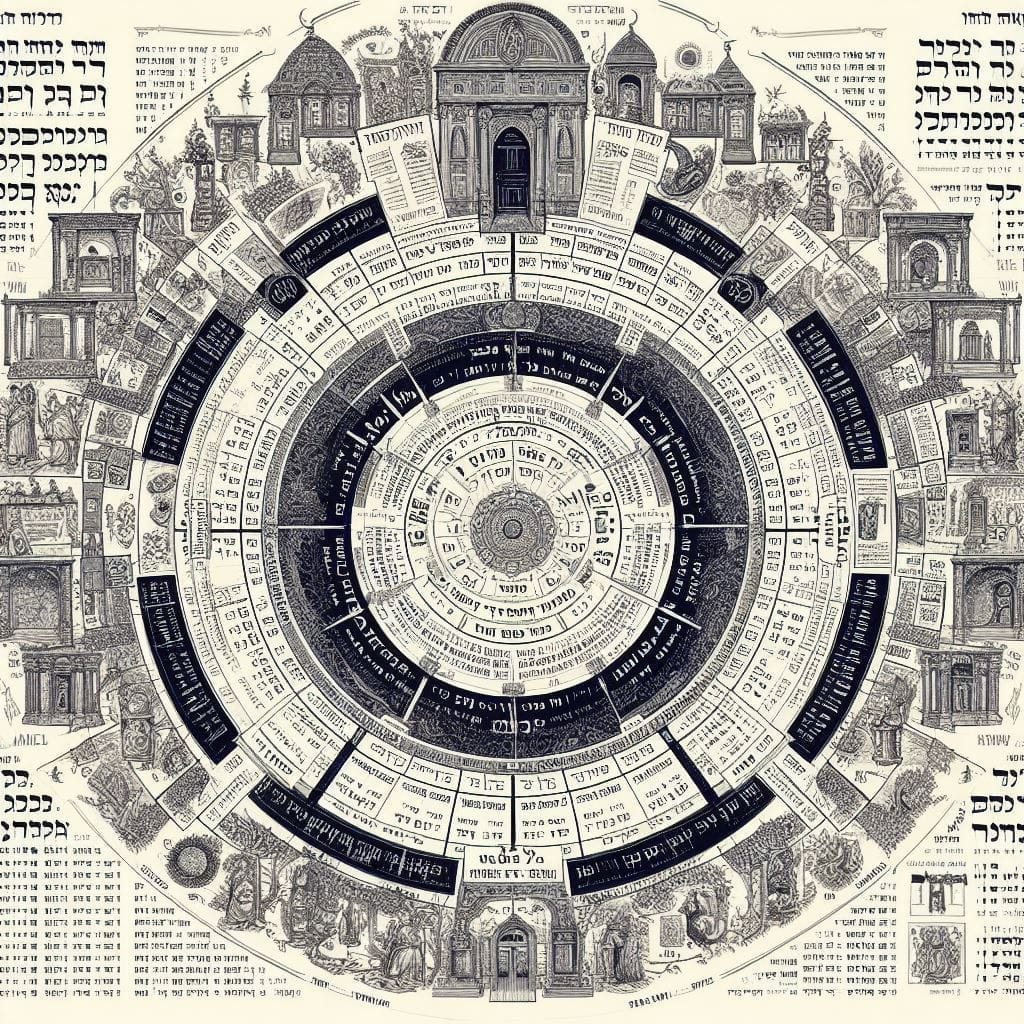
7. The Daily and Weekly Seder of Study
Our method follows a structured rhythm designed to balance breadth and depth.
Morning Seder (after Shacharit):
Sidra of the Day – Read directly from the Masoretic Hebrew text with Targum Onkelos; Rashi’s commentary.
Four Chapters of TaNaKh – Two from Nevi’im (Prophets) and two from Ketuvim (Writings).
Mishnah Study – 3–5 mishnayot daily builds halachic literacy.
Optional Readings – For those who study emerging Messianic literature, one chapter from the ethical or narrative texts between Yaakov and Revelation.
One Page of Musar or Chassidic Writing – to refine middot and inspire joy.
Evening Seder (after Ma’ariv):
Sefer HaMitzvot and Sefer HaChinuch on the mitzvot appearing in the Sidra.
Mishneh Torah (and if time, Shulchan Aruch) corresponding to the same topics.
Trace Each Halacha to the Gemara, revealing the chain of reasoning.
Kitzur Shulchan Aruch or Ben Ish Chai for concise practical rulings and Sephardic ethical texture.
Thursday through Shabbat:
Add Midrash Rabbah, Zohar, Ein Yaakov, or a page of Gemara—texts that expand the soul and root Torah in the Oral Law.
This method naturally complements the triennial cycle. Each Sidra becomes a week’s centerpiece for reflection across Torah, Prophets, Writings, Halacha, and spirituality.
8. The Spiritual Benefit: Depth Over Speed
Why does a slower cycle matter?
Because Torah study is not about finishing—it is about transforming.
The Sages taught:
“הֲפֹךְ בָּהּ וַהֲפֹךְ בָּהּ, דְּכֹלָּא בָהּ.”
“Turn it and turn it, for everything is in it.” — Pirkei Avot
5:22
When we rush, we skim the surface; when we linger, we hear the heartbeat of Torah.
In the one-year system, lengthy parashot can pass too quickly for thoughtful engagement. In the three-year system, a section like Mishpatim—overflowing with civil law—can stretch across three weeks, inviting time to trace every mitzvah from verse to Rambam to practice.
This slower rhythm also aligns with Rebbe Nachman’s principle of hitbodedut—personal contemplation. Torah is absorbed through reflection, not performance.
A triennial rhythm sanctifies study as meditation, not obligation. It gives the student room to live with each mitzvah until it becomes part of daily consciousness.

9. Harmony with Creation: The Boreal Rhythm
Those living above the 45th parallel know that creation itself moves at a different pace. Winters are long and silent; summers are brief yet luminous. The earth demands patience.
The three-year Torah cycle mirrors this northern, contemplative tempo. It lets Torah unfold with the seasons—sowing and harvest, light and snow, dusk and dawn. It allows the study of Bereshit to begin as the world darkens after Sukkot, and the study of Devarim to close as the leaves fall—every year, a spiral through time.
King David wrote:
“כִּי אִם בְּתוֹרַת יְהוָה חֶפְצוֹ, וּבְתוֹרָתוֹ יֶהְגֶּה יוֹמָם וָלָיְלָה.”
“His delight is in the Torah of HaShem, and in His Torah he meditates day and night.” — Tehillim 1:2
To meditate day and night is to move slowly, attentively, like the seasons themselves. The triennial cycle makes this possible for working Jews, for families, and for isolated learners who wish to keep pace with heaven rather than hurry with the city.
It also builds communal unity. Families can study together without pressure; children absorb Hebrew naturally; adults find time to trace mitzvot through sources. Torah becomes a lifelong rhythm rather than a yearly sprint.

10. Conclusion: Returning to the Source
Reinstituting the three-year Torah cycle (sidra) is not a new creation—it is a homecoming.
It returns us to the rhythm of ancient Jerusalem, acknowledged by the Talmud and preserved in halachic memory.
Through this cycle we gain:
Depth – time to explore Torah, Halacha, and commentary thoroughly.
Language – space to strengthen Hebrew and Aramaic skills.
Continuity – a link with the earliest sages of Eretz Yisrael.
Balance – a rhythm attuned to work, family, and natural life.
Unity – alignment with Klal Yisrael through the annual parashah while cultivating the inner order of the Sidra.
The Rambam reminds us that while customs may vary, the Torah itself is eternal. Its rhythm can adapt to human circumstance without losing holiness. The Seder HaYerushalmi offers a path that honors both our limitations and our longing—to live Torah deeply, not hurriedly.
As we restore this ancient pattern, we restore serenity to study and sanctity to time.
May our return to the triennial cycle renew our covenant with learning, with the Land, and with the Eternal One who gave us His Torah to unfold—slowly, beautifully—through every generation.
The Three-Year Torah Cycle in Northeastern Michigan and Beyond
At Shaarei Tzafon — The North Gate, our return to the ancient three-year Torah reading cycle represents more than a preference for a particular schedule. It reflects our conviction that serious Torah study should be accessible to Jewish individuals and families wherever they live.
Here in the Alpena region of Northeastern Michigan, where Jewish families may be separated by considerable distances and traditional religious institutions are limited, maintaining a regular rhythm of Torah learning requires personal commitment.
Through our educational work, we encourage the study of Torah, Targum Onkelos, Mishnah, Talmud, Rambam, and the classical commentators. The triennial cycle allows us to examine these teachings carefully while balancing the responsibilities of work, family, and daily religious observance.
Our approach also preserves a connection with the annual Torah portions studied throughout the wider Jewish world.
Yet this educational vision is not limited to Judaism in Alpena, Hillman, Rogers City, or Northern Michigan.
Shaarei Tzafon's wider mission extends from the 45th parallel toward the Arctic, particularly across Northern Michigan, Canada, and Alaska. We believe that the restoration of meaningful Torah learning in small communities can help preserve the rich inheritance of Ashkenazi and Sephardi Jewish life throughout these northern regions.
The three-year Torah cycle offers one practical example of how an ancient Jewish custom can contribute to contemporary religious life.
We do not seek to replace the established traditions of every Jewish community. Rather, we seek to demonstrate how an historically grounded approach to Torah study can support families, independent batei midrash, and small communities seeking to cultivate traditional Jewish life.
Our work begins locally in Northeastern Michigan, but the opportunity to study Torah belongs to Jews everywhere.

Shaarei Tzafon — The North Gate
Orthodox Jewish Life and Torah Study in Northeastern Michigan
Shaarei Tzafon — The North Gate, led by Rabbi Ariel Manning, is an independent, family-led Orthodox Jewish educational and publishing initiative based in Northeastern Michigan. We support traditional Jewish life, Torah study, Halakhah, and Jewish education throughout Alpena, Hillman, Rogers City, and surrounding communities. Those interested in traditional Judaism are welcome to contact us for educational resources, Torah learning, and opportunities for discussion by prior arrangement.
Rooted locally, our greater mission extends northward from the 45th parallel — The North Gate — through Michigan, Canada, and Alaska toward the Arctic. We seek to encourage independent Jewish communities, family-centered Torah education, and the renewal of small batei midrash and shtieblach, preserving the rich traditions of Orthodox Judaism for future generations.
Our work begins in Northeastern Michigan, but our vision extends from the 45th parallel toward the Arctic.
Guided by Rambam and Mori Qafiḥ, uplifted by Rebbe Nachman, and grounded by Avraham ben HaRambam’s balance of halakha and inward avodah.
The Orchard’s Path
publishes our books and curricula.
Our mission: a bright, authentic Jewish presence in every northern town.
Created with ©systeme.io


