
Judaism, Pedigree, and the Collapse of Moral Categories
B"H
I want to speak tonight with care, seriousness, and precision. Not defensively. Not polemically. And not emotionally. Because the issue we’re touching is real, growing, and dangerous—not only for Jews, but for anyone who wants to think clearly about morality, responsibility, and civilization.
I recently listened to a long lecture addressing what is sometimes called the “return of the Jewish Question.” It was serious, sober, and mostly correct. It avoided hysteria. It avoided slogans. And it correctly identified a renewed pattern of anti-Jewish suspicion as something corrosive, irrational, and ultimately self-defeating.
But I believe the lecture stopped one step before the conceptual clarification that actually dissolves the problem.
What we are dealing with here is not simply antisemitism in its classic form. It is something more layered, more modern, and more confused. It is what I would call a stacked problem: several pressures converging at once, producing resentment where explanation should exist.
Let me name those pressures carefully.
First, there is a numbers and visibility problem. Jews are a very small population, yet they are highly visible in media, academia, finance, and politics. Visibility without proportional context has always bred myth. In the age of algorithms, fragments, and virality, it breeds fixation.
Second, there is status anxiety—a widespread sense, across societies, of lost coherence and unstable hierarchy. People watch certain groups praised for resilience and success while feeling their own narratives eroding. In the absence of explanation, comparison hardens into suspicion.
Third, there is moral whiplash. On the one hand, Jews are praised for survival, resilience, and continuity. On the other hand, some of the most destabilizing forces of modern culture—sexual radicalism, revolutionary politics, ideological extremism—are publicly associated with individuals who happen to be Jewish. Names and associations matter. When this dissonance is not explained, resentment fills the vacuum.
The lecturer described this phenomenon as selective noticing. That diagnosis is correct—but incomplete.
What is actually missing is category clarity.
And the single clarification that collapses most conspiracy thinking almost immediately is this:
Judaism is a religion first, not a race.
That sentence is not a slogan. It is a legal, theological, and civilizational claim. And it is precisely the claim formalized by Rambam in the Mishneh Torah.
Judaism and Pedigree Are Not Identical
Judaism is covenant, law, obligation, discipline, and commanded life.
Jewish pedigree is ancestry, family history, and cultural inheritance.
These two overlap—but they are not identical.
A Jew can reject Torah.
A Jew can reject God.
A Jew can reject Jewish moral constraints.
And still be ethnically Jewish.
At that point, what that person produces is not Judaism. It is secular ideology with a Jewish surname.
This is not a modern apologetic maneuver. It is embedded directly in halakhah.
Rambam teaches that Shabbat is the eternal sign—האות—between God and Israel. This is not poetic language. It is legal language. Shabbat is the public marker of covenantal allegiance.
Rambam then draws a sharp distinction. A Jew who violates other mitzvot remains within Judaism’s moral jurisdiction—rish‘ei Yisrael. But a Jew who publicly desecrates Shabbat is treated, for halakhic purposes, as one who has rejected the covenant itself.
Rambam equates such a person with an idolater.
This is decisive.
Judaism itself refuses to anchor moral responsibility in ancestry. It already disqualifies Jews who reject its defining covenant from representing it.
Judaism is not a racial bloc.
It is a law-bound civilization.
Karl Marx as a Test Case
This is why Karl Marx serves as a useful example—and why correcting the narrative around him matters.
Karl Marx was Jewish by birth. He was baptized. He was raised in a Christian intellectual environment. He was explicitly hostile to religion, including Judaism.
To say “communism came from Jews” is technically shallow.
What is more accurate is this:
Communism emerged from post-Christian, post-Jewish European secular philosophy, some not all of whose architects happened to have Jewish ancestry.
That is a civilizational problem, not a Jewish one.
Judaism itself rejects class warfare.
Judaism rejects utopian coercion.
Judaism rejects the erasure of property, family, hierarchy, and law.
About 1000 years earlier, Rambam dismantles Marx without ever naming him.
Where Resentment Actually Forms
Resentment forms when praise and blame coexist without explanation.
People see Jewish figures honored, Jewish suffering acknowledged, Jewish resilience admired. At the same time, they see Jewish names attached to moral or ideological chaos—and no internal Jewish distinction being explained.
The unspoken question becomes:
“If Jews are one group, why don’t they answer for their own?”
That is where confusion hardens into suspicion.
Because Judaism does answer for its own—but the public rarely sees how.
Here is the sentence missing from much public discourse:
Judaism is not responsible for Jews who abandon Judaism.
Judaism condemns sexual licentiousness.
Judaism condemns revolutionary chaos.
Judaism condemns the dissolution of family, hierarchy, and obligation.
When Jews are flattened into a racial bloc, the very moral system that could clarify responsibility disappears. And that flattening is what turns grievance into conspiracy.
The Internet: Information Without Structure
We must address another factor honestly, or the conversation becomes unserious.
We are living in an age of free-flowing information: screenshots without context, fragments without hierarchy, claims without scholarship. Many people encounter Jewish texts, history, and trauma not through education, but through isolated excerpts framed as forbidden truths.
They encounter claims such as:
“The Holocaust numbers are wrong.”
“The Talmud teaches hatred of non-Jews.”
“Accusations of antisemitism are used to silence criticism.”
If every such claim is met with outrage rather than explanation, trust collapses.
And this must be said plainly:
Not every uncomfortable question is antisemitism.
Some are ignorance.
Some are misinformation.
Some are genuine confusion in a landscape without structure.
If hatred and confusion are not distinguished, resentment is amplified.
Holocaust Distortion and the Need for Confidence
The Holocaust is among the most thoroughly documented events in modern history.
The scholarly consensus on its scope is overwhelming. Claims that “the numbers are fabricated” do not arise from serious historiography; they arise from skepticism culture, where doubt itself is mistaken for insight.
But outrage is not the answer.
Judaism does not fear facts.
Truth withstands scrutiny.
An adult response explains:
How historians know what they know
Where uncertainty exists—and where it does not
How denial operates psychologically, not evidentially
Silence breeds myth.
Explanation dissolves it.
The Talmud and Screenshot Theology
The same applies to the Talmud.
Yes, there are harsh passages.
Yes, there is insider language.
Yes, there is polemic shaped by persecution and legal context.
But the Talmud is not a theology book about Christians or Muslims.
It is a legal corpus, addressing specific cases, written in a hostile environment (where ACTUAL Greco-Roman and middle-eastern pagans robbed, lied to, attacked, murdered, and raped Jews), using technical categories.
Extracting isolated lines and presenting them as “what Jews believe” is like extracting a line from a courtroom transcript and claiming it defines an entire civilization.
Judaism already has rules for reading texts:
Context
Authority
Halakhic conclusion
Practice
Legend
Folklore
History
Without these categories, any legal system appears monstrous.
The error is not acknowledging difficult passages.
The error is refusing to explain how Judaism processes them.
Why “Everything Is Antisemitism” Fails
When all criticism, inquiry, or discomfort is labeled antisemitism, the term loses meaning. And when the term loses meaning, real antisemitism becomes harder to identify and confront.
There is antisemitism.
It is rising.
And it is dangerous.
But Judaism does not survive by moral panic.
It survives by giving clarity.
Final Clarity
This framework does not excuse Jewish participation in history.
It locates responsibility correctly.
It allows criticism without racialization.
Inquiry without conspiracy.
Honesty without panic.
Judaism does not survive by shouting.
It survives by teaching, explaining, and drawing lines.
Rambam did not fear Aristotle.
He did not fear Islam.
He did not fear philosophy.
He feared confusion.
And confusion is exactly what our age produces in abundance.
Judaism’s answer is not silence, and not outrage—but clarity.
Not apologetics.
Not slogans.
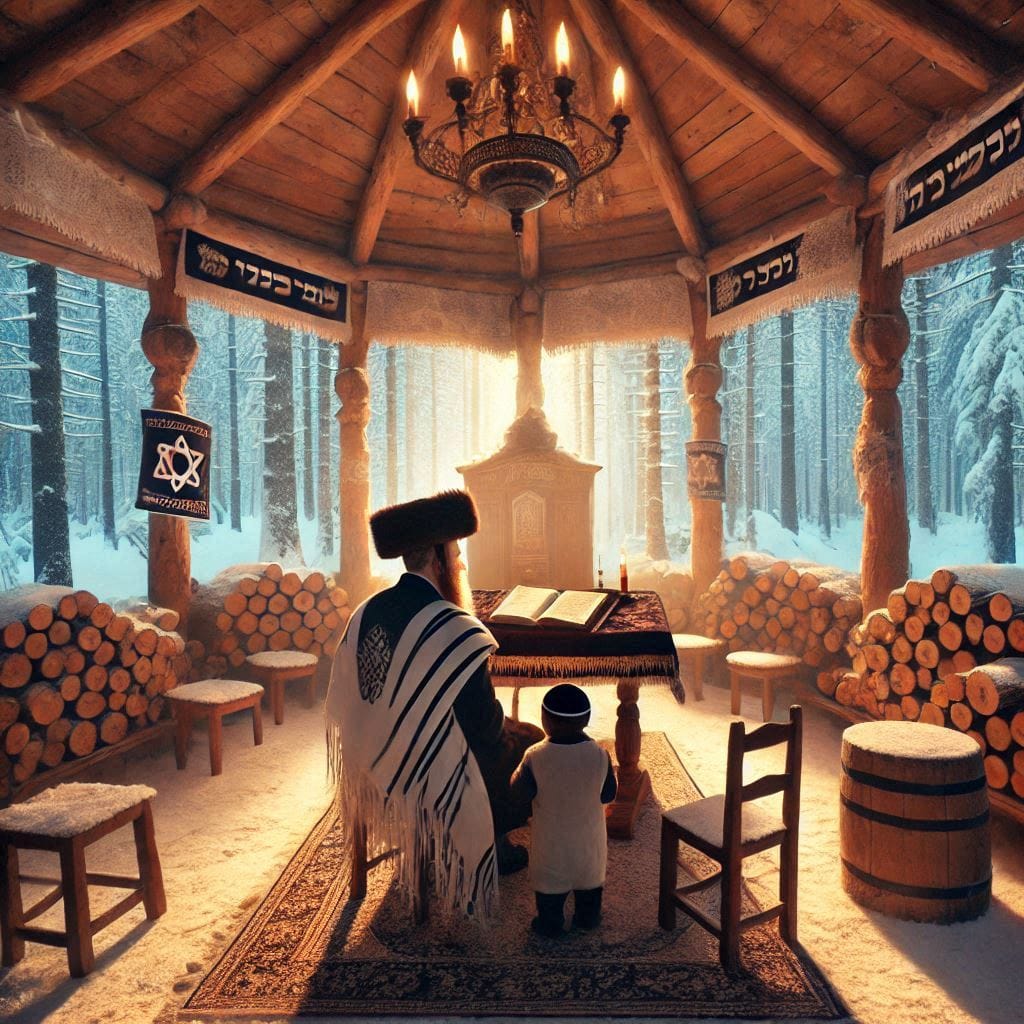
Shaarei Tzafon — The North Gate
Orthodox Jewish Life and Torah Study in Northeastern Michigan
Shaarei Tzafon — The North Gate, led by Rabbi Ariel Manning, is an independent, family-led Orthodox Jewish educational and publishing initiative based in Northeastern Michigan. We support traditional Jewish life, Torah study, Halakhah, and Jewish education throughout Alpena, Hillman, Rogers City, and surrounding communities. Those interested in traditional Judaism are welcome to contact us for educational resources, Torah learning, and opportunities for discussion by prior arrangement.
Rooted locally, our greater mission extends northward from the 45th parallel — The North Gate — through Michigan, Canada, and Alaska toward the Arctic. We seek to encourage independent Jewish communities, family-centered Torah education, and the renewal of small batei midrash and shtieblach, preserving the rich traditions of Orthodox Judaism for future generations.
Our work begins in Northeastern Michigan, but our vision extends from the 45th parallel toward the Arctic.
Guided by Rambam and Mori Qafiḥ, uplifted by Rebbe Nachman, and grounded by Avraham ben HaRambam’s balance of halakha and inward avodah.
The Orchard’s Path
publishes our books and curricula.
Our mission: a bright, authentic Jewish presence in every northern town.
Created with ©systeme.io


