
Rediscovering Human Decency
A Personal Reflection on Life, Humanity, Understanding, and the Importance of Conversation
A teaching from Rabbi Ariel Manning of Shaarei Tzafon
B״H
My goodness, the beauty of life!
Sometimes I sit back and look at my children, and I am simply amazed. My oldest is already in college, and we are preparing to get our second child ready for college. Where has the time gone?
I look at them, and I think about the generations that came before us. I think about everything our ancestors experienced, the struggles they endured, the opportunities they never had, and the world in which my children are now growing up.
And I cannot help but say, Baruch HaShem (Praise Gd).
Life is a beautiful thing.
We live in an extraordinary period of human history. In many respects, we have opportunities, comforts, freedoms, and possessions that previous generations of our families could scarcely have imagined.
In my own family, I can look back and recognize that I have been blessed with material opportunities that many of those before me never experienced.
Yet, at the same time, I look around at our society and see something deeply troubling.
We seem to be losing our sense of human decency.
It reminds me of that famous opening from Charles Dickens:
“It was the best of times, it was the worst of times.”
And isn't that an appropriate description of the world in which we live?

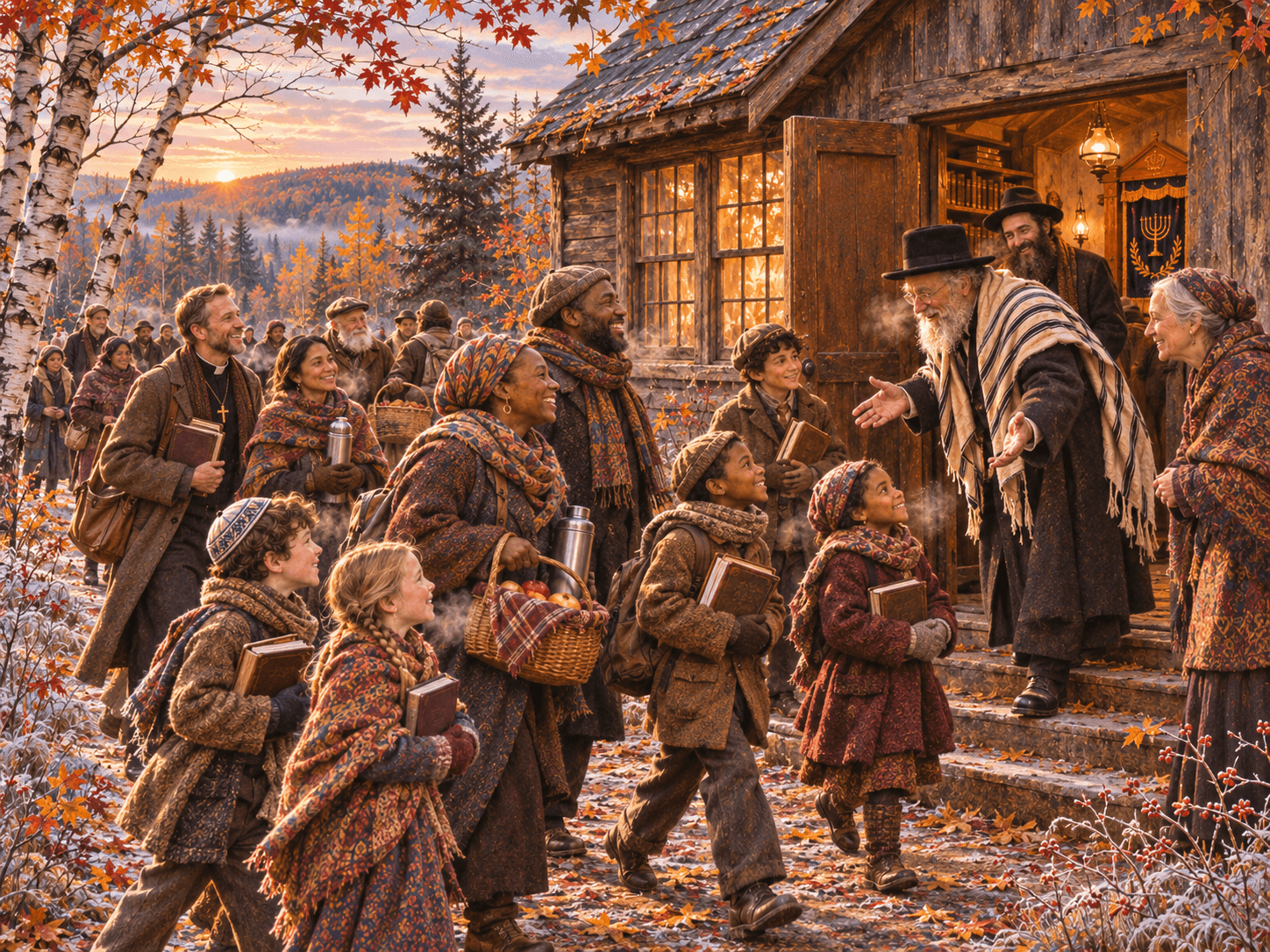
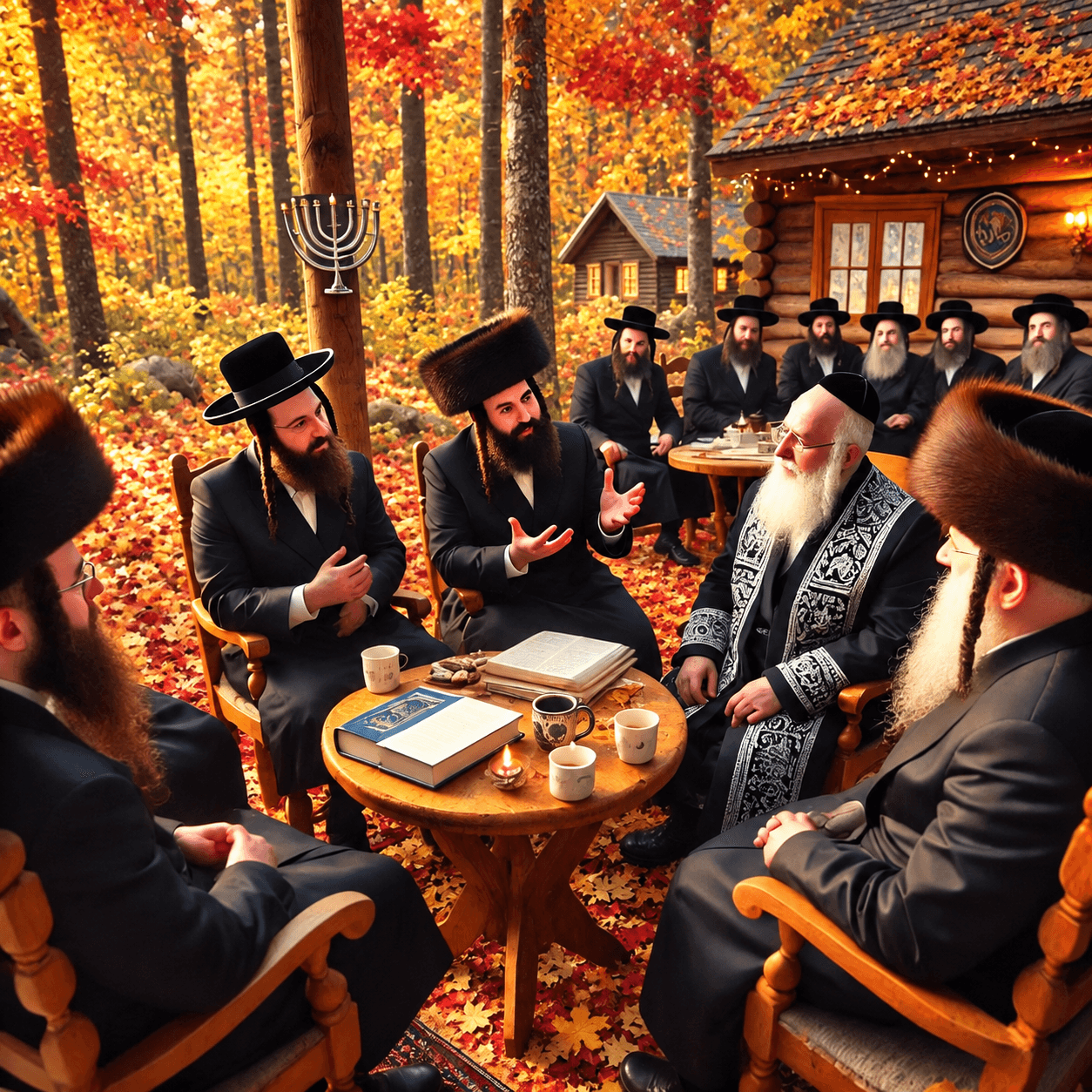
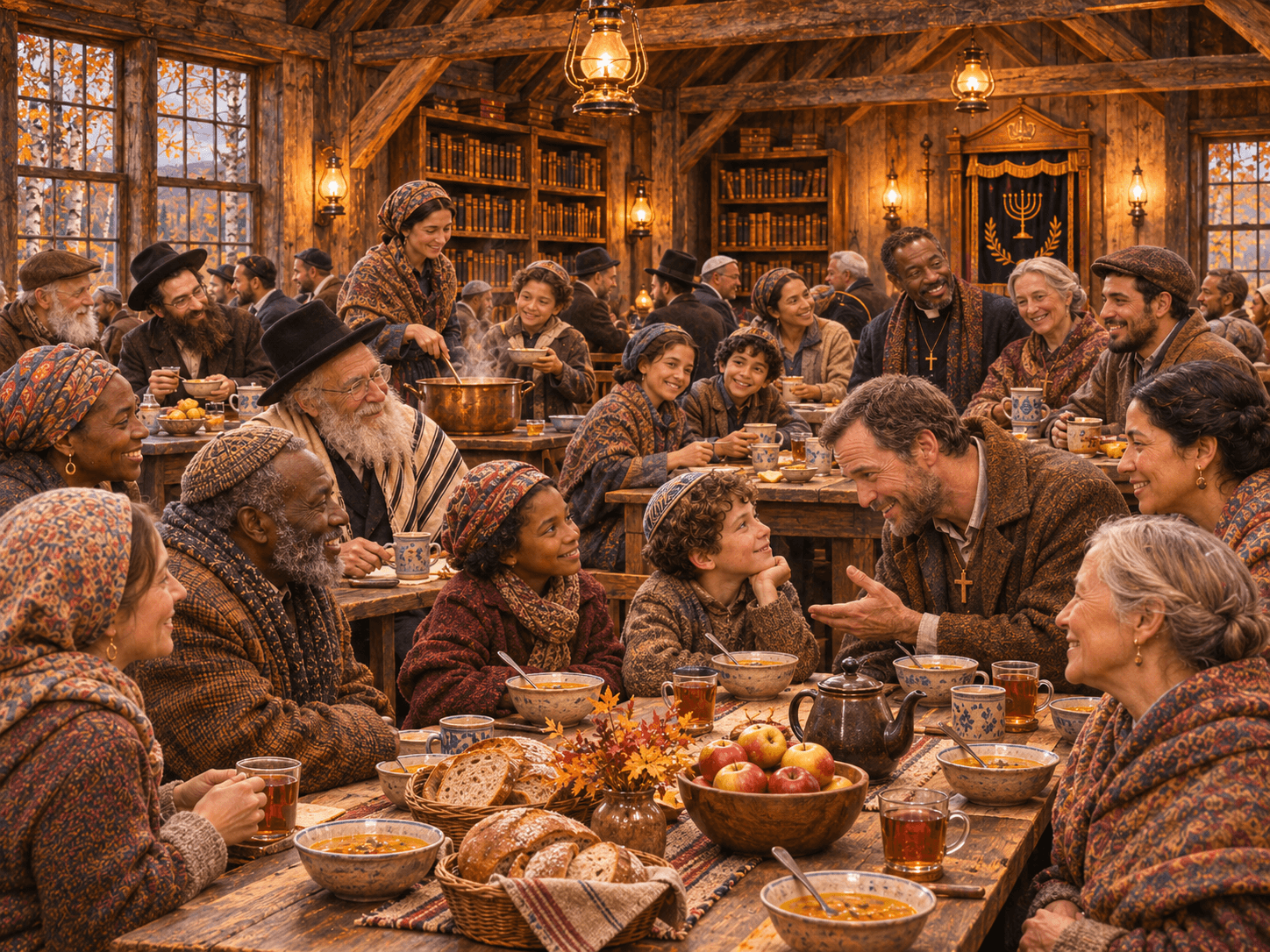
A Note Regarding the AI-Generated Illustrations
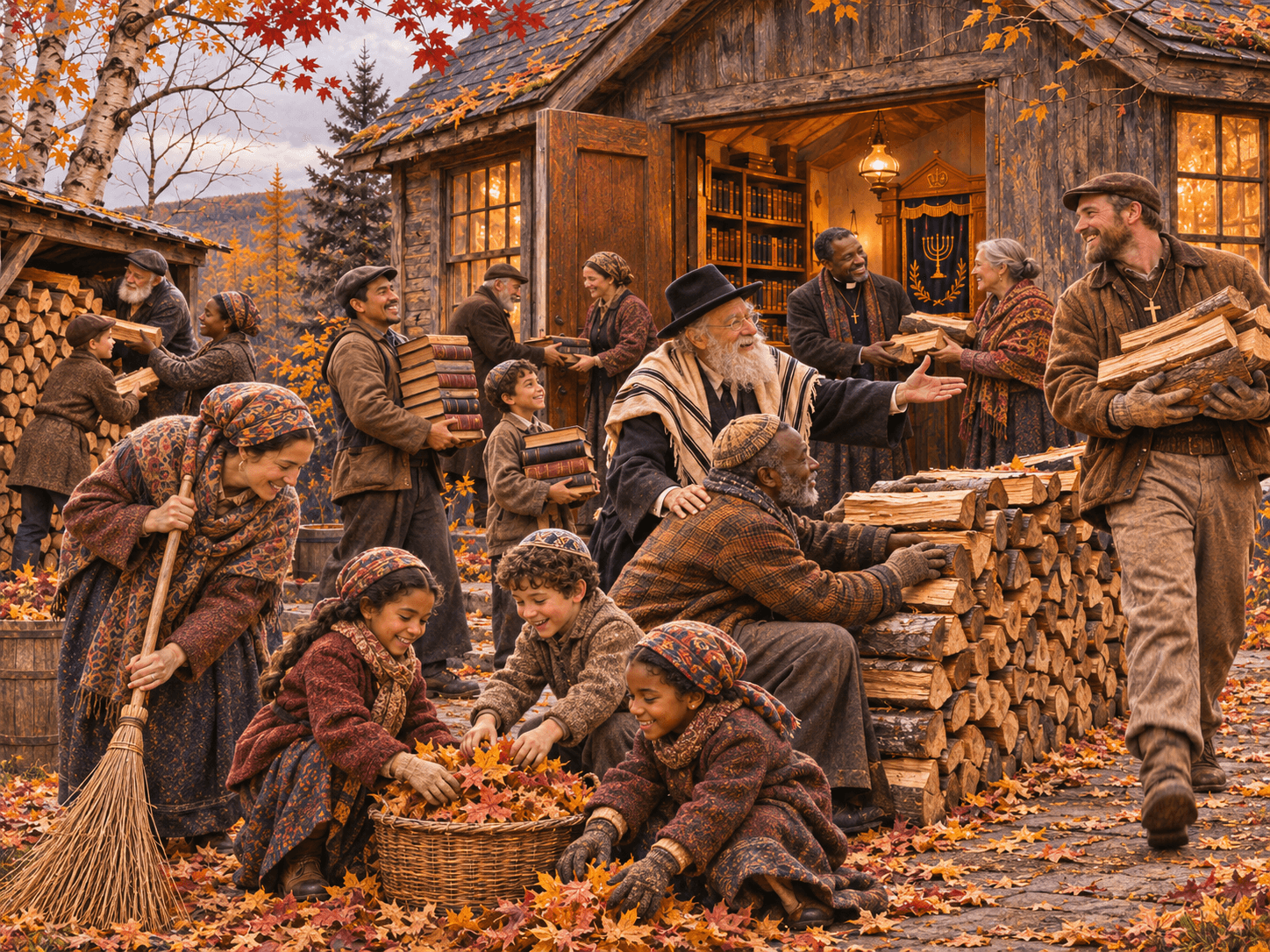
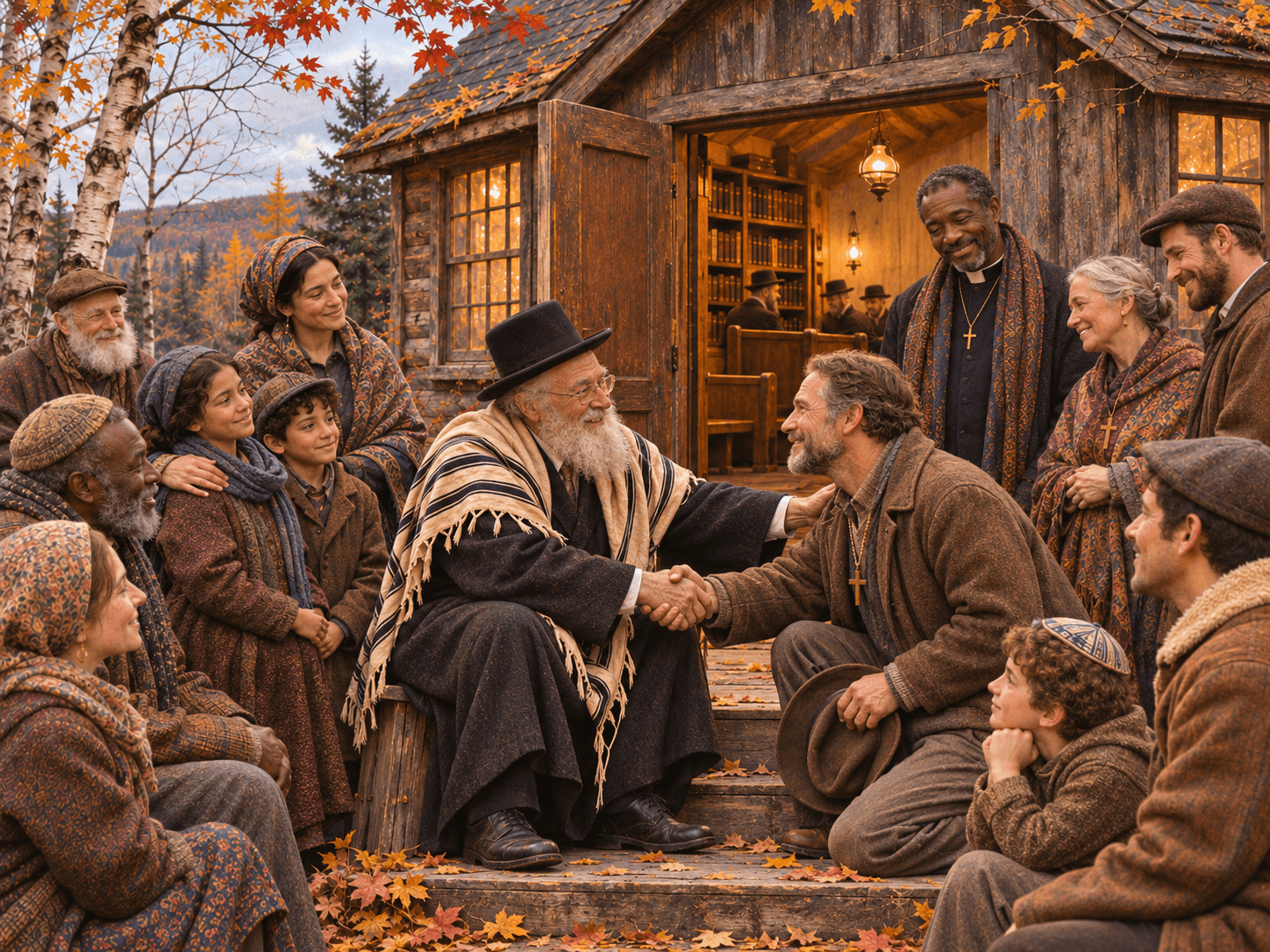
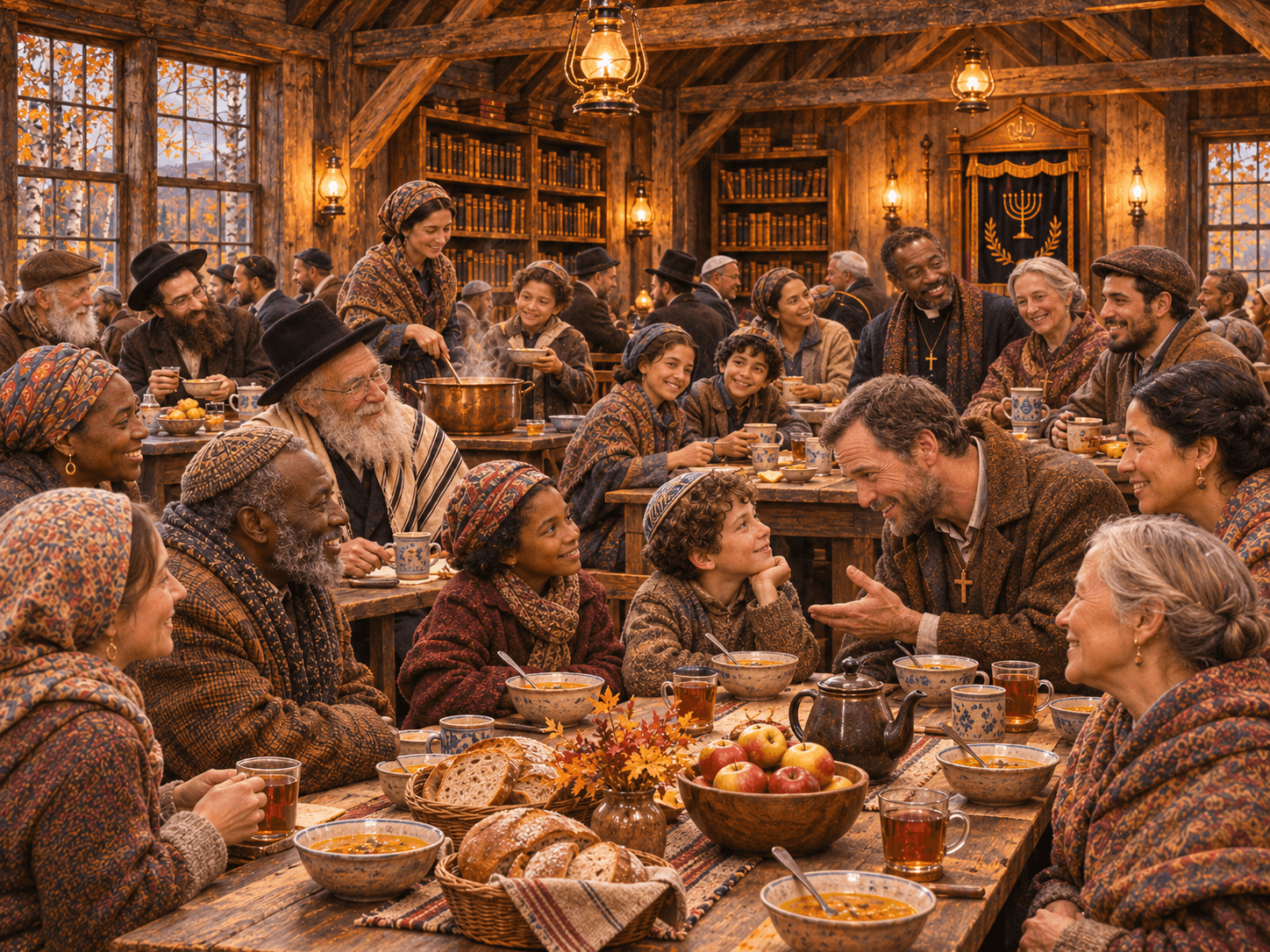
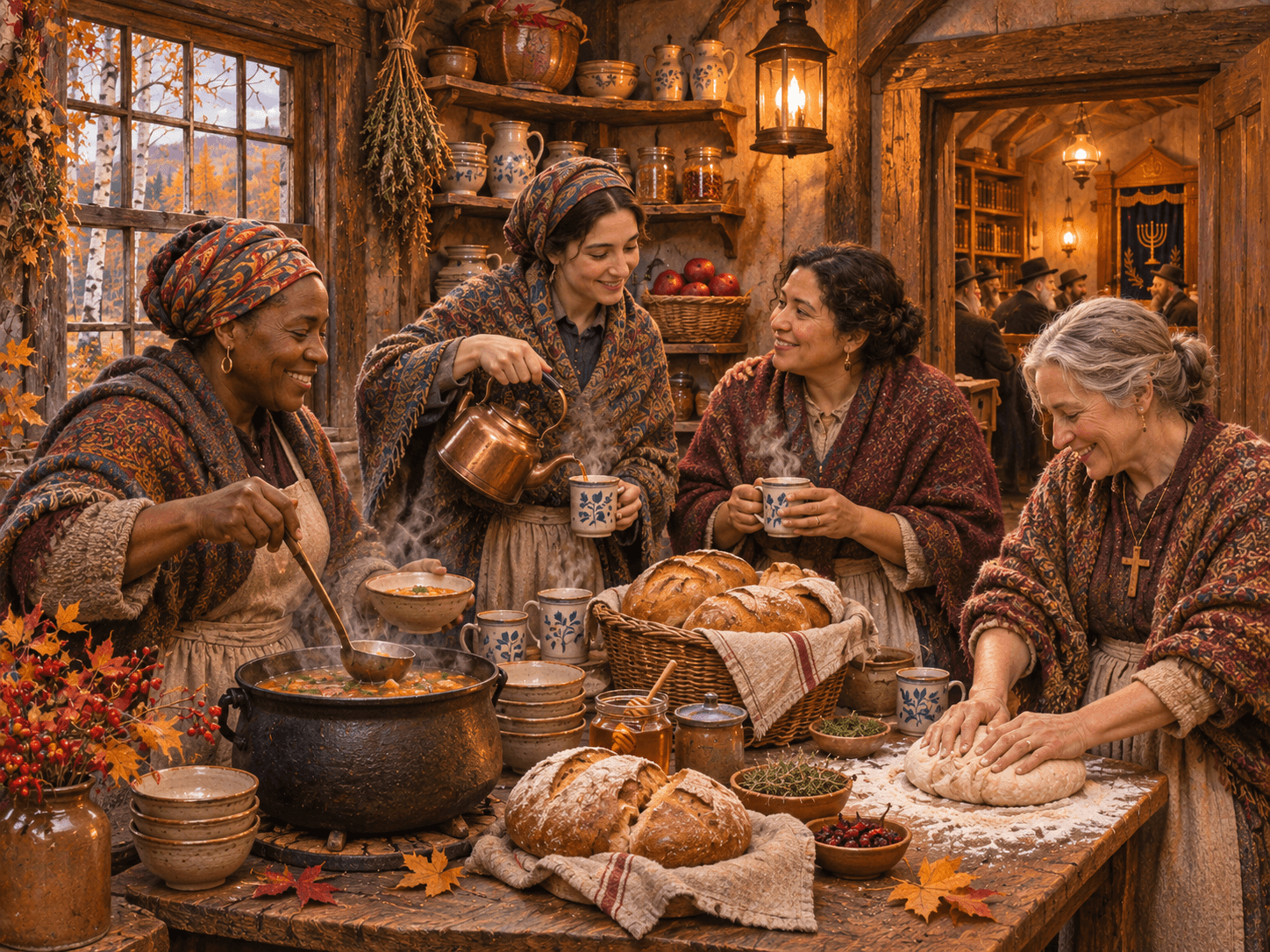
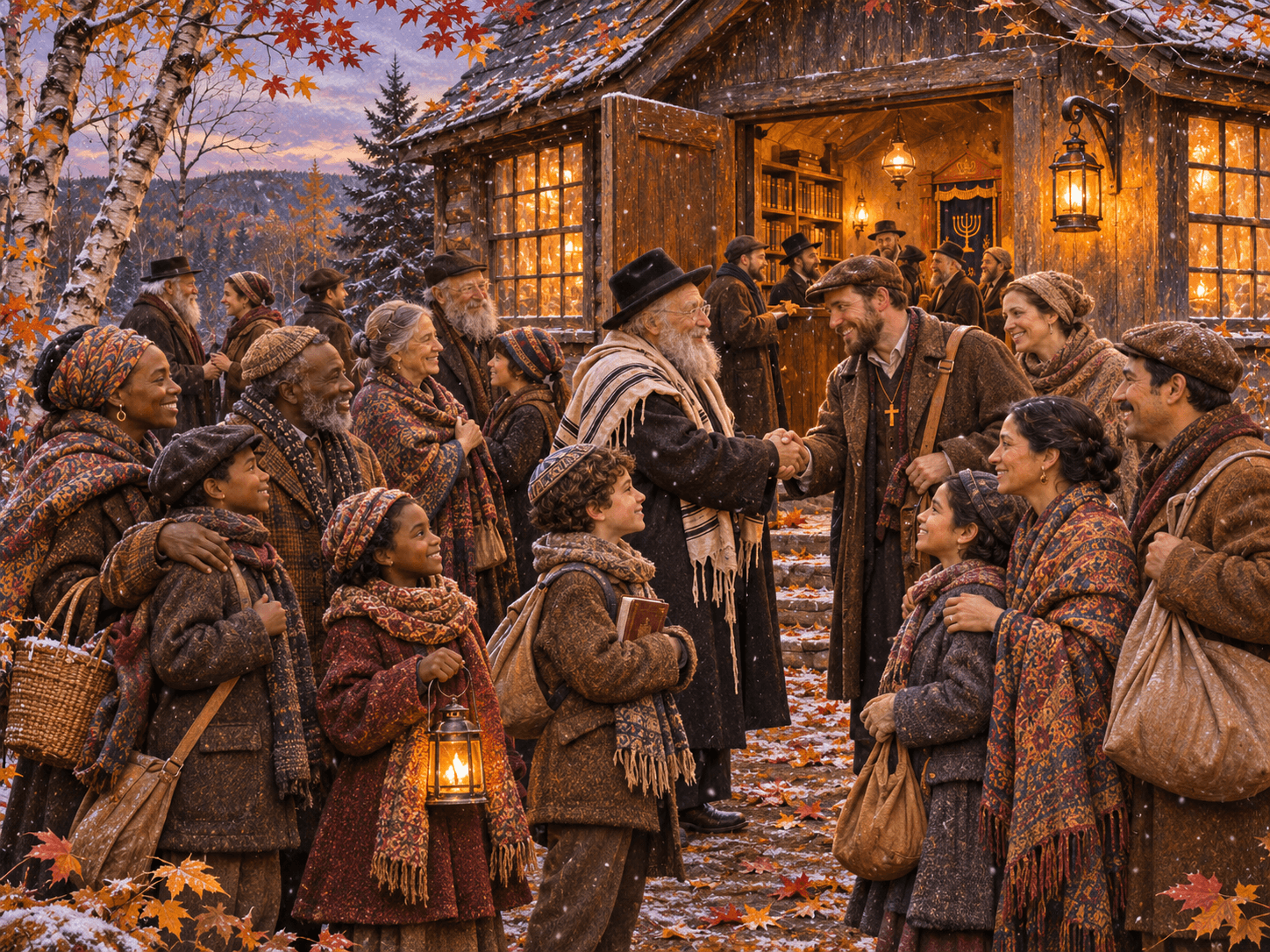
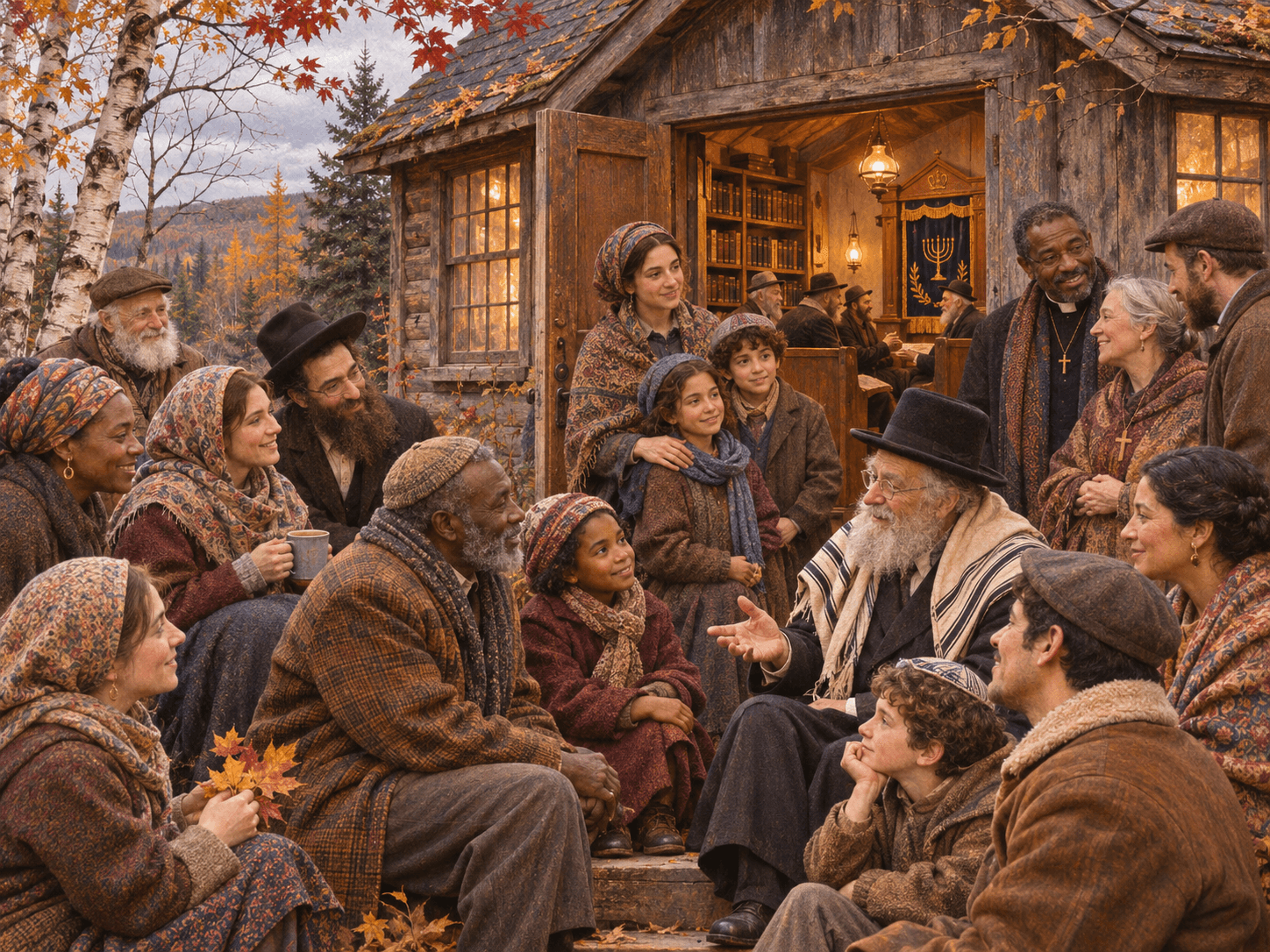
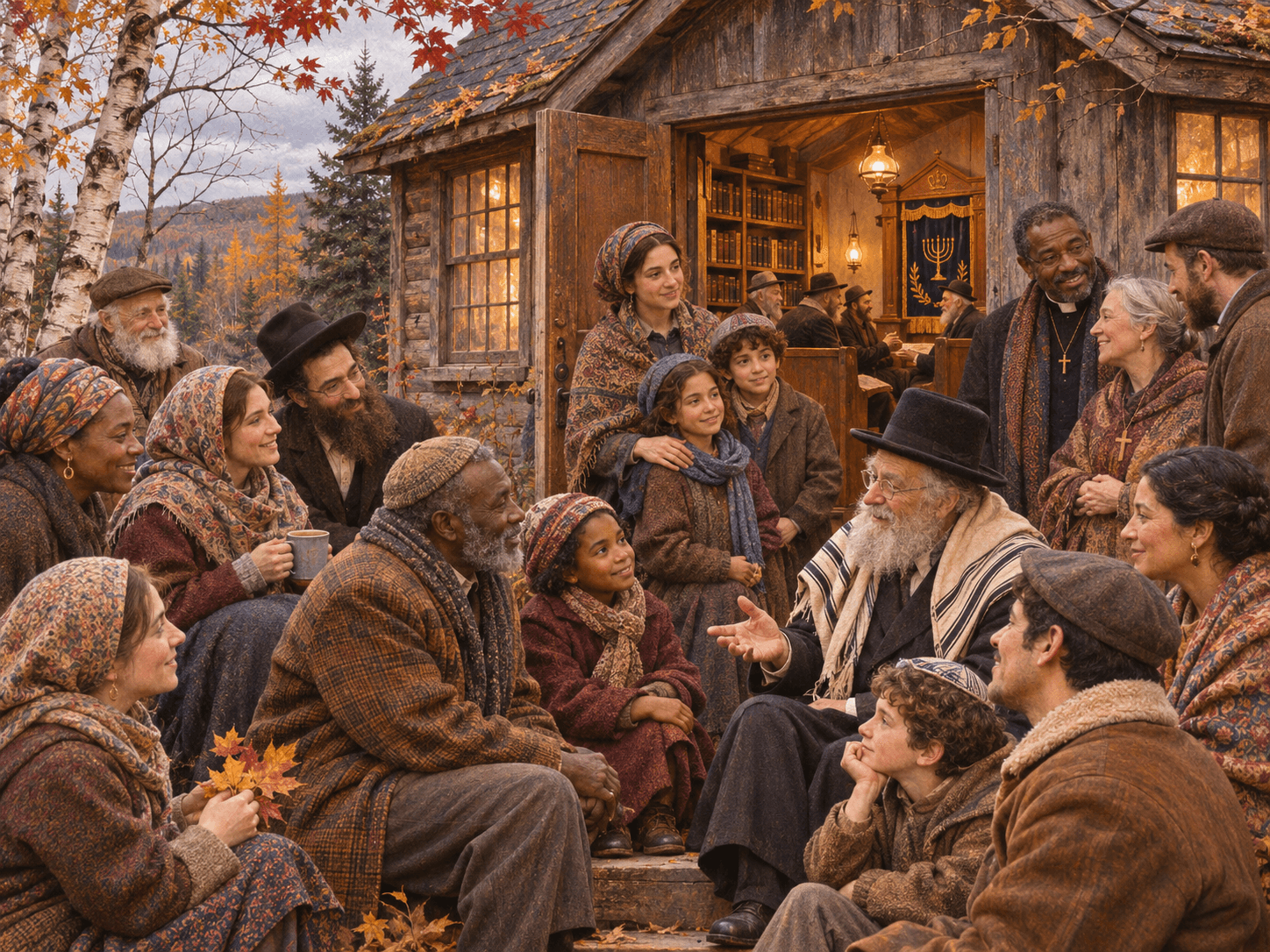
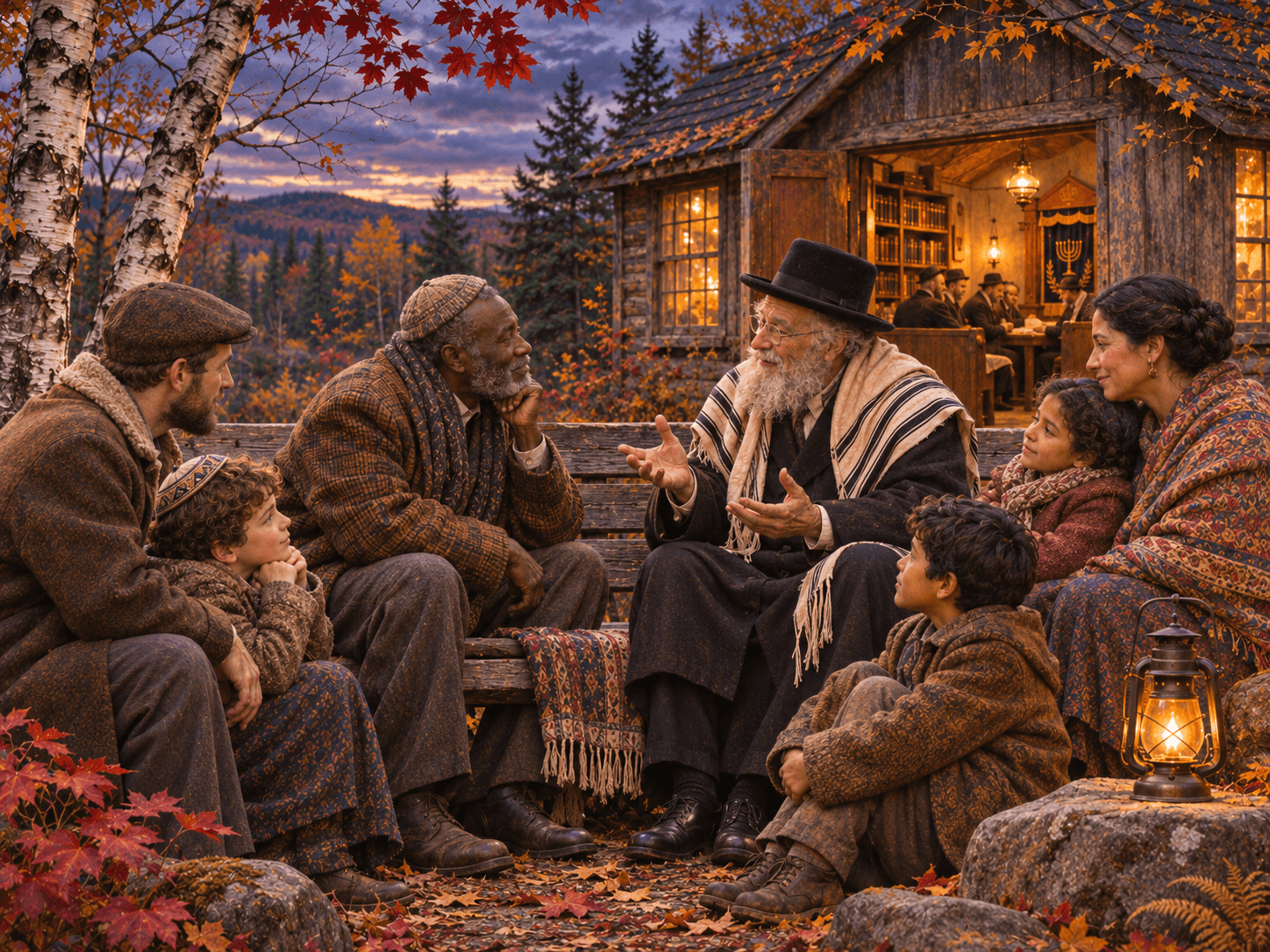
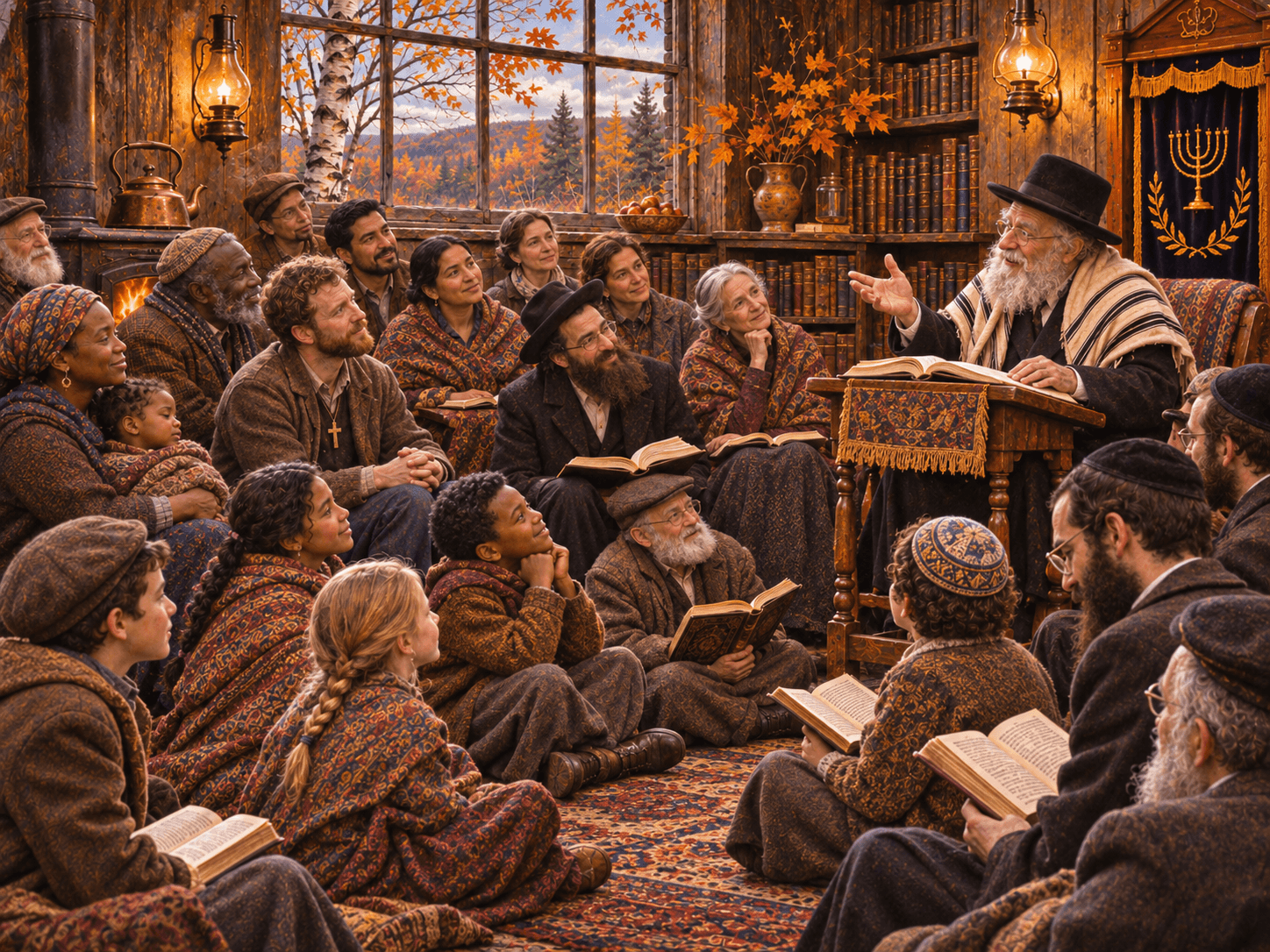
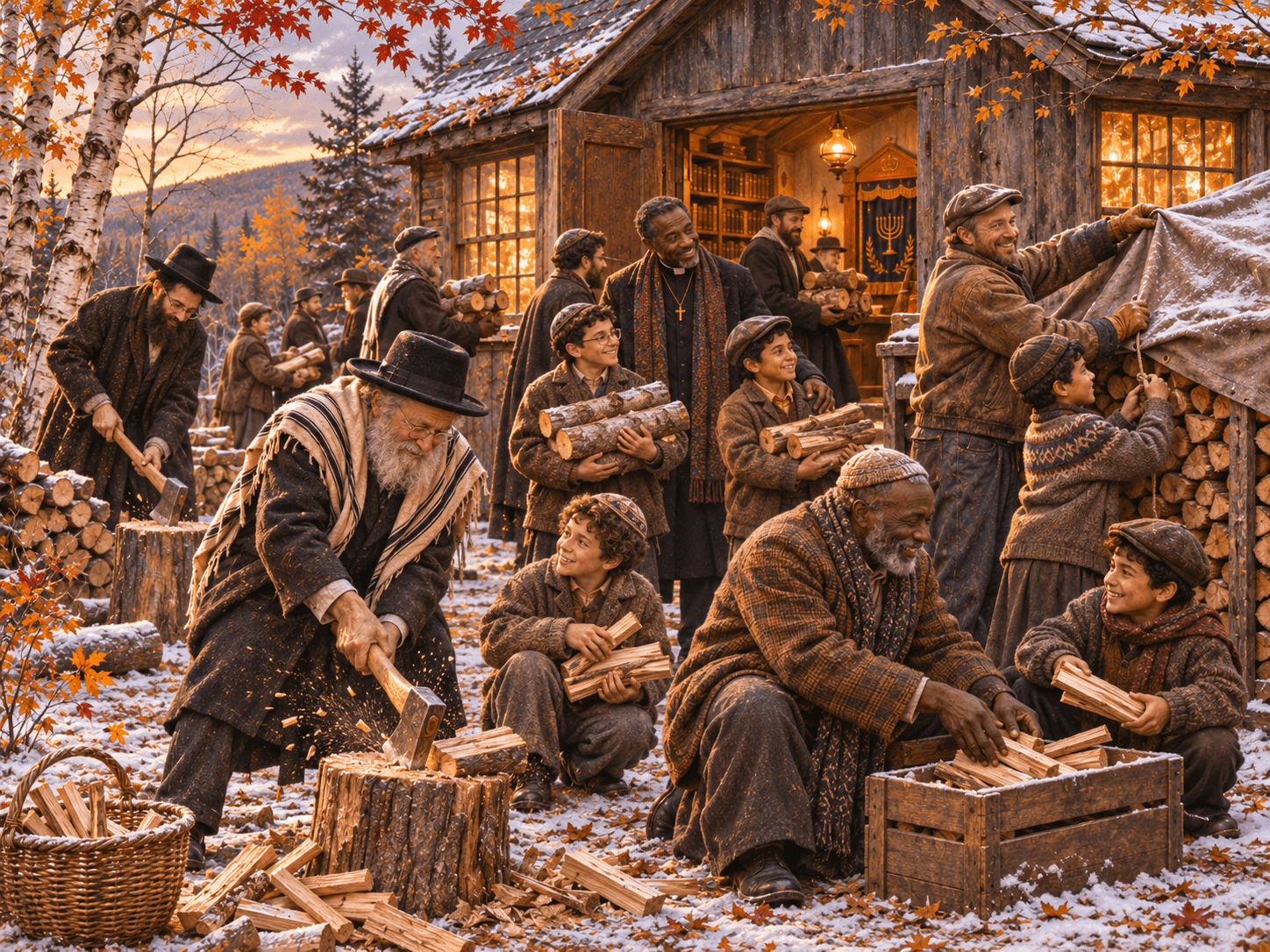
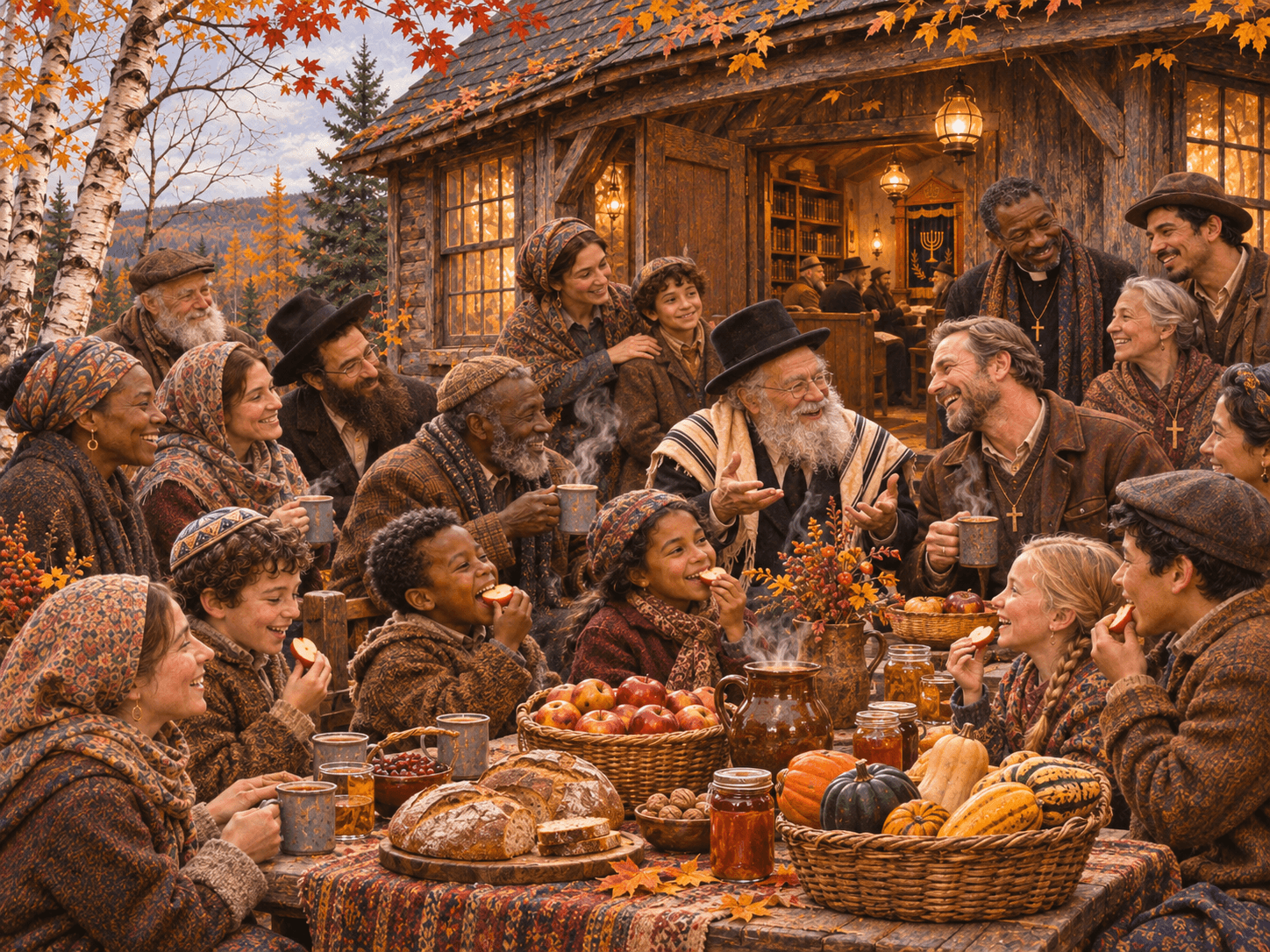
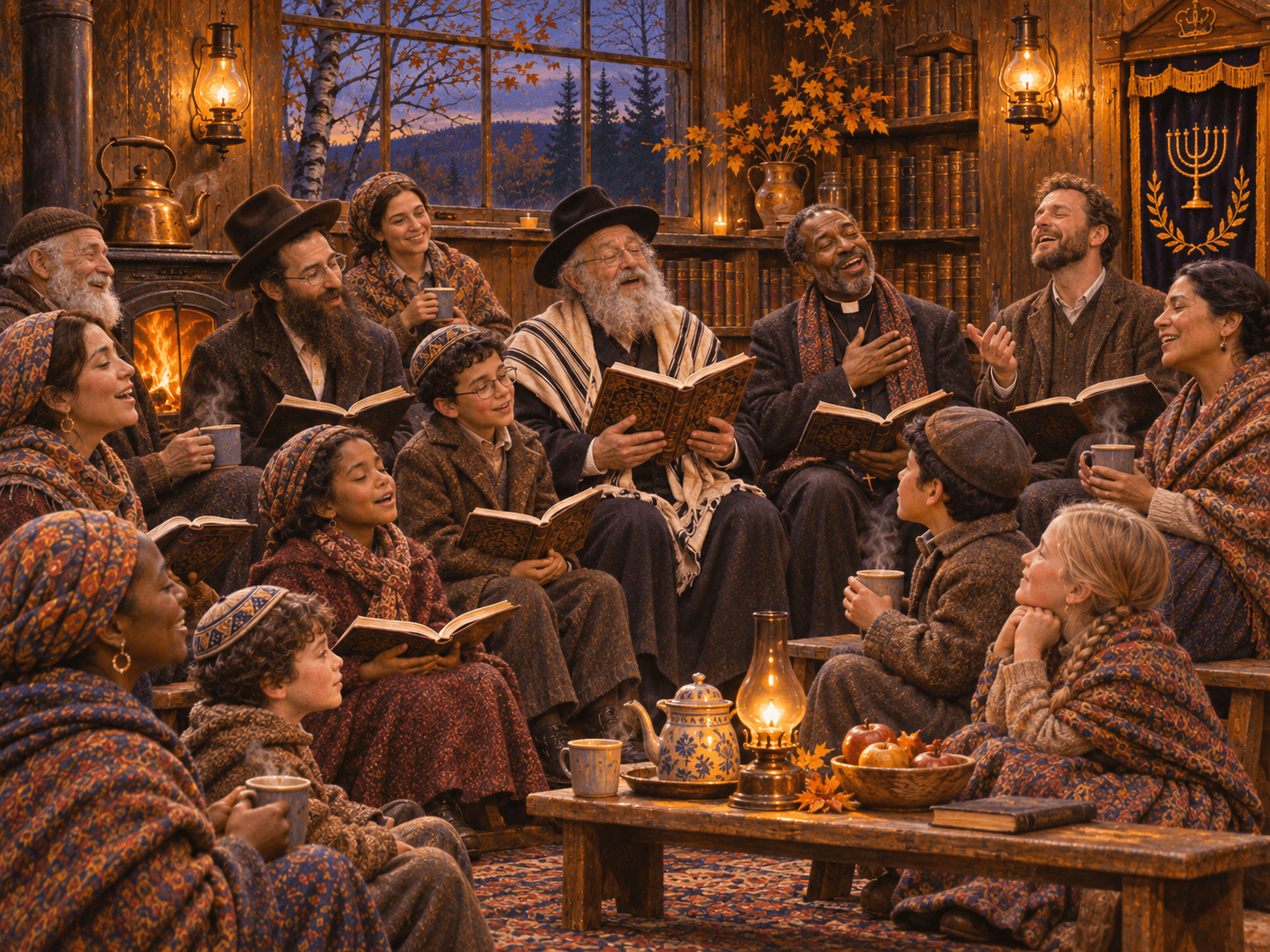
The illustrations accompanying this lecture were created using artificial intelligence to reflect the beauty of human diversity, mutual respect, and community life within the setting of a traditional Jewish shtiebel in Northeastern Michigan.
We recognize that some of these illustrations may not fully conform to Halakhah, including, but not limited to, guidelines concerning the separation of men and women, appropriate religious attire, and other aspects of Jewish religious practice.
These inconsistencies are unintended consequences of the creative interpretation and limitations of artificial intelligence.
The illustrations are intended to convey the broader themes of this teaching: human dignity, compassion, understanding, and peaceful coexistence among people of different backgrounds.
They should not be understood as representations of the actual religious practices, halakhic standards, or communal arrangements of Shaarei Tzafon.
Our commitment to traditional Torah observance and Halakhah remains unchanged.
— Shaarei Tzafon (The North Gate)
Rabbi Ariel Manning of Alpena Michigan
We Are All Human
One of the greatest problems facing society today is the dehumanization of other people.
We have become remarkably comfortable categorizing one another.
Black. White. Hispanic. Asian. Jewish. Christian. Conservative. Liberal. Republican. Democrat.
We see a person's appearance, hear an opinion, notice a political symbol, or discover a religious affiliation, and sometimes we immediately assume we know everything about that individual.
But we do not.
We are human beings.
We belong to one humanity, sharing a common human nature, regardless of our differences in appearance, ancestry, culture, religion, or political convictions.
Our biological similarities are profound, and our ability to have children together across populations reflects that shared humanity. But our human dignity does not depend upon fertility, intelligence, physical ability, or any other individual characteristic.
From the perspective of Torah, there is an even deeper principle.
Every human being is created b'tzelem Elohim, in the image of God.
As it is written:
“And God created Man (The human being) in His image; in the image of God He created him; male and female He created them.” — Genesis 1:27
The Mishnah teaches something extraordinary about the creation of Adam.
In Mishnah Sanhedrin 4:5, also discussed in Talmud Bavli, Sanhedrin 37a, our Sages explain that humanity began with one human being so that no person could say to another:
“My father is greater than your father.”
Think about that for a moment.
No individual can claim that their ancestry makes them inherently superior to another person.
Not because of the family into which they were born.
Not because of the nation from which they descended.
Not because of their appearance, wealth, or social position.
We are all descendants of Adam.
And the Mishnah continues with another remarkable observation. Although humanity shares a common origin, no two human beings are precisely alike.
The Holy One, blessed be He, creates each person with an individual identity.
We share one humanity, yet every human life is individually precious.
That is where our understanding of human dignity must begin.
Not with politics. Not with race. Not with wealth or social position.
With our common humanity.
Two Families Across the Street
Consider a simple example.
Imagine an interracial family living in a neighborhood. Across the street lives another family, and outside their home flies a Confederate flag.
Immediately, assumptions may begin.
The interracial family might see the flag and associate it with slavery, segregation, racism, or painful experiences within their own family history.
Perhaps they have personally experienced discrimination. Perhaps their parents or grandparents endured things that most of us today would find unimaginable.
Perhaps they were even driven away from a community because of who they were.
Those experiences matter.
But what about the person flying the flag?
Do we actually know that individual?
Do we know the family's history? Do we know what suffering, resentment, loss, or inherited attitudes may have shaped that person's understanding of the world?
Perhaps that individual associates the flag with rebellion rather than racial superiority. I have personally known people who displayed Confederate flags and were among the least racially prejudiced individuals one could meet.
Perhaps the explanation is simply, "My daddy flew that flag, and his daddy flew it before him."
Sometimes people inherit symbols and attitudes without ever seriously examining their historical significance.
And sometimes there are other circumstances.
Perhaps a person has experienced a terrible injustice involving someone of another race.
Perhaps someone harmed their wife, mother, sister, or another family member.
Perhaps they experienced violence, betrayal, or some other deeply painful event.
These things happen in human life.
But here is where we must be careful.
The wrongdoing of one individual does not establish the guilt of an entire race or community.
If a Black man commits a crime, that does not make Black people criminals.
If a white man commits a crime, that does not make white people criminals.
The same principle applies to every population.
We must judge people according to their individual actions, not the ancestry they happen to share with someone who committed a wrong.
And we must recognize that sometimes unresolved suffering can push a person toward increasingly extreme beliefs.
That does not justify those beliefs.
But it does mean that understanding the source of someone's anger may help us find a way to reach them.
A Personal Reflection on the Confederate Flag
There is something personal I should add.
My own family history includes ancestors associated with a colored regiment of the Confederate Army.
The precise circumstances of Black participation in Confederate military organizations are historically complicated, and service in an organized fighting regiment should be distinguished from forced labor, support roles, or other forms of association. Nevertheless, these family histories deserve careful examination rather than dismissal.
Would I personally fly the Confederate flag?
No.
It is not a symbol I would choose to display.
Its historical associations with the Confederacy, slavery, and later racial segregation are well established.
But I also recognize something equally important.
This is a free country.
People have the right to express themselves, including through symbols that others may dislike or find offensive, within the protections and limits of the law.
I may disagree with a person's choice.
I may question the meaning of the symbol.
I may explain why I would not display it myself.
But I do not believe that every person who flies that flag should automatically be condemned as a racist.
Some people genuinely understand it as a symbol of rebellion.
Others associate it with family history.
Others may attach meanings to it that are genuinely troubling.
And that is precisely why I believe conversation matters.
If someone wishes to express independence or defiance, I might suggest that the Gadsden flag, with its familiar words "Don't Tread on Me," offers another way to communicate that sentiment.
But ultimately, another person's lawful choice is theirs to make.
I can respect someone's freedom without agreeing with the symbol they choose to display.
And they can respect my freedom to disagree.
That is part of living together in a free society.
When Suffering Becomes Resentment
There is another side to this discussion that deserves careful attention.
Human beings sometimes experience terrible things.
A person may be assaulted.
A family member may be murdered.
A spouse may be unfaithful.
A child may be harmed.
This has happened on all sides.
And when those experiences involve someone from a different racial or cultural background, a person may begin associating the wrongdoing with an entire group.
That is a dangerous development.
But it is also something we should try to understand.
Sometimes the person carrying that resentment has never received justice.
Sometimes the person responsible for the wrongdoing was never held accountable.
And sometimes the victim has carried that pain for years and even generations.
When justice is denied, the resulting wound can spread far beyond the original wrongdoing.
This has happened to Black Americans.
It has happened to White Americans.
It has happened to people of many backgrounds throughout history.
Of course, these experiences have not always occurred on the same scale or under the same historical circumstances. The systematic injustices suffered by entire populations must be recognized alongside the suffering of individuals.
But the moral principle remains.
When someone commits a serious wrong, that person should be held accountable through a fair and impartial system of justice.
Not because of their race.
Not because of their religion.
But because of what they actually did.
The Torah teaches:
"Justice, justice shall you pursue." — Deuteronomy 16:20
Justice matters.
And when justice is neglected, resentment can grow.
Sometimes that resentment becomes hatred.
Sometimes hatred becomes prejudice.
And sometimes prejudice becomes another act of injustice.
Then the cycle continues.
Someone hurts me, so I want to hurt someone else.
But that is not justice.
That is retaliation.
And retaliation against innocent people only creates more suffering.
We need to break that cycle.

Softening the Human Heart
What do we do when we encounter someone who has developed deeply prejudiced attitudes because of painful experiences?
I believe we should begin by recognizing that there is a human being behind those attitudes.
We should talk with them.
We should listen.
We should pray for them.
And, when appropriate, we should pray with them.
We should hope that their hearts can be softened.
Not by pretending that their prejudice is acceptable, but by helping them understand that the person who harmed them does not represent an entire people.
A person who has been wronged deserves justice.
A person who has suffered deserves compassion.
And a person who has developed hatred deserves the opportunity to change.
These are not contradictory principles.
They are part of the same moral responsibility.
In Jewish thought, teshuvah, repentance and return, reminds us that human beings are not necessarily imprisoned by their past behavior.
People can recognize wrongdoing.
They can change their attitudes.
They can repair what is possible to repair.
And they can begin living differently.
But that requires humility.
It requires education.
And sometimes it requires another human being who is willing to sit down and have a conversation.
Judge People by Their Words and Actions
I have a personal rule.
I do not want to call someone racist simply because I disagree with them, dislike a symbol they display, or assume something about their background.
I want to know what they actually believe, what they say, and how they treat other people.
And yes, there is a difference.
I have encountered individuals who have directly expressed a problem with my being Black and Jewish.
That is not an assumption.
That is something expressed directly.
When someone says they have a problem with another person because of race, that is racial prejudice.
When someone expresses hostility toward another person because that person is Jewish, that can be antisemitism.
We should recognize these things for what they are.
But I also believe we need to distinguish between someone who harbors an ignorant attitude, someone who makes a thoughtless remark, someone who expresses outright hatred, and someone who actively seeks to harm others.
These things are not identical, even though all can cause harm.
And the distinction matters because people can learn.
People can change.
People can discover that something their father told them, or their grandfather told them, was simply wrong.
Sometimes a person has inherited an attitude without ever seriously examining it.
That does not excuse prejudice, but it does help explain why education and conversation remain so important.
If we immediately condemn every individual without allowing room for learning, how do we expect people to grow?
The Suffering We Do Not See
There is another part of this discussion that I think society frequently overlooks.
We do not always know what other people have endured.
We know the history of slavery, segregation, discrimination, and the struggles of racial minorities in America. These histories are real and must never be forgotten.
But we should also remember that suffering is not confined to one population.
Consider the millions of European immigrants who came to America searching for a better life.
Some found it.
Others did not.
Some worked in mines, factories, fields, and difficult industrial occupations. Some lived and died in poverty. Some watched their children struggle just as they themselves had struggled.
Imagine a family whose ancestors left Europe believing America would offer them a better future, only to discover that generations later their descendants were still struggling to survive.
That can produce disappointment.
That can produce resentment.
And sometimes, when people believe their struggles have been ignored, resentment begins looking for someone to blame.
This is where society must be particularly careful.
Understanding another person's suffering does not mean accepting prejudice as a legitimate response to that suffering.
A poor white family does not become less deserving of compassion because of its race.
A Black family does not become less deserving of compassion because someone else has also suffered.
The struggles of one community do not cancel out the struggles of another.
Human suffering should not become a competition.
It should become an opportunity for understanding.
Race, Wealth, and the Struggle for Opportunity:
When the Poor Are Pitted Against One Another
There is another issue that I believe deserves much more attention.
Money.
Yes, money.
We talk constantly about racial divisions in America. Black Americans against white Americans. White Americans against immigrants. One community blaming another for lost opportunities, declining wages, unemployment, or economic hardship.
But I think we often overlook something tremendously important.
Sometimes the real conflict is not between Black people and white people.
It is between those who possess economic power and those who do not.
And sometimes the people who suffer the most are encouraged to blame one another rather than examine the decisions being made above them.
I think we need to be very honest about this.
As a Black man, I would say something to my fellow Black Americans.
Not every hardship we experience is caused by people who happen to be white.
Sometimes the problem is a wealthy employer.
Sometimes it is a powerful institution.
Sometimes it is a government policy.
Sometimes it is the pursuit of profit at the expense of ordinary working people.
And I would say something equally important to white Americans.
Not every hardship your family experiences is caused by a Black person, a Hispanic person, an immigrant, or someone who looks different from you.
Sometimes the problem is the very same employer, institution, or economic system that is making life difficult for everyone.
And to understand what I mean, let me give you an example.

Ray and John: Two Men Who Need a Job
Imagine a small American community.
A white man named Ray has lived there his entire life.
His father lived there.
His grandfather lived there.
Perhaps his family has been part of that community for generations.
Ray is not wealthy.
He has a wife, children, a mortgage, and bills to pay.
He applies for a position at a local company.
The owner knows him.
He knows Ray's family.
He knows that Ray has been searching for steady employment.
And perhaps Ray is perfectly qualified for the position.
Now consider another man.
His name is John.
John is Black.
He may have grown up in another community, perhaps somewhere far away.
He has a family to support, bills to pay, and a future he is trying to build.
John is also qualified for the position.
Perhaps he is even better qualified.
But let us imagine that the employer is operating under a hiring initiative intended to increase minority representation.
Perhaps the employer believes that hiring someone from an underrepresented group will help satisfy a contractual requirement, preserve a business relationship, or demonstrate compliance with a diversity goal.
Historically, some employers operated under government affirmative-action requirements, although those requirements were not simply universal racial hiring quotas and the federal rules have changed.
Perhaps the employer genuinely believes that increasing opportunity for historically excluded populations is the right thing to do.
Or perhaps the employer is primarily concerned with protecting the company's financial interests.
Maybe both motivations exist.
Now suppose John receives the position.
Ray does not.
Ray is devastated.
He needed that job.
His family needed that job.
And now he watches another man arrive from outside the community and receive an opportunity he desperately wanted.
What happens next?
Perhaps Ray begins to resent John.
Perhaps he says, "My family has been here for generations, and this fellow comes in and gets the job."
Perhaps he believes the decision was based on race rather than qualifications.
And perhaps that belief spreads throughout his family and community.
But here is the question I want us to consider.
What did John do wrong?
He applied for a job.
He was qualified.
He needed to support his family.
He accepted an opportunity that was offered to him.
And what did Ray do wrong?
He applied for a job.
He was qualified.
He needed to support his family.
He hoped to obtain an opportunity in his own community.
Two men. Two families. Two people trying to make a living.
And now they may resent one another.
But neither man necessarily made the hiring decision.
Neither man created the policy.
Neither man controlled the employer's financial calculations.
So why should they become enemies?
What About the Employer?
Now let us examine the person who actually made the decision.
The business owner.
Perhaps the owner is wealthy.
Perhaps the company depends upon government contracts or other financial arrangements.
Perhaps the owner believes that following a particular hiring initiative will benefit the business financially.
Now, there are circumstances in which such decisions arise from genuine attempts to correct historical discrimination.
We should acknowledge that.
But there can also be circumstances in which the employer is motivated less by justice than by protecting profits, securing contracts, or preserving personal wealth.
The owner might be thinking about maintaining the company's revenue.
Perhaps maintaining a bonus.
Perhaps ensuring the business can continue operating without financial disruption.
And yes, perhaps maintaining the comfortable lifestyle that comes with substantial wealth.
Meanwhile, Ray and John may both be struggling to pay their bills.
One received the position.
The other did not.
And the employer may go home without having to face the resentment developing between those two families.
This is where I think we need to start asking some serious questions.
Was the hiring decision fair?
Were both applicants evaluated according to their actual qualifications?
Was race improperly used to disadvantage one applicant?
Were the stated policies even legally required, or did the employer simply claim they were?
Was the employer genuinely trying to remedy discrimination, or primarily trying to protect a financial interest?
Or was John simply the stronger candidate, and Ray misunderstood why he was not selected?
We cannot determine these things merely by looking at the race of the person who received the job.
We have to examine the facts.
Because if John was better qualified, we should recognize that.
If Ray was unfairly excluded because of race, we should recognize that too.
Justice requires an honest examination of what happened, not an automatic assumption about who must be guilty.
But Why Did These Policies Develop?
Now we need to look at the other side.
Because I do not want anyone reading this to believe that we can simply ignore American history.
For generations, Black Americans were excluded from employment opportunities because they were Black.
Not because they were unqualified.
Not because they lacked intelligence.
Not because they were unwilling to work.
But because employers and institutions deliberately denied them opportunities.
Imagine John living several generations earlier.
He applies for a job.
He is qualified.
Perhaps he is the most qualified applicant.
But he is told that the company will not hire him because of his race.
That happened,
...note this happened great-grandfather when he wanted to become a banker; the bank told him that people wont trust a colored banker...
And we should never pretend otherwise.
It was wrong.
It was unjust.
It deprived individuals and families of opportunities to build wealth, obtain education, purchase homes, and provide for future generations.
And those disadvantages could accumulate over time.
So governments and institutions eventually attempted to address these problems through civil-rights legislation, enforcement, affirmative-action programs, and other measures.
Some efforts were beneficial.
Some were controversial.
Some may have been poorly designed or implemented.
And some created new questions about fairness that deserve honest discussion.
We must be able to recognize both the injustice these policies were intended to correct and the possibility that an attempted remedy can itself be administered unjustly.
That is not a contradiction.
That is the complexity of human society.
And if our goal is true justice, then we must be willing to examine consequences as well as intentions.
When Two Poor Men Become Enemies
Now return to Ray and John.
Suppose they actually sat down together.
Suppose Ray learned that John had grown up in poverty, struggled to obtain an education, and spent years searching for stable employment.
And suppose John learned that Ray had watched his own community decline, had family members lose their jobs, and had spent years trying to support his household.
What might they discover?
Perhaps they would discover that they had far more in common than they realized.
Both want to work.
Both want to raise their children.
Both want to provide food, housing, and security for their families.
Both want their children to have opportunities that they themselves may never have enjoyed.
And perhaps both feel that those possessing wealth and influence rarely understand what ordinary families experience.
Yet instead of having that conversation, they are encouraged to view one another through the lens of race.
Ray blames John.
John may believe Ray dislikes him because he is Black.
And suddenly two working families are divided.
But the real questions about fairness, accountability, and economic opportunity remain unanswered.
That is the tragedy.
An Old Lesson from American Slavery
There is a historical dimension to this discussion that I think is especially important.
During American slavery, enslavers sometimes created or exploited divisions among the people they held in bondage.
We often hear about distinctions between enslaved people who worked in the fields and those assigned to work inside the enslaver's household.
Their experiences could differ significantly.
Some household workers had access to different living conditions, clothing, food, or responsibilities.
That did not make them free.
That did not mean they were not enslaved.
And it certainly did not mean their lives were necessarily easier or safer.
Household workers could be subjected to constant surveillance, violence, and sexual exploitation.
But differences in treatment could nevertheless create tensions, rivalries, or perceptions of status.
Some enslavers exploited those distinctions to maintain control.
Imagine the cruelty of that situation.
One enslaved person is encouraged to believe that he is somehow better than another because the enslaver has granted him certain privileges.
The other person may resent him.
And the two begin arguing over their relative positions.
But who controls both of them?
The enslaver.
Who determines their assignments?
The enslaver.
Who possesses the economic power?
The enslaver.
And who benefits when enslaved people are divided rather than united in resisting their oppression?
The enslaver.
We must not pretend this describes every plantation or every relationship among enslaved people. Their experiences were diverse, and many maintained powerful bonds of family, solidarity, mutual assistance, and resistance.
Nevertheless, the practice of dividing people according to status and privilege offers an important historical lesson.
Those with power can sometimes strengthen their position by encouraging those beneath them to compete against one another.
And I think we should ask ourselves whether something resembling that pattern can still occur in modern economic life.
Not because modern employment is equivalent to slavery.
It is not.
But because the strategy of exploiting divisions among people with less power is not limited to one historical period.
"At Least You're not Black"
There is another historical reality that deserves attention.
Consider the poor white laborer in American history.
He may have owned very little.
He may have worked in terrible conditions.
He may have been unable to provide the opportunities he wanted for his family.
But in a society built upon racial hierarchy, he could still be told that he possessed a superior social position because he was white.
In effect:
"Your life may be difficult, but at least you are not Black."
Think about what that communicates.
It tells someone who is economically disadvantaged that their racial identity gives them a status above another struggling human being.
It offers the appearance of superiority without necessarily improving their material circumstances.
The Black worker remains disadvantaged by racism.
The poor white worker may continue suffering economically.
And the wealthy or powerful individual may continue enjoying advantages unavailable to either of them.
Many explored this very problem in his examination of American history, describing how social recognition attached to whiteness could influence the relationship between poor white workers and Black workers.
Race mattered enormously, even when economic interests overlapped.
And that is precisely the point.
Racial hierarchy and economic exploitation can reinforce one another.
We should never reduce all racism to money.
Racial hatred has its own history, beliefs, institutions, and destructive power.
But neither should we overlook the financial interests that have sometimes sustained racial divisions.
The person who benefits from injustice may not always be the person who expresses the loudest prejudice.
Most of the time the person shouting hateful things is himself struggling economically.
And sometimes the person exercising substantial economic power remains largely unnoticed.
That deserves serious reflection.

When People Were Bought and Sold
There is another question I want us to consider.
It concerns the very foundations of American slavery.
People were captured, transported, sold, purchased, and treated as property.
African slavery involved complex networks of violence, warfare, captivity, and commerce. African rulers, merchants, and intermediaries participated in the sale of captives, while European and American traders, enslavers, and colonial institutions financed and expanded the Atlantic system.
Recognizing the involvement of different participants does not make their power, responsibility, or historical roles identical.
But it raises a profound moral question.
When one group of human beings sells another group of human beings, and someone else purchases them, what has happened to the recognition of our common humanity?
How does a person come to look upon another human being as merchandise?
How does someone measure the value of a mother, father, son, or daughter according to the price they can command?
How does a person look at another human being and see property rather than a life?
And what happens to a society when economic gain becomes more important than human dignity?
We should be deeply troubled by these questions.
Because slavery was not simply an expression of individual prejudice.
It was also an economic institution.
Human beings were exploited for labor and profit.
Their suffering became part of a commercial system.
And immense wealth was accumulated through the denial of their freedom.
This does not mean every person within a particular racial population was equally responsible.
Nor does it diminish the role of racial ideology in sustaining slavery.
It means that economic greed and racial dehumanization became deeply intertwined.
And that should concern every person who believes human life possesses inherent dignity.
What Does the Torah Teach Us?
The Torah offers a very different understanding of human worth.
We are reminded that humanity begins with Adam.
As the Mishnah teaches in Sanhedrin 4:5, no person can boast that their father is greater than another person's father.
We share a common origin.
And that means we cannot reduce the value of another human being to ancestry, skin color, social status, or economic usefulness.
The Torah also commands:
"You shall not oppress a hired worker who is poor and needy."
— Deuteronomy 24:14
And:
"You shall not commit injustice in judgment. You shall not favor the poor or show deference to the great; in righteousness shall you judge your fellow."
— Leviticus 19:15
Consider that second passage.
We are commanded not to favor the powerful because they possess influence.
But neither are we permitted to distort justice simply because someone is poor.
Justice must remain justice.
If a Black applicant has been excluded because of race, that is wrong.
If a white applicant has been excluded because of race, that too demands scrutiny under the same principles of justice.
If an employer is exploiting workers, that employer should be held accountable.
And if public policies are producing unintended injustices, we should have the courage to examine and reform them.
Not because we wish to abandon equality.
But because we wish to achieve it.
Real Progress Requires More Than Changing Who Gets the Job
This is where I believe society needs something much more substantial than slogans.
We need meaningful changes in how we understand justice, opportunity, wealth, and our responsibilities toward one another.
We need economic systems in which ordinary people can work and support their families.
We need educational opportunities that are genuinely accessible.
We need employers who evaluate people honestly and fairly.
We need to confront discrimination wherever it occurs.
We need public policies that address actual disadvantages without unnecessarily creating new forms of resentment.
And we need to examine whether powerful individuals and institutions are benefiting while ordinary people carry the burdens of their decisions.
That may require substantial reform.
Perhaps even radical reform in certain areas of society.
But reform cannot succeed merely by moving resentment from one population to another.
We cannot repair yesterday's injustice by teaching people to despise their neighbors today.
And we cannot create lasting equality by ignoring the experiences of those who believe they have been treated unfairly.
We have to listen.
We have to investigate.
We have to distinguish genuine discrimination from assumption.
We have to recognize that sometimes an unpopular policy has a legitimate historical purpose, while also acknowledging that a legitimate purpose does not automatically make every implementation just.
Most importantly, we need to restore the idea that another person's opportunity is not automatically an injury to me, and my own suffering does not make another person my enemy.

Ray and John Are Not Enemies
Let us return one final time to Ray and John.
Ray is white.
John is Black.
Ray needs employment.
John needs employment.
Ray loves his family.
John loves his family.
Ray wants his children to have a better future.
John wants exactly the same thing.
And perhaps if those two men sat down and talked, they would discover that neither was responsible for the injustices the other had experienced.
Perhaps Ray would begin to understand why earlier generations of Black Americans demanded changes in employment practices.
Perhaps John would begin to understand why Ray felt overlooked in a community where his family had struggled for generations.
Perhaps both would begin asking questions about the employer, the economic circumstances of their community, and whether opportunities were being distributed fairly.
And perhaps they would discover that they had no reason to hate one another.
They might still disagree about policy.
They might still disagree about politics.
They might still have different interpretations of American history.
That is fine.
They are human beings.
They are allowed to disagree.
But imagine what could happen if, instead of exchanging accusations, one simply said to the other:
"Tell me what happened to you. I want to understand."
What if we began there?
What if people were willing to listen before condemning?
What if we recognized that the person across from us might have experienced an injustice that we ourselves had never considered?
And what if we began holding those responsible for actual wrongdoing accountable, rather than assigning guilt to entire populations?
That would be progress.
Not the kind of progress measured merely by statistics, employment reports, or political victories.
But moral progress.
Human progress.
The kind of progress that allows families to live alongside one another without inherited resentment determining their relationships.
The Real Question
I believe we need to stop asking which race deserves to win and begin asking whether people are being treated justly.
We need to stop assuming that every hardship is caused by someone who looks different from us.
We need to examine the economic decisions, political policies, historical injustices, and individual circumstances that actually shape people's lives.
And we need to remember that race and class are not always separate issues.
Sometimes they overlap.
Sometimes discrimination contributes to poverty.
Sometimes poverty exists without racial discrimination.
Sometimes a wealthy person exploits another person of the same race.
And sometimes economic interests encourage divisions between people who otherwise have much in common.
But through all these circumstances, one principle must remain unchanged.
A human being is not worth more because he is wealthy, and he is not worth less because he is poor.
He is not worth more because he is White.
He is not worth less because he is Black.
Nor the other way around.
We are human beings.
We are descendants of Adam.
And we have a moral responsibility to treat one another accordingly.
Perhaps the most dangerous thing that can happen to a society is when ordinary people become so occupied with blaming one another that they stop asking who is actually responsible for the injustices they experience.
And perhaps one of the greatest things we can accomplish is to sit down together, look one another in the eye, and say:
"You are not my enemy. You are my fellow human being. Now, let's talk about what is wrong and how we can make it right."
That, I believe, is where genuine progress begins.
And that is where human decency must lead us.

A Personal Word About My Political Philosophy
I think it is appropriate here to explain something about my own political convictions.
I consider myself a religious conservatarian, someone whose political philosophy brings together elements of traditional conservatism and libertarianism, grounded in my commitment to Torah, Halakhah, and the moral responsibilities of religious life.
I believe in individual liberty, limited government, personal responsibility, traditional values, and the importance of family and community.
However, my religious convictions come before my political philosophy. While conservatarianism helps express my understanding of government and individual freedom, the Torah establishes the moral obligations that guide how I believe human beings should treat one another.
Freedom must always be accompanied by responsibility, justice, compassion, and human decency.
I believe people should generally be free to live their lives according to their own convictions, provided they respect the rights and freedoms of others.
But freedom comes with moral responsibility.
Freedom does not give us permission to exploit others, mistreat our neighbors, or abandon human decency.
My concern for economic justice does not mean that I oppose private enterprise, personal wealth, or the right of individuals to prosper.
There is nothing inherently wrong with becoming wealthy.
But possessing wealth does not place someone above the moral obligations that apply to everyone else.
Likewise, I believe government has legitimate responsibilities, especially in protecting individual rights, administering justice, and ensuring that the law is applied fairly.
However, government power must also be limited, accountable, and exercised responsibly.
And while I value traditional institutions and customs, I do not believe that every inherited attitude is necessarily correct.
Tradition deserves respect, but prejudice does not become righteous simply because it has been passed down through generations.
As an Orthodox Jew, my understanding of morality is ultimately grounded in the Torah, Nevi'im and Ketuvim (which are the Hebrew Bible-Christians call this the Old Testament), and Halakhah (Jewish Law), not in a political party or ideology.
My political philosophy helps explain how I understand government and individual liberty. Torah teaches me the moral responsibilities that accompany that liberty.
I do not expect everyone to agree with my political convictions.
Nor should they have to.
I believe we should be capable of discussing political differences without turning those differences into personal hostility.
And that brings me to the presidencies of Barack Obama and Donald Trump, and the divisions that have shaped American society in recent decades.

Politics and the Feeling of Being Forgotten
This brings me to something else I have thought about over the years: American politics.
Consider the presidencies of Barack Obama and Donald Trump.
Two very different men.
Two very different political approaches.
And two presidencies that have become deeply connected to the way Americans understand race, economic opportunity, political identity, and the future of their country.
I believe there is something important we can learn from examining how Americans responded to both men.
Barack Obama and the Expectations of a Nation
Barack Obama was a biracial president, born to a white American mother and a Black Kenyan father.
His family background connected him to different experiences within American society and beyond it.
When Obama became president in 2009, his election represented an extraordinary moment in American history.
For many Black Americans, it represented possibilities that previous generations could scarcely have imagined.
For many other Americans, regardless of race, it represented hope, change, and the possibility of a different political future.
And those feelings deserve recognition.
But I have wondered about something else.
Did some Americans, particularly white working-class Americans struggling economically, begin to feel that they had been forgotten?
I am not saying Obama intended to forget them.
I am not even saying that their perception was necessarily accurate.
But perceptions matter.
Imagine a family whose ancestors immigrated from Europe generations ago, hoping to find economic opportunity like both Obama and Trump.
Perhaps those opportunities never fully materialized.
Perhaps the family experienced generations of poverty, unemployment, factory closures, or declining economic security.
Now imagine that family watching national conversations increasingly focus on the historical and contemporary struggles of racial minorities.
Those struggles were real.
They deserved attention.
But what if this family began to wonder:
"What about us?"
"Does anyone care about our situation?"
"Does anyone understand what our family has experienced?"
Perhaps some people felt that a president whose ancestry connected him to both Black and white communities would understand their experiences particularly well.
And perhaps some were disappointed when they believed their economic circumstances had not substantially improved.
Whether that disappointment was justified requires examining actual policies and economic conditions.
But the feeling of being overlooked can be powerful.
A person who believes that society has forgotten their family can become resentful, even when that resentment is directed toward the wrong people.
And we should be willing to talk about that.
At the same time, we must acknowledge that some opposition to Obama involved racial prejudice, just as other opposition arose from disagreements about government spending, healthcare, economic policy, constitutional principles, and the proper role of government.
We cannot responsibly place every critic into one category.
Nor should we pretend that racial attitudes played no role at all.
Human beings and their political motivations are often more complicated
than that.
Donald Trump and the Expression of Resentment
Then came Donald Trump.
And I think his rise provides another opportunity to reflect on what happens when people believe they have been ignored.
Trump's political message appealed to many Americans who believed that political institutions had become disconnected from their everyday lives.
Some were concerned about manufacturing jobs.
Some were concerned about immigration.
Some were concerned about wages, trade, and economic security.
Others were dissatisfied with political institutions or believed that their communities and values were no longer respected.
These concerns were not all identical, and neither were the people expressing them.
But there was a recurring theme.
People wanted to be heard.
Now, I do not believe that supporting Donald Trump automatically makes someone racist.
That would be an unfair assumption.
Just as I would not assume that everyone who supported Barack Obama agreed with every policy of his administration, I would not assume that everyone who supports Donald Trump agrees with everything he has said or done.
People support political leaders for many different reasons.
Some are economic.
Some are cultural.
Some are religious.
Some involve foreign policy, taxation, national security, or the judiciary.
And some political attitudes are influenced by prejudice.
We must be willing to recognize these distinctions.
But I think something else happened during this period of American history.
Certain people who had harbored resentment, hostility, or prejudiced attitudes for many years began expressing those feelings more openly.
Perhaps they had inherited certain beliefs from their parents or grandparents.
Perhaps they had experienced genuine hardships.
Perhaps they believed society had treated them unfairly.
Perhaps they felt that they had been prevented from expressing their frustrations.
And when the political environment changed, they felt more comfortable saying what they had previously kept to themselves.
But there is a difference between expressing a legitimate grievance and directing hostility toward innocent people.
Having the freedom to speak does not mean that every way of speaking is wise, just, or decent.
And this is not a problem confined to one political movement.
People across the political spectrum can become so convinced of their own righteousness that they stop listening to anyone who disagrees.
They begin viewing political opponents not simply as people with different opinions, but as enemies.
That is dangerous.
Presidents Do Not Create Every Division
There is something I want to emphasize.
I do not believe that Barack Obama created every racial resentment that surfaced during his presidency.
Nor do I believe Donald Trump created every resentment that has been expressed during his presidencies.
American divisions existed long before either man entered the White House.
They existed in our families.
They existed in our communities.
They existed in our economic institutions.
They existed in our political traditions.
And some were inherited from generations long gone.
A president can influence how people discuss these divisions.
A president can attempt to reconcile them.
A president can also, intentionally or unintentionally, contribute to their intensification.
Political leaders bear responsibility for their own words, policies, and conduct.
But ordinary citizens also bear responsibility for how they treat one another.
We cannot place the entire moral condition of American society upon the shoulders of one individual.
A president may influence the national conversation, but each of us remains responsible for our own character.
And that brings us back to human decency.
When Political Disagreement Becomes Personal Hatred
I have watched people become increasingly hostile toward others simply because of whom they voted for.
Families argue.
Friendships end.
Neighbors stop speaking.
People begin assuming that another person's entire moral character can be determined by a political preference.
And sometimes the accusations become extraordinary.
One person is immediately called a racist.
Another is called a communist.
Another is accused of hating America.
Another is dismissed as ignorant or morally inferior.
But do we actually know these people?
Do we know why they voted the way they did?
Do we know their family's history?
Do we know their economic circumstances?
Do we know the suffering they have experienced?
Perhaps a person voted for a particular candidate because they were concerned about feeding their children.
Perhaps another person voted differently because they were concerned about discrimination or the treatment of vulnerable populations.
Perhaps both believed they were acting in the best interests of their families and their country.
They may disagree profoundly about what policies would accomplish those goals.
But disagreement does not automatically make either person less human.
We must learn to challenge ideas without dehumanizing the people who hold them.
That does not mean refusing to identify genuinely hateful statements or harmful policies.
It means examining what people actually believe, say, and do rather than assigning collective guilt.
The Economic Question We Keep Overlooking
And here is where our earlier discussion about Ray and John becomes especially important.
I sometimes wonder how many Americans have become so focused upon political and racial divisions that they have stopped examining the economic decisions affecting their lives.
Ray is White.
John is Black.
Both are struggling to support their families.
Both want economic stability.
Both want opportunities for their children.
Yet one might be encouraged to blame the other for circumstances neither created.
And the wealthy employer, powerful institution, or political authority responsible for those circumstances may receive far less attention.
Now, economic inequality does not explain every political disagreement.
Nor does it eliminate the reality of racial discrimination.
But we should be willing to ask whether our political arguments sometimes distract us from the problems we actually share.
Are wages sufficient?
Can working families afford housing?
Can parents afford to educate their children?
Can people obtain healthcare?
Can small communities retain economic opportunities?
Are powerful institutions being held accountable?
These are concerns that cross racial and political boundaries.
And I believe we would accomplish far more by discussing them seriously than by constantly looking for another population to blame.
Our Responsibility as Human Beings
The Torah teaches:
"Justice, justice shall you pursue."
— Deuteronomy 16:20
It does not instruct us to pursue justice only when the person who has been wronged agrees with our politics.
It does not tell us that economic exploitation becomes acceptable when the employer belongs to our preferred political party.
And it does not permit us to deny another person's humanity because we disagree about government policy.
Justice remains justice.
The Mishnah teaches that humanity began with Adam so that no person could boast that their father was greater than another person's father.
What a lesson for our political age!
A Republican cannot claim greater inherent human worth than a Democrat.
A Democrat cannot claim greater inherent human worth than a Republican.
A white American cannot claim superiority over a Black American.
Nor can a Black American claim superiority over a White American.
Our political positions, our ancestry, and our economic circumstances do not determine the value of our humanity.
We are all descendants of Adam.
And we must learn to treat one another accordingly.
Let Us Return to Conversation
Perhaps one of the greatest tragedies of our present political climate is that we have forgotten how to talk to one another.
We have become accustomed to shouting.
Accusing.
Condemning.
Mocking.
And sometimes simply refusing to listen.
But how can we expect people to learn if we never allow them to ask questions?
How can we expect people to abandon prejudice if every conversation begins with condemnation?
And how can we expect reconciliation if we insist that those who disagree with us must first surrender their dignity?
I believe we need to recover something very simple.
The willingness to say:
"Let's have a conversation."
Tell me why you believe what you believe.
Tell me what happened to your family.
Tell me why you feel forgotten.
Tell me what you fear for your children's future.
And allow me to share my experiences as well.
Perhaps we will discover that we have more in common than we imagined.
Perhaps we will still disagree.
That is perfectly fine.
We do not need to agree about every political issue to live alongside one another with decency.
We do not need to support the same president to recognize one another's humanity.
And we certainly do not need to share the same ancestry, religion, or economic circumstances to treat one another with respect.
Freedom to speak should be accompanied by the wisdom to speak responsibly.
Having something to say does not mean that we must say it cruelly.
Having suffered an injustice does not entitle us to inflict injustice upon others.
And disagreeing with someone does not mean we must strip that person of dignity.
Barack Obama and Donald Trump are both important figures in modern American history.
People will continue debating their presidencies, their policies, their successes, their failures, and their influence upon our country.
Those debates are part of living in a free society.
But long after any particular president has left office, we will still have to live with one another.
Our children will still have to build their futures together.
Our neighbors will still be our neighbors.
And our moral obligations toward one another will remain.
Presidents come and go. Political movements rise and fall. But our responsibility to recognize the humanity of another person does not disappear.
That is something worth remembering.
And perhaps it is something we need to remember now more than ever.

The Best of Times and the Worst of Times
I want to emphasize something that I think is very important.
I believe things are better today than they were in the past.
I genuinely do.
When I consider the lives of my ancestors, the experiences of previous generations, and the opportunities available to my children, I cannot deny the tremendous progress that has been made.
That does not mean discrimination has disappeared.
It has not.
People still make sly remarks. People still harbor prejudices. People still judge others because of their appearance, their religion, or their family background.
I have experienced some of those things myself.
But I refuse to allow those experiences to convince me that humanity has made no progress.
We have.
And that progress should encourage us to continue moving forward.
We should not overly romanticize the past, but neither should we become so consumed by the problems of the present that we forget how much has changed.
Gratitude for progress and recognition of remaining injustice are not contradictory.
We can acknowledge both.
And perhaps that is part of the wisdom we need today.

We Must Continue Learning
One thing I have come to understand is that learning never ends.
I have things to learn.
My children have things to learn.
Every person I encounter has something to learn, just as every person may have something to teach me.
I expect to continue learning until the day I die.
And I hope my children will approach life with that same understanding.
No one possesses all knowledge.
No political movement, racial community, religious community, or generation has a monopoly on wisdom.
This is especially important when we encounter claims about human differences.
We should reject racial pseudoscience and attempts to rank human beings according to supposed biological or intellectual superiority or inferiority.
Our differences are real, but they do not establish a hierarchy of human worth.
And when we encounter an unfamiliar person, we should remember that there is an entire life behind that individual.
A childhood.
A family.
Experiences of joy and disappointment.
Perhaps grief.
Perhaps poverty.
Perhaps tremendous success.
Perhaps suffering we cannot even imagine.
We do not know until we take the time to listen.
The Mishnah teaches:
"Who is wise? One who learns from every person." — Pirkei Avot 4:1
What a remarkable principle.
Not merely learning from people who agree with us.
Not merely learning from people who look just like us.
But recognizing that wisdom may come from unexpected places.

Human Decency Is Not Weakness
There is something else that needs to be said.
Human decency does not mean that every opinion is correct.
It does not mean that we must tolerate cruelty, excuse hatred, or remain silent in the face of injustice.
There are good actions and bad actions.
There are moral responsibilities.
There are boundaries that should not be crossed.
But we can oppose an action without denying the humanity of the person responsible for it.
We can challenge an opinion without humiliating the person expressing it.
We can confront prejudice while still believing that the prejudiced individual is capable of change.
That is not weakness.
It requires tremendous strength.
It is easy to insult someone.
It is easy to dismiss an entire group of people.
It is much more difficult to sit across from someone whose views offend us and attempt to understand how that person came to believe what they believe.
Understanding does not require agreement.
And compassion does not require abandoning our principles.
The Torah commands:
"You shall love your neighbor as yourself."
— Leviticus 19:18
And elsewhere:
"You shall love the stranger."
— Deuteronomy 10:19
These teachings remind us that our obligations toward others cannot be reduced to personal preference.
Human decency is not simply a pleasant social custom.
It is a moral responsibility and for us who follows The Torah or The Bible it is a command from Gd.

Let Us Have a Conversation
I think one of the greatest things we could recover in American society is the simple willingness to say:
"Let's have a conversation."
Not a shouting match.
Not an exchange of insults.
Not an attempt to prove that one group is inherently better than another.
A conversation.
Let us talk about history.
Let us talk about suffering.
Let us talk about poverty, opportunity, race, religion, and the things that divide us.
Let us examine what is true, what is mistaken, and what we may have inherited without questioning.
Let us recognize that someone can be wrong without being beyond redemption.
And let us remember that we ourselves may have something wrong as well.
We need more humility.
We need more patience.
We need more compassion.
We need more willingness to listen.
And above all, we need to remember that the person across from us is a human being.
The Beauty of Life
I return to where I began.
My children.
I look at them growing up, preparing for college, discovering the world, and beginning to build lives of their own.
And I think about the extraordinary gift of life.
I think about the generations that came before them and the generations that, God willing, will come after them.
What kind of world are we preparing for those generations?
Will we teach them to fear everyone who is different?
Will we teach them that every disagreement is an act of hatred?
Will we teach them to judge people before knowing them?
Or will we teach them something better?
Will we teach them that human dignity matters?
That kindness matters?
That learning matters?
That even when we disagree, we can still treat one another with respect?
I want my children to know that the world contains both goodness and evil, that injustice is real, and that they have a responsibility to stand for what is right.
But I also want them to know that the world is filled with people whose stories they have not yet heard.
People who may surprise them.
People who may teach them something.
People who may become their friends.
People whose lives are every bit as precious as their own, because all lives matter...
We have come a long way as a society.
We still have a long way to go.
But I believe we can continue moving forward.
Not by denying history.
Not by pretending that prejudice does not exist.
And certainly not by dehumanizing those with whom we disagree.
We move forward through education, moral responsibility, humility, compassion, and the willingness to recognize one another's humanity.
The best of times and the worst of times.
Perhaps both can exist together.
But what we do with the time we have been given is ultimately our responsibility.
We must continue to grow in love, in peace, in understanding, and in human decency.
Because life is beautiful.
And every human life deserves dignity.
Baruch HaShem.(Praise Gd)
One final question:
If we really believe every human being descends from Adam, how can we justify treating another person as inherently inferior because of their ancestry????????

Shaarei Tzafon — The North Gate
Orthodox Jewish Life and Torah Study in Northeastern Michigan
Shaarei Tzafon — The North Gate, led by Rabbi Ariel Manning, is an independent, family-led Orthodox Jewish educational and publishing initiative based in Northeastern Michigan. We support traditional Jewish life, Torah study, Halakhah, and Jewish education throughout Alpena, Hillman, Rogers City, and surrounding communities. Those interested in traditional Judaism are welcome to contact us for educational resources, Torah learning, and opportunities for discussion by prior arrangement.
Rooted locally, our greater mission extends northward from the 45th parallel — The North Gate — through Michigan, Canada, and Alaska toward the Arctic. We seek to encourage independent Jewish communities, family-centered Torah education, and the renewal of small batei midrash and shtieblach, preserving the rich traditions of Orthodox Judaism for future generations.
Our work begins in Northeastern Michigan, but our vision extends from the 45th parallel toward the Arctic.
Guided by Rambam and Mori Qafiḥ, uplifted by Rebbe Nachman, and grounded by Avraham ben HaRambam’s balance of halakha and inward avodah.
The Orchard’s Path
publishes our books and curricula.
Our mission: a bright, authentic Jewish presence in every northern town.
Created with ©systeme.io


