
Walking With Hashem
B"H
Part 1 – The Question We Are Afraid to Ask
Judaism is often described—by insiders and outsiders alike—as a religion of law. That description is not false, but it is incomplete. The deeper question is not whether Judaism is legal, but what the law is meant to produce. If halacha results only in correct behavior, then something essential is missing. The Torah never aimed merely at compliance; it aimed at relationship.
Many Jews today know what to do but struggle to articulate who they are with while doing it. This is not a failure of commitment. It is a failure of articulation and cultivation. Over generations of exile, persecution, and survival, Judaism learned to guard its structure fiercely. In doing so, it sometimes left the inner language of presence assumed rather than taught.
This lecture begins with a recovery: not of innovation, but of intention. The Torah’s goal was never obedience alone. It was that Israel would walk with Hashem—in clarity, in discipline, and in love.

Part 2 – Torah and Mitzvot as Covenant, Not Sentiment
Torah and mitzvot are the relationship itself. They are not expressions of love; they precede love. They establish a binding reality—a brit. Like marriage, covenant is not validated by feeling. One does not “feel married.” One is married.
This is why the Torah speaks in the language of command. Command does not negate love; it protects it from volatility. A relationship built on inspiration alone collapses under pressure. A covenant endures.
Understanding Torah this way corrects two errors:
That mitzvot are merely symbolic
That Judaism is opposed to intimacy
On the contrary, covenant is the precondition for intimacy. Without commitment, closeness is unstable. Without obligation, love becomes self-referential.

Part 3 – Halacha: The Language of Love Made Reliable
If Torah and mitzvot establish the bond, halacha is how that bond is lived in time.
Halacha is not control; it is care with precision. It teaches when to stop, when to speak, when to refrain, when to act. These are not arbitrary restrictions; they are the grammar of fidelity.
Yet halacha alone can become mechanical if detached from awareness. One can keep every rule and never once turn toward the One who commanded them. This is not halacha’s fault. It is the result of halacha being treated as an end rather than a language.
Halacha answers the question: What is required of me?
Relationship asks: Who am I with while fulfilling it?

Part 4 – Rational Mysticism: Holding Light Without Breaking Unity
Judaism affirms a hidden reality of light. This is not optional or marginal. But Judaism insists that this light never contradict reason, halacha, or divine unity.
This is the path of rational mysticism, articulated by figures such as Saadia Gaon, Maimonides, Avraham ben HaRambam, Abraham Abulafia, and Yiḥya Qafiḥ.
For them, mysticism is not magic. It is disciplined awareness. Letters, numbers, and inner states are languages of encounter, not independent forces. Rationality is the vessel; mysticism is the light. Without vessels, light destroys. Without light, vessels are empty.

Part 5 – The Legitimate Place of Folk Mysticism
Alongside disciplined mysticism stands folk mysticism—the intuitive, symbolic, lived spirituality of ordinary Jews.
Folk mysticism appears in:
Seasonal awareness
Simple prayer
Customs and gestures
Stories and metaphors
This is the mysticism of our Hasidic Master.
This is not superstition by default. It is raw, unrefined, and beautiful theology expressed through experience. Its danger lies only when symbols harden into doctrine or replace mitzvot.
Rational mysticism does not erase folk mysticism. It interprets and guards it, ensuring that simplicity remains faithful and that intuition does not fracture unity.

Part 6 – Avraham ben HaRambam and the Degrees of Shabbat
Avraham ben HaRambam offers a clear example of the lecture’s central idea through his teaching on Shabbat. He explains that Shabbat contains degrees of observance:
Legal observance – refraining from melacha
Experiential observance – oneg and menuchah
Devotional observance – conscious awareness of Hashem
A person may observe Shabbat correctly and still miss its inner aim—not because halacha failed, but because presence was never cultivated. Shabbat is meant to be time walked with God, not only time abstained from labor.
This establishes a principle: Judaism expects growth in awareness, not perfection of feeling.

Part 7 – Walking With Hashem: The Reclaimed Biblical Core
Here we confront an uncomfortable truth: Other Abrahamic religions preserved the posture of “walking with God,” even while distorting theology.
Walking with HaShem is biblical, not foreign.
Judaism never rejected it—but often many from other religions assumed it.
To walk with Hashem means:
Relational awareness
Ongoing inner address
Faithfulness without drama
Presence without illusion
This is not prophecy. It is companionship.
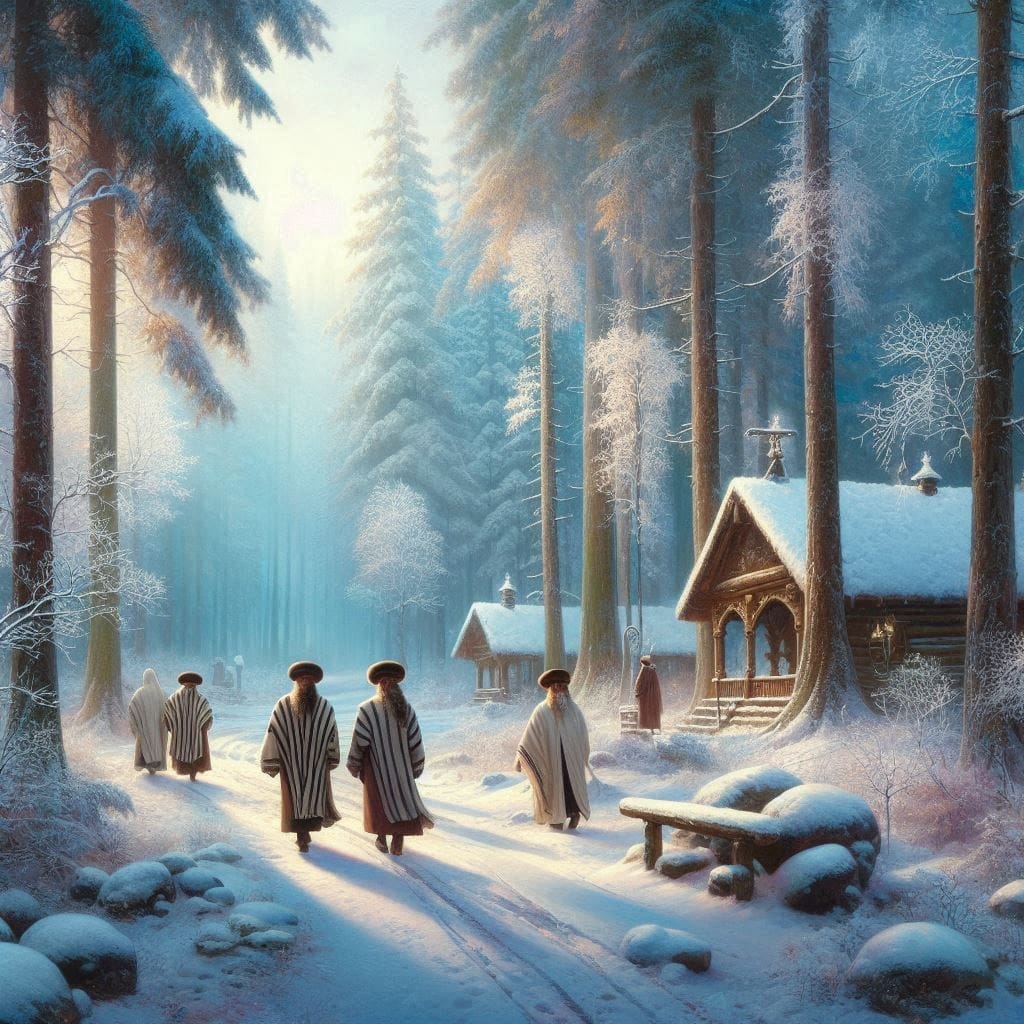
Part 8 – Thoughtful Living as Daily Avodah
Walking with Hashem manifests as thoughtful living:
Pausing before mitzvot
Doing them slowly
Speaking less, noticing more
Addressing Hashem plainly during the day
This is not emotionalism. It is attentive faithfulness.

Part 9 – Loving Hashem Through the Seasons
Creation itself teaches theology.
Spring: renewal and hope
Summer: fullness and gratitude
Fall: humility and gathering inward
Winter: loyalty in concealment
To love Hashem in all seasons is to love Him beyond reward.
This is mysticism trenched in reality, not abstraction.

Part 10 – The Final Synthesis
Judaism at its fullest is not law versus love, nor reason versus mysticism.
It is:
Covenant that does not break
Law that does not harden
Mysticism that does not distort
Simplicity that does not trivialize
Law becomes love made reliable.
Love becomes law made alive.
And life becomes a quiet walk with Hashem—
in clarity, fidelity, and every season.
This is not innovation.
It is remembrance.

Walking With HaShem, Torah, and the Northern Jewish Tradition
At Shaarei Tzafon — The North Gate, we believe that traditional Orthodox Jewish life must remain firmly grounded in Torah and Halakhah while cultivating a living relationship with HaShem through prayer, contemplation, love, and the daily observance of mitzvot.
Here in Northeastern Michigan, including Alpena, Hillman, Rogers City, and surrounding communities, our educational work encourages Jewish individuals and families to understand that Judaism is not merely a system of religious obligations, but a covenant that shapes how we think, act, pray, and experience the presence of HaShem throughout our lives.
The idea of walking with HaShem provides an important example.
Throughout Jewish history, rationalist scholars, Hasidic teachers, and contemplative traditions have emphasized different aspects of the relationship between religious observance and inward devotion.
The philosophical writings of Saadia Gaon and Rambam, the devotional teachings of Avraham ben HaRambam, and the spiritual insights of Rebbe Nachman of Breslov demonstrate different approaches to cultivating awareness of HaShem.
Although these traditions differ in their philosophical explanations and spiritual methods, they invite serious consideration of how the commandments shape not only outward conduct but also the inner life of the individual.
Our approach places particular emphasis upon Torah, Mishnah, Talmud, Rambam, and the Geonim as foundations of Jewish learning, while appreciating the richness of Hasidic spirituality, personal prayer, contemplation, and the moral teachings of Jewish tradition.
We distinguish between binding Halakhah and optional devotional practices without diminishing the profound spiritual value that such practices may possess.
A Jewish person does not need mystical experiences to walk with HaShem. Faithfulness in prayer, honesty in business, kindness toward others, Shabbat observance, and the fulfillment of everyday commandments are themselves expressions of the covenant.
This understanding becomes especially meaningful for Jewish families living in rural northern regions, where forests, lakes, orchards, changing seasons, and the stillness of winter provide opportunities for reflection and gratitude.
The wider mission of Shaarei Tzafon extends northward from the 45th parallel — our symbolic North Gate — through Michigan, Canada, and Alaska toward the Arctic.
We seek to encourage family-centered Orthodox Jewish life, independent batei midrash, and small traditional communities where Torah study, Halakhah, and meaningful devotion remain foundations of everyday living.
Our purpose is not to create another system of spirituality or impose one Jewish philosophy upon every family, but to demonstrate that the covenant of Torah can be lived fully, thoughtfully, and lovingly wherever Jewish life takes root.
Walking with HaShem does not require extraordinary spiritual experiences. It requires an ordinary life lived with extraordinary awareness of Torah, covenant, and the One who commanded us.
Shaarei Tzafon — The North Gate
Orthodox Jewish Life and Torah Study in Northeastern Michigan
Shaarei Tzafon — The North Gate, led by Rabbi Ariel Manning, is an independent, family-led Orthodox Jewish educational and publishing initiative based in Northeastern Michigan. We support traditional Jewish life, Torah study, Halakhah, and Jewish education throughout Alpena, Hillman, Rogers City, and surrounding communities. Those interested in traditional Judaism are welcome to contact us for educational resources, Torah learning, and opportunities for discussion by prior arrangement.
Rooted locally, our greater mission extends northward from the 45th parallel — The North Gate — through Michigan, Canada, and Alaska toward the Arctic. We seek to encourage independent Jewish communities, family-centered Torah education, and the renewal of small batei midrash and shtieblach, preserving the rich traditions of Orthodox Judaism for future generations.
Our work begins in Northeastern Michigan, but our vision extends from the 45th parallel toward the Arctic.
Guided by Rambam and Mori Qafiḥ, uplifted by Rebbe Nachman, and grounded by Avraham ben HaRambam’s balance of halakha and inward avodah.
The Orchard’s Path
publishes our books and curricula.
Our mission: a bright, authentic Jewish presence in every northern town.
Created with ©systeme.io


