
Antisemitism Part 4 Synagogue of Satan
B"H
Few phrases have been more abused in antisemitic rhetoric than the expression “synagogue of Satan” in the Book of Revelation. It has been lifted out of context, stripped of history, and used as though it were a timeless curse on the Jewish people. But that is not how the phrase begins. In Revelation it appears only twice: once in Smyrna in Revelation 2:9, and once in Philadelphia in Revelation 3:9. In Smyrna the issue is tied to slander; in Philadelphia the issue is tied to those who “say they are Jews and are not, but lie.” Whatever one thinks of the theology, the original frame is local, not universal. It is about conflict in two actual cities of Roman Asia Minor, not a blanket statement against all Jews everywhere.
That matters even more because the author of Revelation is not securely identifiable with John the Christian Apostle. A great deal of scholarship distinguishes the author as John of Patmos, a seer writing apocalyptic warnings to the assemblies of Asia Minor. That does not erase the severity of the book, but it does remind us that we are dealing with a specific historical voice in a specific struggle, not with a universal charter for anti-Jewish polemic. The phrase begins as the language of one strict apocalyptic writer addressing conflict in his own world.

So the first stage is local conflict.
At the earliest level, “synagogue of Satan” belongs to Smyrna and Philadelphia. The charge is not simply, “they are Jews.” The charge is that certain opponents claim legitimate covenantal standing but, in the seer’s eyes, do not deserve that claim. The wording only works because the argument is over authenticity, truthfulness, and faithful identity. It is sectarian, sharp, and polemical, but still local. It is the language of a disputed community, not yet a doctrine about the whole Jewish people.
The second stage is memory of civic hostility, and here Smyrna becomes especially important.
The Martyrdom of Polycarp, a very early Christian text tied directly to Smyrna, says that when Polycarp was condemned, the crowd gathered wood for the fire and that the Jews were especially eager to help. However one evaluates the biases of that text, it shows that early Christian memory in Smyrna preserved a vivid recollection of conflict with local Jews. At this point the struggle is still remembered as urban, civic, and immediate. It is still about neighbors, rival communities, and tension inside one city. It has not yet become a universal anti-Jewish doctrine. It is still a memory of Smyrna.
The third stage is apocalyptic amplification.
By the Ante-Nicene period, the earliest surviving commentary on Revelation, Victorinus of Pettau’s Commentary on the Apocalypse, intensifies the language. Commenting on Revelation 2:9, Victorinus says that those who “say they are Jews and are not” are “the synagogue of Satan, since they are gathered together by Antichrist.” That is a major development. The local conflict of Smyrna is no longer merely a clash between rival communities. It is now read as part of the final cosmic struggle. The opponents are gathered by Antichrist. The quarrel has moved from city tension into end-times warfare.
That is a crucial shift. Once a local dispute is drawn into apocalyptic cosmic categories, it becomes easier to detach it from history. The phrase begins to float free from Smyrna and Philadelphia and becomes a symbol of ultimate opposition. The conflict is no longer just social and local; it is Satanic, apocalyptic, and eschatological. That does not yet equal the later full anti-Jewish program, but it prepares the ground for it.
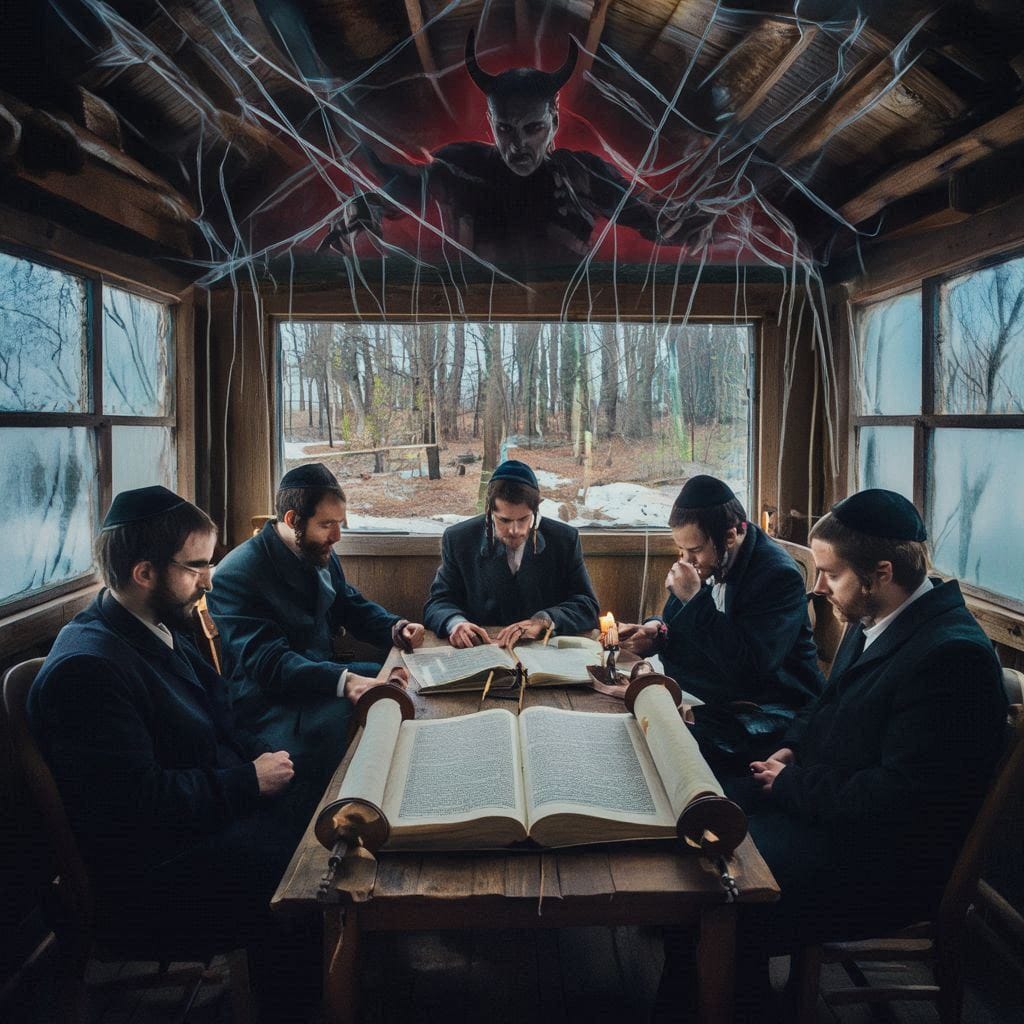
The fourth stage is theological abstraction.
In later commentary tradition, the issue increasingly becomes: who is the true Jew? Commentators such as Oecumenius read Revelation 2:9 in a way that contrasts the opponents with the true faithful. The old local conflict is now pulled into a broader Christian theological framework about true and false Israel, inward and outward Jewishness, and who really bears covenantal legitimacy. Once the text is read this way, the polemic widens. It is no longer merely “they harmed us in Smyrna.” It becomes “they are not what they claim to be.” That is a much broader theological move, and it lays groundwork for supersessionist readings.
The debate is not merely ethnic. It is over a title of honor, covenant, and faithfulness. In that sense, later Christian commentary often treated the verse as a struggle over who is the true people of God. But once that argument hardens, it can become deeply dangerous, because it makes local polemic into a theory of religious displacement. The text is now being theologized far beyond its local origin.
Then comes the fifth stage: Post-Nicene escalation into broad anti-Jewish rhetoric.
Here John Chrysostom is one of the clearest and harshest witnesses. In his sermons Against the Jews, he no longer remains close to the limited horizon of Smyrna and Philadelphia. He says, “the synagogue is not only a brothel and a theater; it also is a den of robbers and a lodging for wild beasts.” He goes further and says that when God has forsaken a place, that place becomes “the dwelling of demons.” This is no longer a local dispute in Asia Minor. This is a sweeping denunciation of synagogue life itself. What began as a conflict with particular opponents has become a broad rhetorical and a violent assault on Jewish worship and communal holiness.
And Chrysostom’s purpose was practical, not merely theoretical. He was preaching in a context where many Christians were still drawn to Jewish festivals, synagogue attendance, and Jewish rhythms of life. His language was meant to sever that attraction. So this is not an accidental exaggeration. It is deliberate pastoral polemic. It shows how a line that began in Revelation as a local conflict could be transformed, centuries later, into a programmatic weapon against Jews more generally.
Then there is a sixth stage: generalized Christian reuse of the phrase.
By the time of Augustine, the expression “synagogue of Satan” could be used not only against Jews, but also against whom they considered heretics. In On Baptism, Augustine quotes Rogatianus of Nova, who says, “Christ established the Church, the devil heresy: how can the synagogue of Satan have the baptism of Christ?” Augustine argues against the reasoning, but the quotation itself is revealing. By this point the phrase has become a reusable label for illegitimacy. It is no longer tied only to Smyrna, Philadelphia, or even Jews. It has become a stock insult for rival religious bodies. That shows how far it had drifted from its original setting.

That historical progression is the heart of the matter.
First, in Revelation, the phrase belongs to two cities and specific opponents.
Then, in the Martyrdom of Polycarp, the memory of conflict is still local and civic.
Then, in Victorinus, the conflict is apocalypticized and linked to Antichrist.
Then, in later commentary, it is theologized into a question of true and false Israel.
Then, in Chrysostom, it is universalized and weaponized against synagogue life more broadly.
Then, by Augustine’s era, it is portable enough to be used even against heretics.

Now Smyrna gives us another important historical anchor: Rufina.
An inscription from Smyrna refers to Rufina, a Jewish woman called archisynagogos, usually translated “head of the synagogue” or “synagogue ruler.” The inscription also shows that she had real social and legal standing, involving a burial place, penalties, and archival record. Whatever debates remain about the exact daily duties of the office, the inscription proves that Jewish communal life in Smyrna was real, organized, institutional, and visible. It also shows that, at least in later evidence, a woman could bear a synagogue leadership title there which very odd.
That does not prove that Revelation was reacting to Rufina personally, but its a possibility. The chronology usually places Revelation in the late first century, while Rufina’s inscription is generally treated as second- or third-century evidence. So we should not overclaim. But Rufina still matters because she shows that Smyrna’s synagogue world was concrete and developed, and perhaps socially more flexible than later assumptions would suggest. In a religious culture that was broadly male-driven, Rufina stands out as unusual, but her presence proves that diaspora synagogue life could have local features that did not neatly fit later rigid expectations.

A careful historical judgment would be this: we cannot say with certainty that John of Patmos personally met Rufina or directly attacked a synagogue led by her, though the possibility cannot be entirely ruled out.
If a woman did hold visible authority in a synagogue setting, that would likely have stood out in a world that was strongly male-driven and religiously traditional. Within a strict and polemical text like Revelation, and in the context of a movement emerging out of the Jewish world yet defining itself sharply, one can at least understand why such a development might have been viewed negatively by John and described in severe language.
At the same time, what we can say more securely is that later evidence from Smyrna confirms the existence of a real synagogue culture there, complete with leadership structures, institutional maturity, and social complexity. That makes it more plausible that Revelation’s original dispute was with actual local communities and concrete claims of authority, not with an abstract hatred of Jews as such. The original conflict was urban, local, and specific before later centuries broadened it into something far larger.

Now comes the addendum, and it matters greatly.
This lecture is not an attempt to say that churches themselves are evil.
This is not written to condemn Christians as Christians.
We always call for brotherhood with our fellow followers of God, even though we have different callings...
It is not written to deny that Christian tradition contains depth, beauty, repentance, holiness, and serious moral reform.
The point is narrower and more responsible: to trace how a phrase like “synagogue of Satan” developed in interpretation, how it moved from local conflict into broad polemic, and how those developments helped nourish antisemitic rhetoric. The goal is not to demonize the Church, but to confront bad interpretation and inherited contempt with honest scholarship.
That fairness is important especially when speaking about the Catholic Church in the modern era. The Second Vatican Council’s Nostra Aetate marked a watershed by rejecting antisemitism and by refusing to hold Jews as a whole collectively responsible for the death of Jesus. Catholic institutions continue to build on that turn. The USCCB, for example, released Translate Hate: The Catholic Edition in 2024 in partnership with the American Jewish Committee as part of its effort to help Catholics identify and combat antisemitism. So it would be unfair and careless to pretend that the present Catholic Church has made no effort to correct inherited anti-Jewish teaching. It has.

At the same time, ideas travel. Polemics do not stay trapped in one communion. Long after parts of the Catholic world began correcting anti-Jewish teaching, similar rhetoric and assumptions continued circulating in parts of the Protestant world, especially in some evangelical and self-described Bible-believing settings where historical scholarship is often bypassed. In such circles one still hears Revelation quoted as if it obviously condemns Jews in general, or hears older deicide language and contempt recycled in simplified form. The irony is that some of these voices imagine themselves to be anti-tradition, when in fact they are often carrying forward some of the harshest traditional polemics of the Christian past—only without the discipline of serious scholarship. This final point is partly an inference from the documented Catholic reforms alongside the well-known persistence of antisemitic interpretations in modern Christian discourse.
This is why this lecture exists. It exists to answer those who still use this rhetoric carelessly. It exists to say: if you are going to invoke Revelation, then you must deal with Smyrna and Philadelphia as real places. You must deal with the progression from local conflict, to apocalyptic amplification, to theological abstraction, to universalized polemic. You must deal with the fact that later Christian tradition often expanded the text far beyond what the text itself strictly requires. And you must deal with the fact that many churches today have already recognized the danger of inherited anti-Jewish rhetoric and worked to correct it. To ignore all that and still wield the verse against Jews is not fidelity to Scripture. It is propaganda wearing a biblical costume.

So the closing conclusion is this:
The phrase “synagogue of Satan” did not begin as a doctrine about all Jews, and it certainly cannot honestly be used as a judgment against a traditional or Orthodox synagogue. A real synagogue devoted to the worship of the God of Israel, to Torah, to prayer, and to covenant life is not a “synagogue of Satan.” It is a synagogue to HaShem the God of Israel. It is a beit knesset, a house of gathering before the Holy One. It is a place where Jews bless HaShem, study His Torah, guard His commandments, and bind themselves again to the life of Israel.
In Revelation, the phrase began as the language of an intense local conflict in Smyrna and Philadelphia, directed at specific opponents in a specific historical struggle. It was the language of polemic, not a universal verdict on all synagogues and not a condemnation of the Jewish people as such. Over time, however, later Christian writers expanded it. First it was drawn into apocalyptic symbolism. Then it was turned into theological claims about true and false Israel. Then it was widened into broader anti-Jewish denunciation. And finally it became a reusable polemical label for almost any religious enemy. That is the history, and that history must be told honestly.
So let this be said plainly: a synagogue where Jews gather to pray to HaShem, read Torah, study the words of Moshe and the prophets, and live in covenant faithfulness is not a place of Satanic devotion. It is a place of avodat HaShem. It is not a house of darkness. It is a house where the Name of HaShem is remembered, where the people of Israel stand before their God, where children learn Torah, where elders bless, where mourners weep, where communities repent, rejoice, and return. To call such a place “the synagogue of Satan” is not careful reading. It is slander.
That is why this matters so much. The original text does not give anyone permission to spit on Jewish houses of worship, to curse Jewish prayer, or to turn Jewish communal life into a demonic caricature. That misuse belongs not to honest exegesis, but to the long and tragic history of weaponized interpretation. And when churches have repented of such rhetoric, that repentance should be acknowledged with fairness. But when modern voices still repeat those old weaponized readings without scholarship, without context, and without moral seriousness, they should be answered clearly, firmly, and with the full weight of history.
A synagogue to HaShem is a synagogue to HaShem. A house of Torah is a house of Torah. And no abuse of Revelation has the right to take that away.

Antisemitism Series — Part IV: The Synagogue of Satan
Revelation, Christian Anti-Judaism, Torah Study, and the Historical Defense of Jewish Worship
Does the expression “synagogue of Satan” in the Book of Revelation condemn the Jewish people and their synagogues, or has a localized religious controversy been transformed into centuries of anti-Jewish rhetoric?
In this fourth installment of the Shaarei Tzafon Antisemitism Series, Rabbi Ariel Manning examines the historical development of one of the most controversial expressions in early Christian literature.
The phrase appears in Revelation 2:9 and 3:9, addressing disputes associated with Smyrna and Philadelphia in Roman Asia Minor. Although scholars disagree about the precise identity of the opponents described by John of Patmos, the passages arise within particular historical and religious conflicts rather than presenting a carefully developed doctrine concerning all Jews throughout history.
The teaching traces how subsequent Christian interpretation expanded these disputes into broader theological and apocalyptic categories.
Early Christian writings, including the Martyrdom of Polycarp, preserve memories of conflict between religious communities. Later commentators, including Victorinus of Pettau, incorporated such controversies into apocalyptic interpretations, while John Chrysostom's anti-Jewish sermons demonstrate how rhetoric could develop into sweeping denunciations of Jewish worship.
The historical inscription concerning Rufina, a Jewish woman bearing the title archisynagogos in Smyrna, offers evidence of organized Jewish communal life in the city, though it does not establish a direct connection with Revelation.
Yet this article does not seek to condemn Christianity or Christians collectively.
Modern Christian scholarship and institutional reforms deserve recognition.
Particularly significant is the Second Vatican Council's Nostra Aetate, which rejected antisemitism and collective accusations against the Jewish people.
For students of Torah and Jewish history, the larger lesson concerns the danger of removing religious texts from their historical context and transforming ancient disputes into permanent accusations against an entire people.
A Jewish synagogue is a Beit Knesset, a place devoted to HaShem, communal prayer, Torah reading, Torah study, and the preservation of Jewish covenantal life.
From ancient Smyrna to Jewish communities in Alpena, Hillman, Rogers City, and throughout Northeastern Michigan, the dignity of Jewish religious worship must not be undermined through distorted interpretations of another tradition's scripture.
The central message: A synagogue dedicated to HaShem, Torah, prayer, and the commandments is a house of Jewish worship—not a place of Satanic devotion.
Responsible religious dialogue requires historical knowledge, honest interpretation, and the willingness to reject inherited prejudice without abandoning legitimate theological differences.
Published by Shaarei Tzafon — The North Gate, an independent, family-led Orthodox Jewish educational and publishing initiative based in Northeastern Michigan, serving Alpena, Hillman, Rogers City, and surrounding communities.
Shaarei Tzafon promotes traditional Jewish life, Torah study, practical Halakhah, and the renewal of independent Jewish learning communities throughout the northern boreal regions, extending from the 45th parallel toward the Arctic tundra.
Article: https://www.shaareitzafon.org/antisemitism-part-4-synagogue-of-satan
Shaarei Tzafon — The North Gate
Orthodox Jewish Life and Torah Study in Northeastern Michigan
Shaarei Tzafon — The North Gate, led by Rabbi Ariel Manning, is an independent, family-led Orthodox Jewish educational and publishing initiative based in Northeastern Michigan. We support traditional Jewish life, Torah study, Halakhah, and Jewish education throughout Alpena, Hillman, Rogers City, and surrounding communities. Those interested in traditional Judaism are welcome to contact us for educational resources, Torah learning, and opportunities for discussion by prior arrangement.
Rooted locally, our greater mission extends northward from the 45th parallel — The North Gate — through Michigan, Canada, and Alaska toward the Arctic. We seek to encourage independent Jewish communities, family-centered Torah education, and the renewal of small batei midrash and shtieblach, preserving the rich traditions of Orthodox Judaism for future generations.
Our work begins in Northeastern Michigan, but our vision extends from the 45th parallel toward the Arctic.
Guided by Rambam and Mori Qafiḥ, uplifted by Rebbe Nachman, and grounded by Avraham ben HaRambam’s balance of halakha and inward avodah.
The Orchard’s Path
publishes our books and curricula.
Our mission: a bright, authentic Jewish presence in every northern town.
Created with ©systeme.io


