
God Is Not a Man Sitting on a Cloud Part 3
B”H
How Mysticism Works Without Images
A Continuation of the Yesodei HaTorah Teaching for Shaarei Tzafon
Part 1 – The Necessary Question
After Parts 1 and 2, an honest question emerges:
If God has no body,
no form,
no internal divisions,
no structure,
then how does mysticism function at all?
If we remove imagery,
remove spatial metaphor,
remove emotional projection,
remove ontological layering—
what remains?
Have we reduced Judaism to abstraction?
The answer is no.
But mysticism must now operate within discipline.
Part 2 – Essence and Experience
The key distinction is this:
Rambam defines what God is not in His essence.
Mysticism describes how the human soul experiences divine reality.
These are not the same domain.
Divine essence is absolutely simple.
Human perception is layered, emotional, dynamic.
Mystical language belongs to the human side.
It does not describe structure within God.
It describes structure within the receiver.
God remains One.
The complexity belongs to us.
Part 3 – Sefirot as Reception, Not Division
The language of sefirot must be handled carefully.
If one imagines ten parts within God, that violates Divine simplicity.
But if one understands the sefirot as describing how creation receives divine governance, the danger dissolves.
God is simple.
Creation is complex.
The complexity belongs to the vessel, not the source.
The sun does not change when light passes through stained glass.
The glass produces color.
The source remains one.
Mystical language describes the stained glass.
Not the sun.
Part 4 – Divine Light Without Substance
Mystical texts speak constantly of light.
Light must be understood symbolically.
Light does not mean substance.
Light means revelation.
When something becomes intelligible, we say it is illuminated.
When providence becomes visible, we say divine light shines.
God is not made of light.
Light describes manifestation, not composition.
If light becomes ontology, Divine simplicity is compromised.
If light remains metaphor, devotion deepens.
Part 5 – Immanence Without Corporeality
Hasidic language declares:
אין עוד מלבדו — there is nothing besides Him
This does not mean the world is God.
It means nothing exists independently.
Creation is contingent.
God alone is necessary.
Immanence means:
Every moment of existence depends on His will.
Not that He occupies matter as substance.
He sustains reality without being contained by it.
He is present everywhere without being spatial.
He transcends without distance.
This preserves both closeness and unity.

Part 6 – Deveikut Without Fusion
Mysticism speaks of deveikut — cleaving to God.
But cleaving does not mean merging substances.
God has no substance to merge with.
Deveikut means alignment:
Alignment of intellect.
Alignment of will.
Alignment of moral action.
In the closing chapters of the Guide for the Perplexed, Rambam describes a person whose mind remains constantly aware of God.
That is mystical.
But it is disciplined mysticism.
The cleaving is awareness, not fusion.
God does not expand into us.
We awaken toward Him.
Part 7 – The Role of Symbols
Here we must be very precise.
Judaism uses symbols, but Judaism does not worship symbols.
Symbols are permitted because human beings must think and speak.
But symbols become dangerous when they harden into metaphysical claims.
A symbol is a tool for the mind.
It is not a map of God’s essence.
This is why Torah and Chazal speak in images while simultaneously forbidding form.
Symbols serve three roles in a disciplined mystical model:
Pedagogy
Symbols teach what the intellect cannot grasp directly.
“Light” teaches revelation.
“Kingship” teaches authority.
“Throne” teaches rule and judgment.
“Crown” teaches transcendence over comprehension.
They are a language for learning — not anatomy.Emotional Direction
Symbols aim the heart.
Awe, humility, gratitude, fear of sin, longing for teshuvah — these are trained through imagery.
The image is not the object of worship.
It is the arrow that points beyond itself.Spiritual Discipline
Symbols can shape kavvanah without inviting projection.
A person may use symbolic meditation to refine awareness — but must never claim that the symbol describes God’s internal structure.
This is the rule:
Use symbols to elevate the soul.
Never use symbols to define God.
When symbols remain servants, mysticism becomes Torah.
When symbols become masters, mysticism becomes myth.
Part 8 – Hashem and the Torah Are Not Two
At this point we must address something difficult.
There are two common distortions in religious life.
The first distortion is mysticism without Torah.
Some become intoxicated with spiritual language — divine light, divine presence, inner experience — yet neglect halacha.
They speak constantly of closeness, yet drift into sin because their devotion lacks structure.
The second distortion is Torah without Hashem.
Others follow halacha carefully, but Hashem is rarely in their speech. They speak only of rulings, categories, technical precision — but not of standing before the Living God.
Both are fractures.
The Torah does not permit either.
We must understand something foundational:
Hashem and the Torah are not two separate realities.
HaShem and His Torah are ONE!!!!!
The Torah is not an independent legal system.
And Hashem is not an abstract mystical presence detached from law.
The Rambam teaches:
הוא היודע והוא הידוע והוא הדעה עצמה
He is the Knower, He is the Known, and He is the Knowledge
itself
If God’s wisdom is not separate from Him, then Torah — as Divine wisdom — is not separate from His will.
When we study Torah, we are not studying something external to God.
We are studying and worshipping HaShem!!!!!!
We are aligning with His wisdom.
When we keep halacha, we are not obeying abstract regulation.
We are aligning with Divine will.
To worship Hashem without Torah is illusion.
To keep Torah without awareness of Hashem is dryness.
Mysticism without halacha becomes self-generated spirituality.
Halacha without consciousness becomes mechanical compliance.
The unity must be preserved.
Torah is the disciplined revelation of Divine will.
And Divine will is encountered through Torah.
You cannot cleave to God by bypassing Torah.
And you cannot cling to Torah while ignoring God.
Part 9 – Cleaving Through Structure
This reframes deveikut entirely.
Deveikut is not achieved by escaping structure.
It is achieved through structure.
Halacha creates rhythm.
Rhythm creates discipline.
Discipline creates clarity.
Clarity creates awareness.
Awareness creates deveikut.
Thus:
Torah is the architecture of cleaving.
Without Torah, mysticism collapses into subjectivity.
Without Hashem-consciousness, Torah collapses into bureaucracy.
Hashem and Torah are one movement:
Divine will revealed and human will aligned.
Part 10 – The Soul as the Field of Mysticism
Where does mysticism operate?
Not in mapping Divine structure.
But in refining the human soul.
Concealment occurs in human perception.
Illumination occurs in human understanding.
“Tzimtzum,” in a disciplined model, describes limitation of human awareness — not contraction within God.
The mystic’s work is inward:
Removing arrogance.
Removing distraction.
Removing projection.
Removing sin.
Mysticism becomes refinement, not metaphysical speculation.
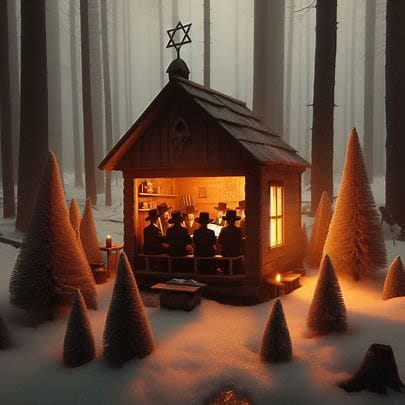
Part 11 – The Northern Balance
Shaarei Tzafon stands between extremes.
Pure rationalism without devotion becomes sterile.
Unrestrained mysticism becomes mythology.
The Northern Gate holds both:
Absolute Divine simplicity.
Deep experiential devotion.
Fidelity to halacha.
Conscious awareness of Hashem.
God remains beyond imagination.
The soul grows within discipline.
Mysticism works because it describes the human side of the relationship.
God does not change.
We do.
God does not emanate parts.
We perceive governance.
When this order is preserved, mysticism strengthens monotheism instead of weakening it.
That is how mysticism works inside the Rambam framework.
That is how devotion survives Divine simplicity.
That is the Northern Gate applied to the inner life.

God Is Not a Man Sitting on a Cloud — Part Three
Divine Unity, Jewish Mysticism, and the Limits of Human Imagination
How can Jews experience closeness to HaShem while recognizing that God has no physical form, no divisions, and no resemblance to anything in creation?
Throughout Jewish history, philosophers, mystics, and Hasidic teachers have explored the relationship between the infinite Creator and the finite human mind. Yet the foundation of authentic Jewish belief remains the absolute unity and incorporeality of HaShem.
Rabbi Moshe ben Maimon, the Rambam, taught that God is neither a body nor a physical force and cannot be described through the limitations of human existence. His teachings in Mishneh Torah and Moreh Nevukhim establish a rational foundation for understanding Divine unity without attributing physical characteristics, human emotions, or divisions to the Creator.
In this third installment of God Is Not a Man Sitting on a Cloud, Rabbi Ariel Manning examines how Jewish mysticism, Kabbalah, the sefirot, and Hasidic devotion can be approached without compromising the fundamental principles of Jewish monotheism.
The discussion considers symbolic descriptions of Divine light, the meaning of deveikut (cleaving to HaShem), and the distinction between spiritual imagery and literal theological belief. It also emphasizes that mystical interpretation and personal devotion must remain grounded in Torah and Halakhah rather than replacing the commandments with subjective spiritual experiences.
The central message is simple: We do not draw closer to HaShem by imagining what God looks like, dividing the Divine into separate powers, or projecting human characteristics onto the Creator. We draw closer through knowledge, humility, Torah, mitzvot, and the disciplined cultivation of love and reverence for HaShem.
Jewish spirituality does not require us to abandon reason, nor does rational Jewish philosophy require us to abandon devotion. Both can contribute to a meaningful religious life when properly understood.
Published by Shaarei Tzafon — The North Gate, an independent, family-led Orthodox Jewish educational and publishing initiative in Northeastern Michigan, serving Alpena, Hillman, Rogers City, and surrounding communities. Shaarei Tzafon promotes traditional Jewish life, Torah study, Halakhah, and the renewal of independent Jewish learning communities north of the 45th parallel.
https://www.shaareitzafon.org/god-is-not-a-man-sitting-on-a-cloud-part-3
Shaarei Tzafon — The North Gate
Orthodox Jewish Life and Torah Study in Northeastern Michigan
Shaarei Tzafon — The North Gate, led by Rabbi Ariel Manning, is an independent, family-led Orthodox Jewish educational and publishing initiative based in Northeastern Michigan. We support traditional Jewish life, Torah study, Halakhah, and Jewish education throughout Alpena, Hillman, Rogers City, and surrounding communities. Those interested in traditional Judaism are welcome to contact us for educational resources, Torah learning, and opportunities for discussion by prior arrangement.
Rooted locally, our greater mission extends northward from the 45th parallel — The North Gate — through Michigan, Canada, and Alaska toward the Arctic. We seek to encourage independent Jewish communities, family-centered Torah education, and the renewal of small batei midrash and shtieblach, preserving the rich traditions of Orthodox Judaism for future generations.
Our work begins in Northeastern Michigan, but our vision extends from the 45th parallel toward the Arctic.
Guided by Rambam and Mori Qafiḥ, uplifted by Rebbe Nachman, and grounded by Avraham ben HaRambam’s balance of halakha and inward avodah.
The Orchard’s Path
publishes our books and curricula.
Our mission: a bright, authentic Jewish presence in every northern town.
Created with ©systeme.io


