
Judaism in Space
B"H
1. The Question That Sounds Like a Joke but Is Not
At first, “Judaism in space” sounds like a comedy line. It sounds like something from Mel Brooks: Jews floating through the stars, arguing about Shabbat candles in zero gravity, or asking whether the space station needs a mezuzah. But the PBS teaching Fiddler on the Moon: Judaism in Space shows that the question is much more serious than that.
The question is not only, “Can a Jew keep Judaism in space?” The real question is, what happens to halacha when the natural world around the Jew changes?
On Earth, we know what day is. We know what night is. We know where the sun rises. We know where Jerusalem is. We know how months work. We know the animals, grains, waters, and seasons of this world. But in orbit, sunrise and sunset can happen many times in one Earth day. On the Moon, the day is not like our day. On Mars, the day is close to Earth’s day, but not exactly. A Martian year is completely different from an Earth year.
So the question becomes: is Judaism only for Earth?
The answer is no. But Judaism is definitely earthbound.
That is the tension.
Judaism is not a vague spirituality floating in the clouds. Judaism is about body, land, food, time, water, direction, family, community, and covenant. Adam is formed from the adamah, the earth. Israel receives Torah in this world, not in an abstract heaven. We sanctify time through actual days. We bless actual food. We face an actual Jerusalem.
So when a Jew leaves Earth, he does not leave halacha behind. He carries the question of halacha with him.
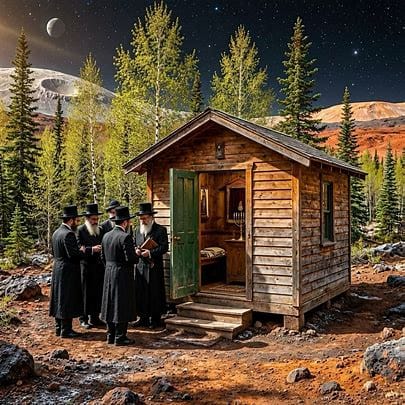
2. Judaism Is Earthbound, but Not Earth-Imprisoned
Neil deGrasse Tyson makes a powerful point in the PBS discussion:
Judaism is earth-based. That is true. Our mitzvot are tied to the rhythms of this planet. Shabbat begins with sunset. Morning prayer belongs to morning. Tefillin are worn by day. Festivals are tied to the Hebrew calendar. Pesach is in the spring. Sukkot belongs to the harvest. Rosh Chodesh depends on the moon. Prayer faces Jerusalem.
This means Judaism is not like some religions that can easily detach from the physical world. Judaism does not say, “Only the soul matters.” Judaism says the body matters. The house matters. The kitchen matters. The field matters. The calendar matters. The direction you face in prayer matters.
But earthbound does not mean trapped.
The Jewish people have always traveled. Abraham leaves his homeland. Israel leaves Egypt. The Torah is given in the wilderness. Jews survive exile after exile: Babylon, Persia, Spain, North Africa, Ashkenaz, Yemen, Poland, America, and beyond. Every place raises new questions. What does Judaism look like in snow? In desert? In a city? In a village? In Alaska? In wartime? In prison? On a ship? At the North Pole?
Space is the next frontier of the same old question.
The Jew asks: how do I adapt without losing the ground of Torah?
That is the heart of this lecture.
Judaism in space is not about inventing a new Torah.
It is about asking how the old Torah governs a new place.
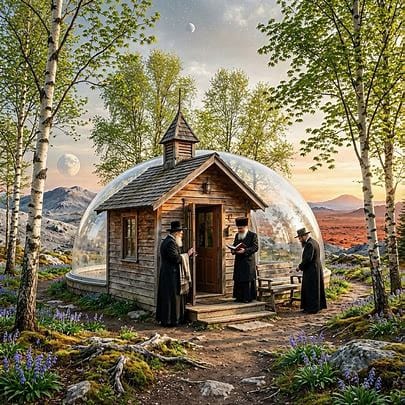
3. The First Rule: When Nature Works, Follow Nature
The first principle is simple: when the natural signs still work, follow them.
On Earth, we do not invent Shabbat privately. We receive it through the seventh day, through sunset, through the community of Israel, and through the Hebrew calendar. A Jew in Michigan, Jerusalem, London, or Morocco follows the normal local day. The sun sets where he is. Night arrives where he is. Shabbat begins where he is.
This is important because Judaism does not erase local reality. The Jew does not live in imaginary time. If he is in Northern Michigan, he follows the time of Northern Michigan. If he is in Israel, he follows the time of Israel. If he is in Alaska, he has to ask more difficult questions because the sun behaves strangely, but even there the question begins with nature.
Halacha begins by taking the world seriously.
So if a future Jew lives on a planet with a normal day-night cycle close enough to human life, there may be room to say that his daily rhythm follows local sunrise and sunset. Morning is morning there. Evening is evening there. People wake, work, eat, rest, and sleep according to the local cycle.
But Shabbat and the festivals are not merely natural. They are covenantal. That means local nature is only one part of the question. The other part is Israel’s calendar.
That is why Mars becomes so complicated.
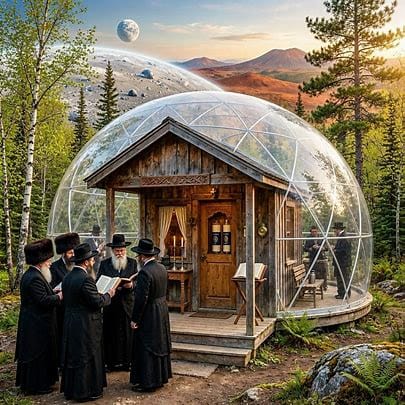
4. The Lost Jew: Rambam’s Desert Case
There is a key halachic source for this discussion. Rambam discusses a person traveling in the desert who forgets which day is Shabbat. He no longer knows where he is in the week. He is not rejecting Shabbat.
He is lost.
What does he do?
He counts six days and sanctifies the seventh. On that seventh day, he makes Kiddush, treats it as Shabbat in memory, and afterward makes Havdalah. But because he may be wrong, every day still has doubt. Therefore, he only does the work necessary for survival.
This is extremely important for space.
A Jew stranded on a damaged ship, cut off from Earth, without calendar data, without communication, without any way to know the day, would become like the lost traveler in the desert. He would count six days and sanctify the seventh. This would not be the ideal form of Shabbat. It would be emergency Shabbat. Survival Shabbat. A personal island of holiness in confusion.
This proves something beautiful: even when a Jew loses the calendar, he does not lose Shabbat completely. He counts. He remembers. He sanctifies.
But this rule cannot become the regular system for a settled community. If every Jew on Mars personally counted his own six days and made his own seventh, there would be chaos. A community needs one calendar.
The Rambam’s desert case is for the lost individual, not for the organized kehillah.
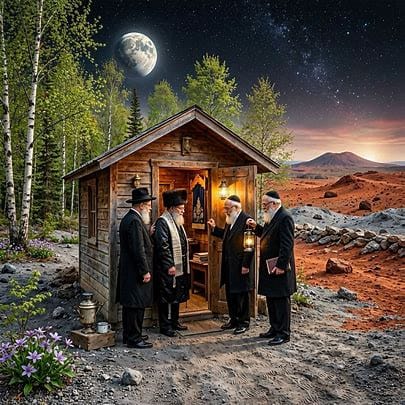
5. Orbit and the Moon: Stay Connected to Earth
The PBS teaching spends time on Ilan Ramon, the Israeli astronaut aboard Columbia, who asked how to mark Shabbat in space. This question is not theoretical. In low Earth orbit, a spacecraft can experience many sunrises and sunsets in a single Earth day. If a Jew tried to follow every orbital sunrise and sunset, Jewish life would become impossible. He would be saying Shacharit, Minchah, Maariv, Shacharit, Minchah, Maariv again and again. Shabbat would collapse into absurdity.
So the practical answer is: follow an Earth-based time standard.
For a temporary astronaut, that could mean the time of the launch site, mission control, or home community. In Ilan Ramon’s case, the discussion centered around Houston time because Houston was the operational center of the mission.
This makes sense. He was not founding a new planet. He was on a mission from Earth, controlled by Earth, communicating with Earth, and returning to Earth.
The Moon is similar, though more dramatic. The Moon’s natural day is much longer than Earth’s. You cannot run ordinary Jewish life by a lunar sunrise and sunset. A Jew on a lunar base should remain tied to Earth’s calendar. The Moon is close to Earth, visually tied to Earth, and practically connected to Earth travel.
The Moon Jew is still living in Earth’s halachic neighborhood.
So for orbit and the Moon, the principle is clear:
When the local sky becomes unusable, remain attached to Earth-time.
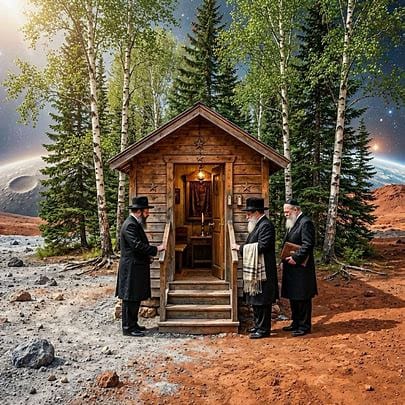
6. Mars: The Hard Case
Mars is harder.
Mars has a day that is close to Earth’s day, but not the same. A Martian sol is about 24 hours and 40 minutes. That is close enough to feel normal, but different enough to create serious problems over time. A Mars colony living by Martian days would slowly drift away from Earth’s rhythm.
A Martian year is also very different from an Earth year.
This creates a major halachic question.
Should Jews on Mars live by Mars time? Or Earth time?
The best answer may be divided.
For ordinary life, Mars Jews may need to live by the Martian sol. Their bodies, work schedules, greenhouse systems, travel, and settlement life may depend on the local sunrise and sunset. In that sense, daily prayer times may eventually have to relate to local Martian day and night.
But Shabbat and Yom Tov must remain connected to the calendar of Israel.
This is the line I would use:
The day may become local, but the calendar must remain covenantal.
Mars can have local morning. Mars can have local evening. Mars can have work cycles, agriculture cycles, and settlement cycles. But Pesach cannot be moved to Martian spring simply because Mars has a different orbit. Sukkot cannot become a Martian harvest festival disconnected from Israel.
Rosh Hashanah cannot be reinvented according to Phobos and Deimos.
The Hebrew calendar belongs to the people of Israel. It is not a private astronomical hobby.
A Mars minhag can develop. A new Torah cannot.
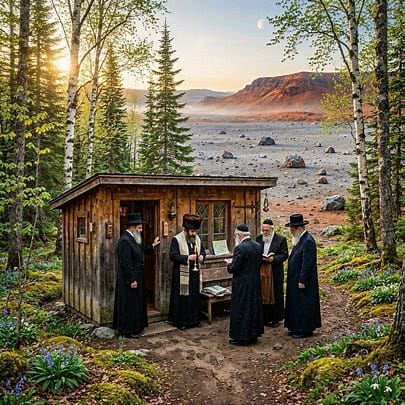
7. Which Way Is Jerusalem?
This is one of the most beautiful and difficult questions.
On Earth, we face Jerusalem. But on a round planet, even that is not as simple as people think. We are not literally seeing Jerusalem. We are orienting ourselves toward it. We stand in our place, turn toward the holy city as best as we can, and direct our heart toward the Holy of Holies.
In space, Jerusalem may no longer be a direction on the horizon. It may be in the sky. On Mars, Earth may appear as a star or wandering light. So should a Jew lie down? Stand on an angled platform? Point upward at 45 degrees? Build a synagogue with a special window facing Earth?
These are serious questions.
The best answer is that halacha requires meaningful orientation, not impossible geometry.
If Earth is visible, a Mars Jew should face Earth, because Earth contains Eretz Yisrael, Jerusalem, and the place of the Mikdash. If Earth is not visible, he should face the calculated direction of Earth. If even that is not possible, the community should establish a mizrach wall, a fixed direction of prayer in the synagogue representing Jerusalem. And if a person cannot determine any direction, he directs his heart toward the Shechinah.
This gives us a powerful teaching:
On Earth, Jerusalem is a direction. In space, Jerusalem becomes a vector. But when the vector fails, the heart still knows where to turn.
The Jew in space does not pray to Earth. He prays toward the place on Earth where heaven touched the ground.
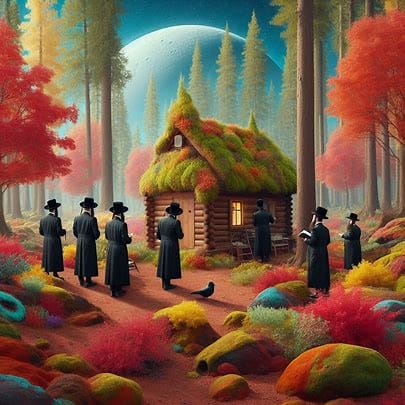
8. Kashrut on Another World
Now imagine a planet with animals, fish-like creatures, plants, or other forms of life. Could a Jew eat them?
This is not simple.
The Torah gives signs for kosher land animals: split hooves and chewing the cud. For fish, fins and scales. Birds are more complex, depending heavily on tradition. Insects are mostly forbidden, with narrow exceptions. But what if the creature is not from Earth? What if it looks like an animal but is biologically something else? What if it has something like hooves, but not exactly hooves? What if it eats like a ruminant, but not in the same way? What if it has scales, but not fish scales? What if it is neither animal, fish, bird, nor insect as Torah categories know them?
The cautious halachic answer is: do not eat until classified by competent authority.
This is where the need for a future beit din becomes clear. A Jewish space settlement would need halachic scholars, scientists, shochtim, farmers, and community leaders working together. The question would not simply be, “Is it edible?” The question would be, “Can this creature be placed inside a Torah category?”
If not, it may remain forbidden, at least by doubt.
This also shows how deeply Jewish kashrut is tied to Earth. Torah names the creatures of this world. It gives signs for the life of this world. On another planet, we would have to ask whether we are dealing with creation in the same halachic categories or something outside our received system.
Until then, space Jews should bring packaged food.
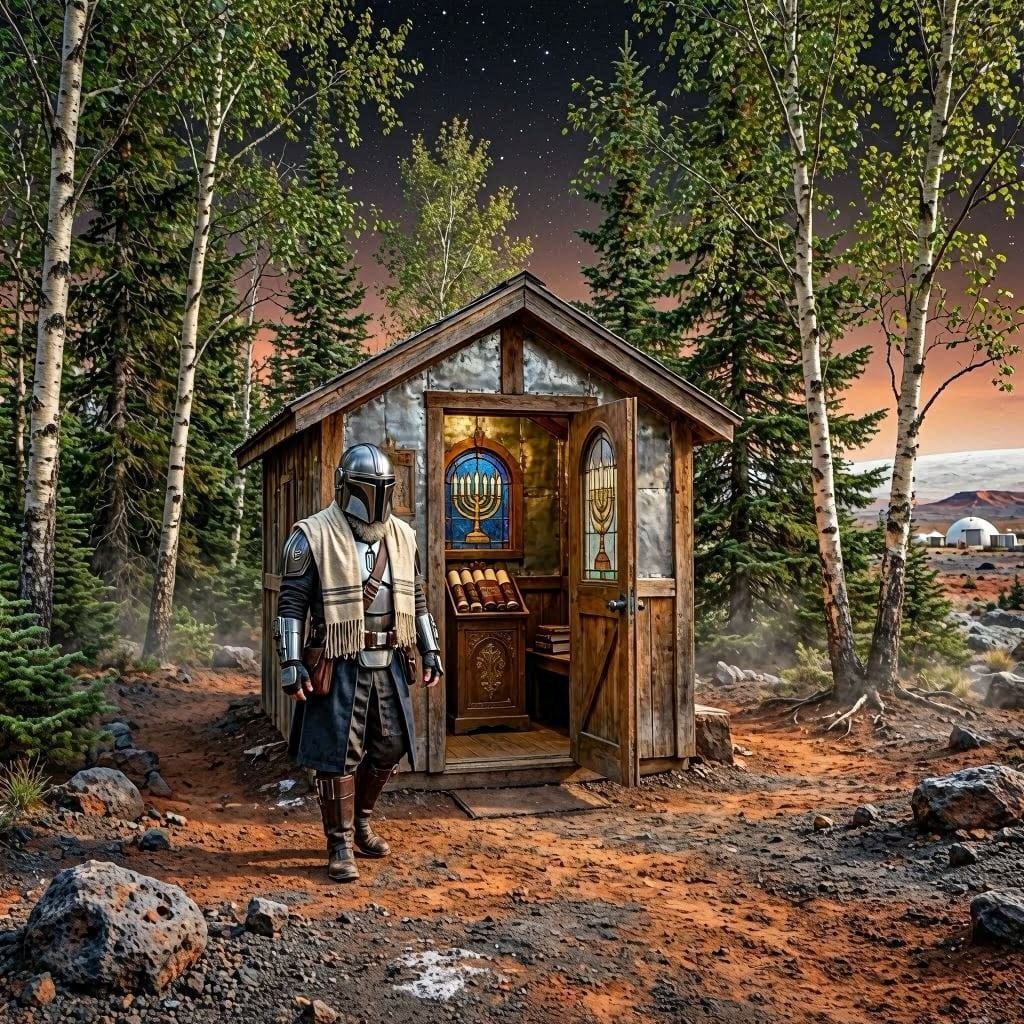
9. Mikvah, Mandalore, and the Memory of a Scattered People a slice of fictional life.
The Mandalorian comparison is worth pausing on, because there are surprising similarities between the Mandalorians and the Jewish people. Not exact similarities, of course. Jews are not a warrior caste, and Torah is not a science-fiction creed. But as a mythic image, the Mandalorians carry several themes that feel very Jewish.
The first similarity is exile.
The Mandalorians are a scattered people. Their homeworld has been devastated. Their clans live in fragments. Some are hidden. Some are assimilated. Some remember the old ways. Some have abandoned them. Some argue over what it really means to be Mandalorian. That is very close to the Jewish historical experience. After the destruction of the Temple and the long exile, Jews also lived scattered across nations, climates, languages, and cultures, while still asking: what keeps us one people?
The second similarity is law as identity.
For the Mandalorian, the phrase is: “This is the Way.” For the Jew, the word is halacha, which literally means “the way” or “the path.” Judaism is not only a set of beliefs. It is a way of walking. It tells you how to eat, pray, marry, mourn, rejoice, rest, work, bless, build a home, and raise children. Likewise, Mandalorian identity is not merely genetic. It is a discipline, a code, a path of life.
The third similarity is conversion or adoption into the people.
Mandalorian identity is not only bloodline. A foundling can become Mandalorian. He can be received, raised, trained, and made part of the people. That has a strong Jewish echo. Judaism is a covenantal people, not merely an ethnicity. A person can join Israel through proper conversion. Once joined, he is part of the people. He is not a visitor. He is not a second-class Jew. He is Israel.
The fourth similarity is sacred boundaries.
For some Mandalorians, removing the helmet is a serious violation. Again, this is not Jewish law. But the idea that a people survives through visible boundaries is very Jewish. Jews have Shabbat, kashrut, circumcision, family purity, modesty, prayer, language, calendar, and community structures. These boundaries are not meant to make us hate others. They preserve identity. They say: we are part of the world, but we are not dissolved into the world.
The fifth similarity is sacred water and return.
Din Djarin must immerse in the living waters of Mandalore. That scene feels Jewish because Judaism also has sacred immersion. Mikvah is not just washing. It is transition, return, purification, and reentry. A convert enters the water and rises as a Jew. A woman immerses and returns to her husband in holiness. A person can enter water in one state and emerge in another.
But here we must also make the distinction. In Judaism, the power is not mythology or magic water from one planet. A mikvah must be halachically valid. It does not have to be in one legendary location. It needs the right kind of water, gathered and held in the right way, according to Torah law. Still, the emotional similarity is obvious: a scattered person returns to sacred water to reconnect with the people.
The sixth similarity is homeland memory.
For Mandalorians, Mandalore is not just real estate. It is memory, identity, origin, pain, and destiny. For Jews, Eretz Yisrael is not just land. It is the land of the covenant, the place of prophecy, the place of the Temple, the place toward which we pray, the place from which Torah civilization is meant to shine. Even in exile, a Jew faces Jerusalem. Even far away, Jerusalem remains the center.
That becomes very important for “Judaism in Space.” A Jew on Mars may look up and see Earth as a small light in the sky. But that light contains Jerusalem. It contains the place of the Mikdash. It contains Sinai, Chevron, Tzfat, Tiberias, and the graves of our fathers and mothers. The Jew in space does not pray to Earth as a planet. He turns toward the place where HaShem placed Israel’s earthly center.
The seventh similarity is survival through transmission.
The Mandalorians survive because they teach the next generation the Way. Jews survive because we transmit Torah. Not merely ideas. Practice. Songs. Foods. Blessings. Stories. Laws. Calendar. Hebrew words. Family discipline. A child learns who he is by watching what his people do.
That is why the Mandalorian image works so well in this lecture. It shows that even in space fantasy, people instinctively understand that a scattered people needs more than emotion to survive. It needs law. It needs memory. It needs symbols. It needs water. It needs elders. It needs children. It needs a homeland. It needs a way.
But Judaism goes deeper.
For Jews, “This is the Way” is not a slogan. It is halacha. It is the path given by HaShem through Torah, carried by Israel through exile, and lived in real bodies, real homes, real kitchens, real marriages, real communities, and real time.
So if there were Jews in space, they would not merely need a flag, a song, or a nostalgic memory of Earth. They would need mikvah. They would need Shabbat. They would need kashrut. They would need prayer toward Jerusalem. They would need children learning Torah. They would need a beit din. They would need a communal calendar.
That is the difference between costume and covenant.
The Mandalorian has armor.
The Jew has halacha.
And wherever the Jew goes — forest, desert, exile, Moon, Mars, or beyond — he carries the way of Torah with him.
10. The Space Jew and the Frontier of Halacha
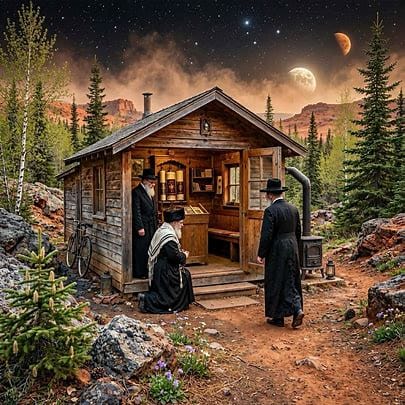
This is where the idea connects to frontier Judaism in the North Wood.
When Jews enter a new environment, they must adapt. But adaptation is not the same thing as rebellion. A rural northern Jewish community adapts to snow, distance, forests, wildlife, isolation, and long winters. A Mars Jewish community would adapt to red dust, domes, oxygen systems, radiation shelters, greenhouse agriculture, artificial light, and a strange sky.
But the principle is the same:
New conditions require new applications, not a new Torah.
A space Jew would need courage. He would need imagination. He would need halachic seriousness. He would need to know when to follow local nature and when to remain tied to Earth. He would need to know when to count six days and sanctify the seventh, and when to submit to the communal calendar of Israel. He would need to know that Jerusalem is not merely east. Jerusalem is the earthly center of prayer. Even if Earth appears as a star in the Martian sky, the Jew knows what that star contains.
It contains Sinai.
It contains Eretz Yisrael.
It contains Jerusalem.
It contains the place of the Mikdash.
It contains the graves of our fathers and mothers.
It contains the calendar of Israel.
It contains the soil from which Adam was formed.
So the Jew may travel into the heavens, but he does not become rootless.
Judaism in space would not be Judaism escaping Earth. It would be Judaism carrying Earth’s covenant into the heavens.
That is the final point.
Judaism is earthbound, because Torah was given to human beings formed from the earth. But Judaism is not earth-imprisoned, because Torah can guide the Jew wherever he goes. The Jew can stand in a forest, a desert, a city, a ship, a prison, an Arctic station, a lunar base, or one day under the red sky of Mars — and still ask the same question:
How do I serve HaShem here without forgetting Sinai?
That is what makes Judaism eternal.
Not that it changes into anything.
But that wherever the Jew goes, Torah goes with him.
Judaism in Space
Torah, Shabbat, Halakhah, and Jewish Life Beyond the Earth
If a Jew leaves the Earth, does he leave behind the obligations of Torah? How would one observe Shabbat, determine the times of prayer, or maintain Jewish religious life in a place where the familiar rhythms of sunrise and sunset no longer apply?
These questions reveal something remarkable about Judaism: Torah is not merely a collection of spiritual beliefs, but a comprehensive way of life involving time, place, action, community, and covenantal responsibility.
In considering Judaism in space, we encounter questions that require both fidelity to traditional Jewish law and careful examination of circumstances the classical authorities could scarcely have imagined.
On Earth, the observance of Shabbat and the calculation of prayer times ordinarily depend upon the cycle of day and night. In orbit, however, a spacecraft may circle the planet many times during a single terrestrial day.
Does every sunrise establish a new halakhic day? Should an astronaut follow the time of a particular location on Earth? How should Jewish festivals be calculated beyond our planet?
These are not questions that can be resolved through imagination alone.
They require serious Torah study, knowledge of the astronomical circumstances, and an examination of the halakhic principles governing zmanim, Shabbat, prayer, the Jewish calendar, and unusual geographic conditions.
The Rambam, Talmud, Geonim, and later halakhic authorities provide methods of legal reasoning, even when the specific technological circumstances were unknown to them. Nevertheless, competing applications of those principles remain possible, and hypothetical solutions must not be mistaken for universally accepted rulings.
Other questions naturally follow. How should Kashrut be maintained aboard a spacecraft? What happens when the requirements of human survival conflict with ordinary religious observance? How does pikuach nefesh, the preservation of human life, operate in an environment where nearly every activity depends upon complex technology?
These discussions demonstrate that Torah study must involve more than memorization. It requires understanding legal categories, their foundations, and the circumstances under which they apply.
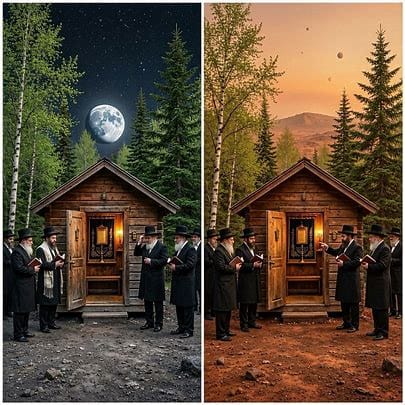
For Shaarei Tzafon, based in Alpena and serving Hillman, Rogers City, and Northeastern Michigan, this subject has an interesting parallel with Jewish life in the far north.
Above the 45th parallel, the changing seasons already raise practical questions concerning prayer times, long summer days, winter darkness, and the calculation of halakhic observances. Farther north, toward the Arctic, these questions become increasingly complicated.
Although spaceflight presents circumstances very different from life in northern latitudes, both remind us that the application of Halakhah requires careful attention to the physical world.
Shaarei Tzafon encourages Torah education that is faithful to classical Jewish sources while capable of investigating new circumstances responsibly.
The central message: Wherever humanity travels, the obligations of Torah remain a subject of serious Jewish responsibility. New environments require careful halakhic reasoning, not the abandonment of Sinai.
From the forests of Northern Michigan to the imagined Jewish settlements of distant worlds, our task remains to study, understand, observe, and transmit the Torah entrusted to Israel.
Published by Shaarei Tzafon — The North Gate, an independent, family-led Orthodox Jewish educational and publishing initiative based in Northeastern Michigan, serving Alpena, Hillman, Rogers City, and surrounding communities.
Shaarei Tzafon promotes traditional Jewish life, Torah study, practical Halakhah, and the renewal of independent Jewish learning communities throughout the northern boreal regions, extending from the 45th parallel toward the Arctic tundra, including the wider northern regions of Michigan, Canada, and Alaska.
Shaarei Tzafon — The North Gate
Orthodox Jewish Life and Torah Study in Northeastern Michigan
Shaarei Tzafon — The North Gate, led by Rabbi Ariel Manning, is an independent, family-led Orthodox Jewish educational and publishing initiative based in Northeastern Michigan. We support traditional Jewish life, Torah study, Halakhah, and Jewish education throughout Alpena, Hillman, Rogers City, and surrounding communities. Those interested in traditional Judaism are welcome to contact us for educational resources, Torah learning, and opportunities for discussion by prior arrangement.
Rooted locally, our greater mission extends northward from the 45th parallel — The North Gate — through Michigan, Canada, and Alaska toward the Arctic. We seek to encourage independent Jewish communities, family-centered Torah education, and the renewal of small batei midrash and shtieblach, preserving the rich traditions of Orthodox Judaism for future generations.
Our work begins in Northeastern Michigan, but our vision extends from the 45th parallel toward the Arctic.
Guided by Rambam and Mori Qafiḥ, uplifted by Rebbe Nachman, and grounded by Avraham ben HaRambam’s balance of halakha and inward avodah.
The Orchard’s Path
publishes our books and curricula.
Our mission: a bright, authentic Jewish presence in every northern town.
Created with ©systeme.io


