
Lag B’Omer in Minhag Borealish
B"H
The Small Fire Between Pesach and Shavuot
1. The Place of Lag B’Omer in the Omer
Lag B’Omer (ל״ג בעומר) is the thirty-third day of Sefirat HaOmer (ספירת העומר), the count from Pesach to Shavuot. The Torah commands Israel to count seven complete weeks from the day after the first festival day of Pesach until the fiftieth day, when we arrive at Shavuot.
Sources: Vayikra / Leviticus 23:15–16; Devarim / Deuteronomy 16:9–10; Rambam, Mishneh Torah, Hilchot Temidin uMusafin 7:22–25; Sefer HaChinuch, Mitzvah 306.
Rambam rules that the mitzvah is to count both the days and the weeks. This means that the Omer is not merely a calendar countdown. It is a spiritual bridge. Pesach gives freedom, but freedom is not complete until Israel reaches Torah. Shavuot is the crown of Pesach. The Exodus is not merely escape from Egypt; it is the movement toward Sinai.
Lag B’Omer stands inside that movement. It is not a Torah festival like Pesach, Shavuot, or Sukkot. It has no biblical korban, no kiddush obligation, and no formal prohibition of melachah. Yet it became a beloved minhag day because it marks a turning point in the emotional and spiritual atmosphere of the Omer.
For Minhag Borealish, this is essential. Lag B’Omer should not become complicated. It is a simple clearing in the forest of the Omer: a day when the heaviness begins to lift, when mourning softens, when the family gathers, and when the fire of Torah is remembered.
2. The Simple Customs of Minhag Borealish
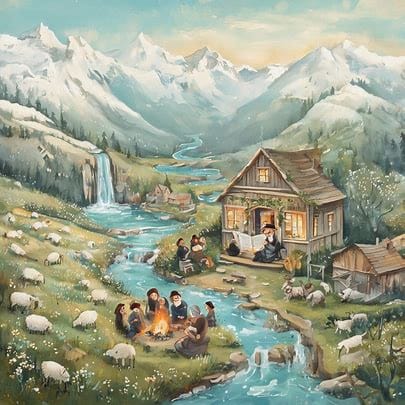
In Minhag Borealish, Lag B’Omer is observed with simplicity. Rural Jews do not need elaborate public ceremonies, large crowds, or expensive celebrations. A family can keep the day in a small backyard, beside a modest fire, with Torah words, a song, and a teaching.
Our customs are:
We cut hair on Lag B’Omer.
We light a small backyard fire.
We speak about Rabbi Akiva’s students.
We tell the story of Rabbi Shimon bar Yochai, Rashbi.
We recognize the heaviness of Sefirat HaOmer.
We begin turning toward Shavuot and Megillat Ruth.
This simplicity is itself part of the holiness. Minhag Borealish is built for families, isolated Jews, homesteaders, rural communities, and people who may not have easy access to large Jewish centers. The observance must be strong enough to carry meaning, but simple enough to actually live.
The day does not need to become a performance. A haircut, a small fire, a reading from the Gemara, a teaching about humility, and a first look toward Ruth are enough. The holiness is not in excess. It is in kavvanah, memory, humility, and continuity.
3. Haircutting and the Lifting of Mourning
The custom of cutting hair on Lag B’Omer comes from the relaxation of the Omer mourning customs. The Shulchan Aruch, Orach Chaim 493, records the custom not to cut hair during the Omer because of the death of Rabbi Akiva’s students. The Rema records that according to Ashkenazic custom, some mourning practices are lifted on Lag B’Omer.
Sources: Shulchan Aruch, Orach Chaim 493:1–2; Rema ad loc.; Mishnah Berurah 493.
Some communities cut hair on Lag B’Omer itself. Some, especially among Sephardim following the wording of the Shulchan Aruch, wait until the thirty-fourth day. Minhag Borealish may follow the common Ashkenazic leniency of cutting hair on Lag B’Omer, especially when this is the family or community custom.
The haircut is not just practical. It is symbolic. During the Omer, the body itself carries the restraint of mourning. Hair grows. Music is limited. Weddings are delayed. The person feels the unfinished nature of the season.
Then Lag B’Omer arrives, and a small permission is given. The hair is cut. The heaviness lifts slightly. The person is reminded that mourning in Judaism is not despair. It has boundaries. It has seasons. It teaches, but it does not swallow life.
In this way, cutting hair becomes a quiet act of hope. It says: we have remembered the tragedy, but we are still walking toward Sinai.
4. Rabbi Akiva’s Students and the Wound of Kavod
The Gemara teaches that Rabbi Akiva had twelve thousand pairs of students, and they died between Pesach and Shavuot because they did not treat one another with proper honor — shelo nahagu kavod zeh lazeh.
Source: Yevamot 62b.
This is the heart of Lag B’Omer. The tragedy was not that Torah disappeared completely, but that Torah became wounded through a lack of honor. These were not ignorant people. They were students of Rabbi Akiva. They had Torah. They had brilliance. They had intellectual power. But they lacked kavod zeh lazeh (כבוד זה לזה) — honor for one another.
That is terrifying. It means a person can learn Torah and still fail in basic human dignity. A person can know sources, argue sharply, and defend truth, yet still damage the vessel that allows Torah to remain among Israel.
The Gemara then says that the world was desolate until Rabbi Akiva taught new students in the south: Rabbi Meir, Rabbi Yehudah, Rabbi Yosi, Rabbi Shimon bar Yochai, and Rabbi Elazar ben Shamua. Through them, Torah was rebuilt.
So Lag B’Omer teaches two things at once: Torah can collapse through dishonor, and Torah can be rebuilt through faithful transmission.
5. The Historical Layer: War as a Plague
Traditionally, the death of Rabbi Akiva’s students is described as a plague. But historically, many have understood the tragedy as connected to Roman persecution and the Bar Kokhba revolt. Rabbi Akiva supported Bar Kokhba, and his students may have been caught in the catastrophe of that revolt.
Sources: Yevamot 62b; Iggeret Rav Sherira Gaon, as discussed by later historians; historical discussions of the Bar Kokhba revolt; Eusebius, Ecclesiastical History 4:6, for an external ancient reference to the Roman devastation after the revolt.
We should speak carefully. The Gemara gives the spiritual diagnosis: they did not honor one another. Historical reconstruction may give the outer garment: Roman violence, persecution, and war.
These do not contradict each other. War itself can be a plague. A plague is not only disease. A plague can be sword, fear, exile, political collapse, communal fragmentation, and the death of a generation. In Tanakh, the sword is often one of the great instruments of national catastrophe, alongside famine and pestilence.
So we can teach:
The Gemara tells us the inner wound.
History may show us the outer event.
The inner wound was lack of kavod.
The outer event may have been Rome, revolt, and war.
This deepens the lesson. When Torah students lack honor, the people become spiritually brittle. When the people are spiritually brittle, war and persecution become even more devastating.
6. Hod shebeHod: The Kabbalistic Meaning
In the Kabbalistic reading of the Omer, the seven weeks correspond to the seven lower sefirot:
Chesed — lovingkindness
Gevurah — strength and restraint
Tiferet — harmony and beauty
Netzach — endurance and victory
Hod — humility and splendor
Yesod — foundation and covenantal connection
Malchut — kingship and manifestation
Lag B’Omer, the thirty-third day, is commonly understood as Hod shebeHod (הוד שבהוד) — humility within humility, splendor within splendor.
This fits the story of Rabbi Akiva’s students with precision. They did not lack Torah. They lacked hod. They lacked the humble splendor that allows one person to honor another person’s Torah, another person’s path, another person’s place in the beit midrash.
Hod is not weakness. Hod is dignity that bows. It is splendor that knows how to make space. It is the beauty of humility without self-erasure.
Therefore, Lag B’Omer is not merely a day of mystical fire. It is a day of repaired humility.
The fire must not be a fire of arrogance.
It must not be a fire of religious ego.
It must not be a fire that burns others.
It must become a small, humble flame of Hod shebeHod.
7. The Small Backyard Fire
The custom of lighting fires on Lag B’Omer is especially associated with Meron and Rabbi Shimon bar Yochai. Later tradition connects the bonfire to the light of Rashbi’s Torah, the revelation of hidden wisdom, and the fire surrounding his final teachings in the Zoharic tradition.
Sources: Zohar, Idra Zuta, Ha’azinu; later customs of Meron; reports attributed to Rabbi Ovadia of Bertinoro regarding gatherings and fires in Meron.
For Minhag Borealish, the fire should be small, safe, and meaningful. A rural Jewish family does not need a massive bonfire. A small backyard fire is enough. The point is not spectacle. The point is memory, warmth, and Torah.
The fire represents:
The light of Torah.
The hidden wisdom associated with Rashbi.
The lifting of Omer heaviness.
The transformation of judgment into mercy.
The warmth of community and family.
The danger of spiritual fire if it is not governed by humility.
This is why the fire must be humble. A wild fire destroys. A hearth warms. The goal of Lag B’Omer is not to become spiritually wild, but spiritually warm.
In Borealish language:
The cave becomes the hearth.
The fire becomes mercy.
The hidden Torah becomes love of Israel.
8. Rashbi: The Cave and the Return
The Gemara in Shabbat 33b tells the story of Rabbi Shimon bar Yochai and his son Rabbi Elazar hiding from the Romans in a cave. They lived in radical separation, sustained by a carob tree and a spring. They immersed themselves in Torah.
Source: Shabbat 33b.
When they first emerged, they saw Jews plowing and planting. They could not understand how people could leave eternal life and involve themselves in temporary life. Wherever they looked, things burned. A Heavenly Voice rebuked them: “Did you emerge to destroy My world?”
They returned to the cave for another twelve months. When they emerged again, Rabbi Elazar still struck, but Rashbi healed. Rashbi had learned how to return.
This is one of the deepest teachings for rural Jews and Jewish hermits. The cave is holy, but only if one learns how to leave it. Solitude is holy when it purifies. The forest is holy when it softens the heart. Isolation can deepen prayer, but it can also produce contempt if not balanced by love of Israel.
Rashbi’s greatness was not only that he entered the cave. His greatness was that he returned from the cave as a healer.
This is the Borealish lesson: the hidden Jew in the forest must still love the Jew in the marketplace.
9. Turning Toward Shavuot and Megillat Ruth
Lag B’Omer does not stand alone. It points toward Shavuot.
For us, Megillat Ruth (מגילת רות) is central to Shavuot.
Sources: Ruth 1–4; Shulchan Aruch, Orach Chaim 490:9, Rema; Midrash Ruth Rabbah.
Ruth is the repair of Rabbi Akiva’s students. They failed in honor. Ruth embodies chesed (חסד). They lacked kavod for one another. Ruth refuses to abandon Naomi. They show Torah fractured by ego. Ruth shows Torah received through humility, loyalty, and covenantal love.
Ruth says:
“Your people shall be my people, and your God my God.”
Source: Ruth 1:16.
That verse is one of the great biblical images of covenantal attachment. Ruth does not come with arrogance. She comes with loyalty. She does not demand honor. She gives honor. She does not enter Israel as a conqueror, but as one who clings, serves, gleans, and receives.
Kabbalistically, Ruth points toward Malchut (מלכות), because from Ruth comes King David. The book ends by tracing the line from Boaz and Ruth to David. Humble chesed becomes kingship.
So the path is:
Pesach gives freedom.
The Omer refines the soul.
Lag B’Omer reveals humble fire.
Shavuot gives Torah.
Ruth teaches how Torah is received: through chesed, humility, loyalty, and covenant.
10. What We Read and How We Keep the Night
A simple Minhag Borealish order for Lag B’Omer may be:
Count the Omer after nightfall.
Light a small, safe backyard fire.
Say: “This fire is for Torah, humility, and healing.”
Read or summarize Yevamot 62b.
Read or summarize Shabbat 33b.
Teach that war can be a plague, but lack of kavod is the inner wound.
Read Ruth 1:16–17 as the bridge toward Shavuot.
Sing a simple niggun or “Bar Yochai,” if that is the family custom.
End by saying: “May our Torah become warmth, not fire that destroys.”
For a short family reading, use:
Vayikra 23:15–16 — counting the Omer.
Yevamot 62b — Rabbi Akiva’s students.
Shabbat 33b — Rashbi in the cave.
Ruth 1:16–17 — Ruth’s covenantal loyalty.
A short teaching on Hod shebeHod.
For adult study, use:
Rambam, Hilchot Temidin uMusafin 7:22–25.
Sefer HaChinuch, Mitzvah 306.
Shulchan Aruch, Orach Chaim 493.
Yevamot 62b.
Shabbat 33b.
Zohar, Idra Zuta, if the group is ready.
Likutei Moharan 6:1, where Rebbe Nachman teaches that one must minimize one’s own honor and increase the honor of HaShem.
Lag B’Omer in Minhag Borealish is a small flame in the boreal night. We cut the hair because mourning begins to lift. We light the fire because Torah still shines. We remember Rabbi Akiva’s students because Torah without honor can collapse. We remember Rashbi because hidden Torah must return as healing. And we begin turning toward Ruth, because Torah is received through chesed, humility, loyalty, and covenant.
After the fire comes the harvest.
After Hod comes Malchut.
After Rashbi comes Ruth.
After the cave comes Sinai.
Lag B’Omer in Minhag Borealish
The Small Fire Between Pesach and Shavuot — Torah, Humility, and Jewish Life in the Boreal North
What does Lag B’Omer teach a Jewish family living far from established Jewish communities, surrounded by forests, lakes, and the quiet of the northern countryside?
Lag B’Omer, the thirty-third day of Sefirat HaOmer, offers an opportunity to reflect upon the relationship between Torah, humility, mourning, and renewal. Situated between Pesach and Shavuot, it reminds us that the journey from freedom to receiving the Torah is also a journey of personal refinement.
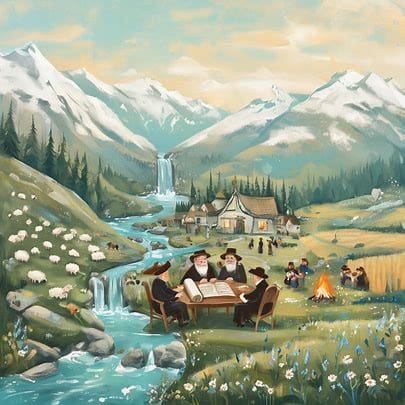
In Minhag Borealish, the observance of Lag B’Omer is deliberately simple. A modest backyard fire, a family haircut according to one's accepted custom, a passage from the Gemara, and a few moments of reflection can transform an ordinary northern evening into a meaningful Jewish experience.
The tragedy of Rabbi Akiva's students, recorded in Yevamot 62b, teaches that even great Torah knowledge cannot sustain a community without mutual respect. Their failure to honor one another becomes a warning against arrogance, division, and the misuse of religious learning.
Rabbi Shimon bar Yochai's experience in the cave, described in Shabbat 33b, offers another lesson. Solitude can deepen Torah study, but the ultimate purpose of spiritual withdrawal is not contempt for the outside world. It is to return with greater wisdom, compassion, and responsibility.
The Kabbalistic association of Lag B’Omer with Hod shebeHod — humility within humility — reinforces this teaching. The fire of Torah must illuminate and warm rather than consume and destroy.
As the Omer continues toward Shavuot, Megillat Ruth introduces the virtues of loyalty, kindness, covenantal commitment, and love of Israel. Ruth's devotion reminds us that the Torah is not merely studied; it must become visible through human conduct.
For Jewish families in Alpena, Hillman, Rogers City, and throughout Northeastern Michigan, these lessons are especially meaningful. Traditional Jewish observance does not require enormous celebrations or elaborate institutions. It requires dedication, knowledge, family participation, and the willingness to preserve inherited customs within the framework of Halakhah.
The central message: A small fire can carry a great tradition. When Torah is joined with humility, kindness, and responsibility, Jewish life can flourish even in the quietest corners of the northern wilderness.
Published by Shaarei Tzafon — The North Gate, an independent, family-led Orthodox Jewish educational and publishing initiative based in Northeastern Michigan, serving Alpena, Hillman, Rogers City, and surrounding communities. Shaarei Tzafon promotes traditional Jewish life, Torah study, practical Halakhah, and the renewal of independent Jewish learning communities throughout the northern boreal regions, extending from the 45th parallel toward the Arctic tundra.
Article: https://www.shaareitzafon.org/lag-bomer-in-minhag-borealish-
Shaarei Tzafon — The North Gate
Orthodox Jewish Life and Torah Study in Northeastern Michigan
Shaarei Tzafon — The North Gate, led by Rabbi Ariel Manning, is an independent, family-led Orthodox Jewish educational and publishing initiative based in Northeastern Michigan. We support traditional Jewish life, Torah study, Halakhah, and Jewish education throughout Alpena, Hillman, Rogers City, and surrounding communities. Those interested in traditional Judaism are welcome to contact us for educational resources, Torah learning, and opportunities for discussion by prior arrangement.
Rooted locally, our greater mission extends northward from the 45th parallel — The North Gate — through Michigan, Canada, and Alaska toward the Arctic. We seek to encourage independent Jewish communities, family-centered Torah education, and the renewal of small batei midrash and shtieblach, preserving the rich traditions of Orthodox Judaism for future generations.
Our work begins in Northeastern Michigan, but our vision extends from the 45th parallel toward the Arctic.
Guided by Rambam and Mori Qafiḥ, uplifted by Rebbe Nachman, and grounded by Avraham ben HaRambam’s balance of halakha and inward avodah.
The Orchard’s Path
publishes our books and curricula.
Our mission: a bright, authentic Jewish presence in every northern town.
Created with ©systeme.io


